A vertical elastic suspension cord has a stiffness of k=1.25 N cm−1k = 1.25\text{ N cm}^{-1}k=1.25 N cm−1.
A sensor of mass 0.40 kg0.40\text{ kg}0.40 kg is attached to the bottom end of the cord, with the top end fixed to a rigid support.
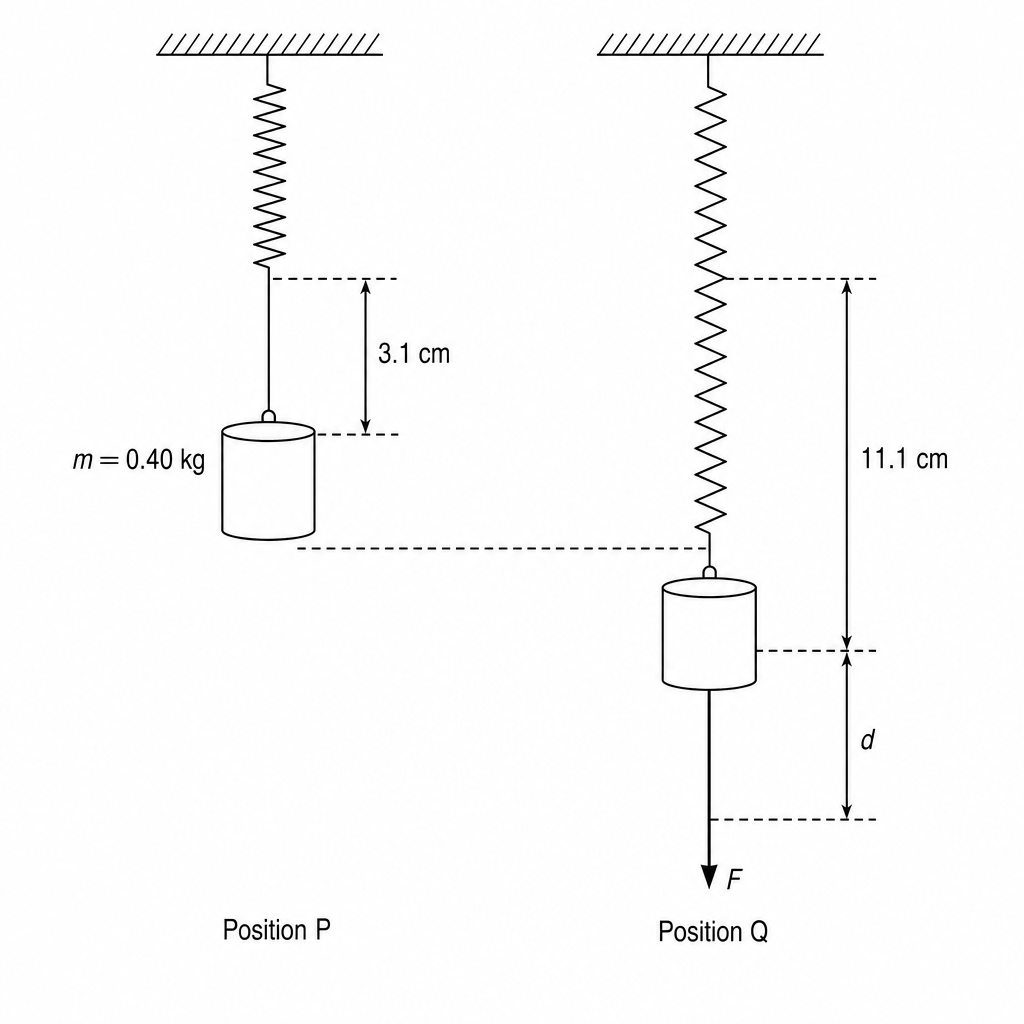
In position P, the sensor rests in static equilibrium, and the extension of the cord is 3.1 cm3.1\text{ cm}3.1 cm.
In position Q, an external downward force FFF is applied to the sensor so that it rests at a distance ddd below its equilibrium position. The extension of the cord in this position is 11.1 cm11.1\text{ cm}11.1 cm.
The force FFF is suddenly removed.
Calculate the magnitude of the sensor's initial acceleration at the instant the force FFF is removed. Assume the elastic cord obeys Hooke's law throughout this displacement.
The sensor subsequently undergoes simple harmonic motion. Calculate the frequency of this motion.
The sensor is now replaced by a magnetic probe of mass 0.55 kg0.55\text{ kg}0.55 kg, which is placed inside a drive coil. The coil is connected to a variable frequency generator that can drive the system at frequencies between 0.5 Hz0.5\text{ Hz}0.5 Hz and 6.0 Hz6.0\text{ Hz}6.0 Hz.
Calculate the natural frequency of this new arrangement.
Describe how the amplitude of the magnetic probe's oscillations changes as the driving frequency of the generator is varied from 0.5 Hz0.5\text{ Hz}0.5 Hz to 6.0 Hz6.0\text{ Hz}6.0 Hz.