This question is about a mechanical oscillation system consisting of an elastic spring of force constant κ \kappa\,κ attached to a suspended mass MMM. For vertical oscillations of this system, the acceleration a a\,a of the mass is related to its displacement x x\,x from the equilibrium position by the expression
a=−(κM)xa = -\left(\frac{\kappa}{M}\right)xa=−(Mκ)x
where κ \kappa\,κ is the stiffness of the spring and M M\,M is the suspended mass. The system executes simple harmonic motion.
Show that the period T T\,T of the oscillations is given by the expression
T2=4π2κM.T^2 = \frac{4\pi^2}{\kappa}M.T2=κ4π2M.
Over many cycles, the amplitude of each oscillation is observed to gradually decay. Explain why this decay occurs and state what effect, if any, this light damping has on the period T T\,T of the system.
Describe with the aid of a labelled diagram how an experiment can be conducted and how the data can be analysed to test the validity of the equation T2=4π2κM\displaystyle T^2 = \frac{4\pi^2}{\kappa}MT2=κ4π2M for oscillations within the elastic limit.
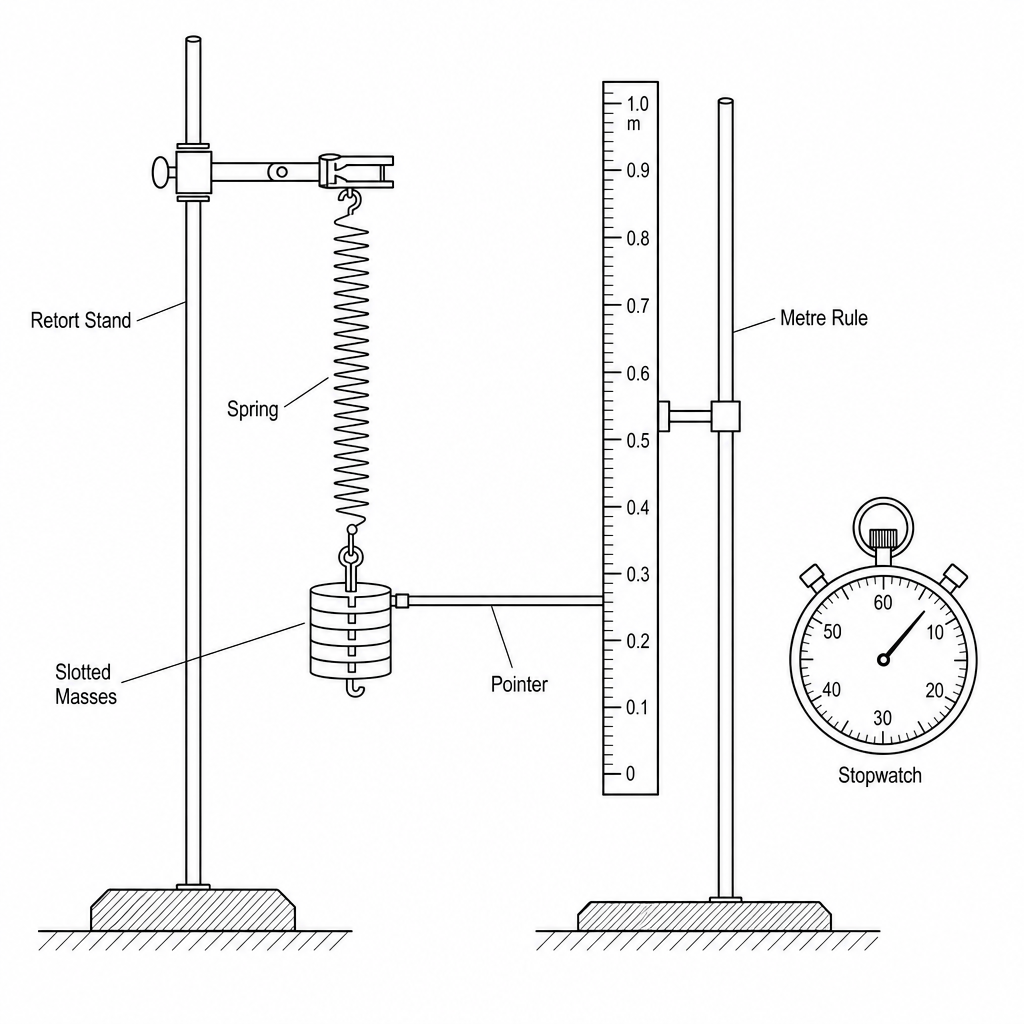
An aerospace engineer designs a mechanical safety-switch timer for a deep-space probe using a mass suspended from a spring. Each complete cycle of the oscillator corresponds to one full period TTT.
Show that for a spring with force constant κ=16 N m−1\kappa = 16\text{ N m}^{-1}κ=16 N m−1, the mass required to achieve a period of 3.5 s is approximately 5.0 kg.
If this safety-switch timer is operated in a microgravity environment on the International Space Station, explain whether this timer would run on time compared with an identical device on Earth.