A research payload of mass mmm is suspended vertically inside a vacuum testing chamber by two identical vertical springs, each of force constant kkk, as shown in the diagram below.
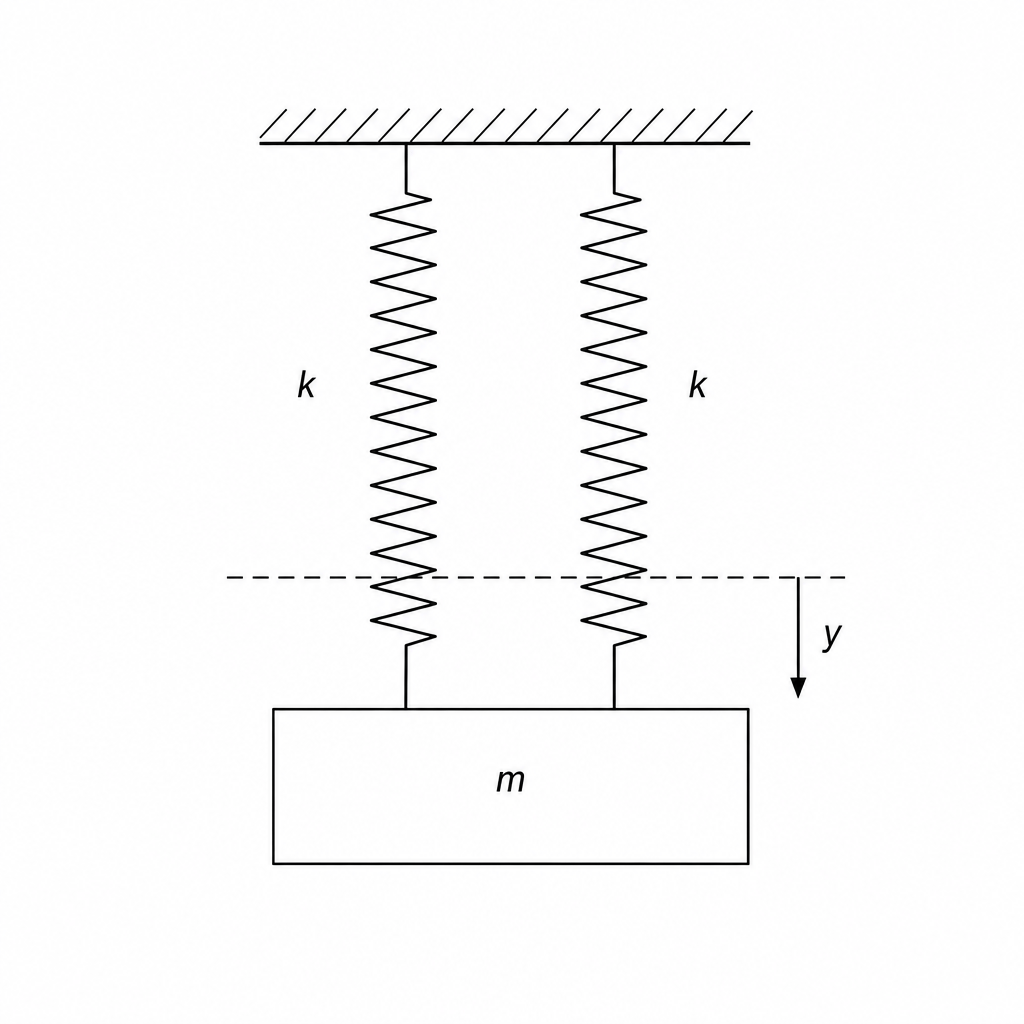
The payload is displaced downwards a distance y0y_0y0 from its equilibrium position and released so that it undergoes simple harmonic motion. The period of oscillation TTT is related to the mass mmm and the force constant kkk by the equation:
T2=2π2mkT^2 = \frac{2\pi^2 m}{k}T2=k2π2m
Show that this equation is homogeneous by reducing both sides to SI base units.
By considering the forces acting on the payload when it is displaced vertically downwards by a distance yyy from its equilibrium position, explain why the magnitude of the net restoring force FFF is given by F=2kyF = 2kyF=2ky.
An astrophysicist investigates this relationship by varying the mass mmm of the payload and measuring the time for 20 complete oscillations to determine the period TTT. The astrophysicist plots a graph of T2T^2T2 (on the vertical axis) against mmm (on the horizontal axis) and finds that the line of best fit has a gradient of 1.18 s2 kg−11.18\text{ s}^2\text{ kg}^{-1}1.18 s2 kg−1. Determine the force constant kkk of each spring. Include an appropriate SI unit with your answer.