The energy level diagram for some of the states of an electron in a hydrogen atom is shown below.
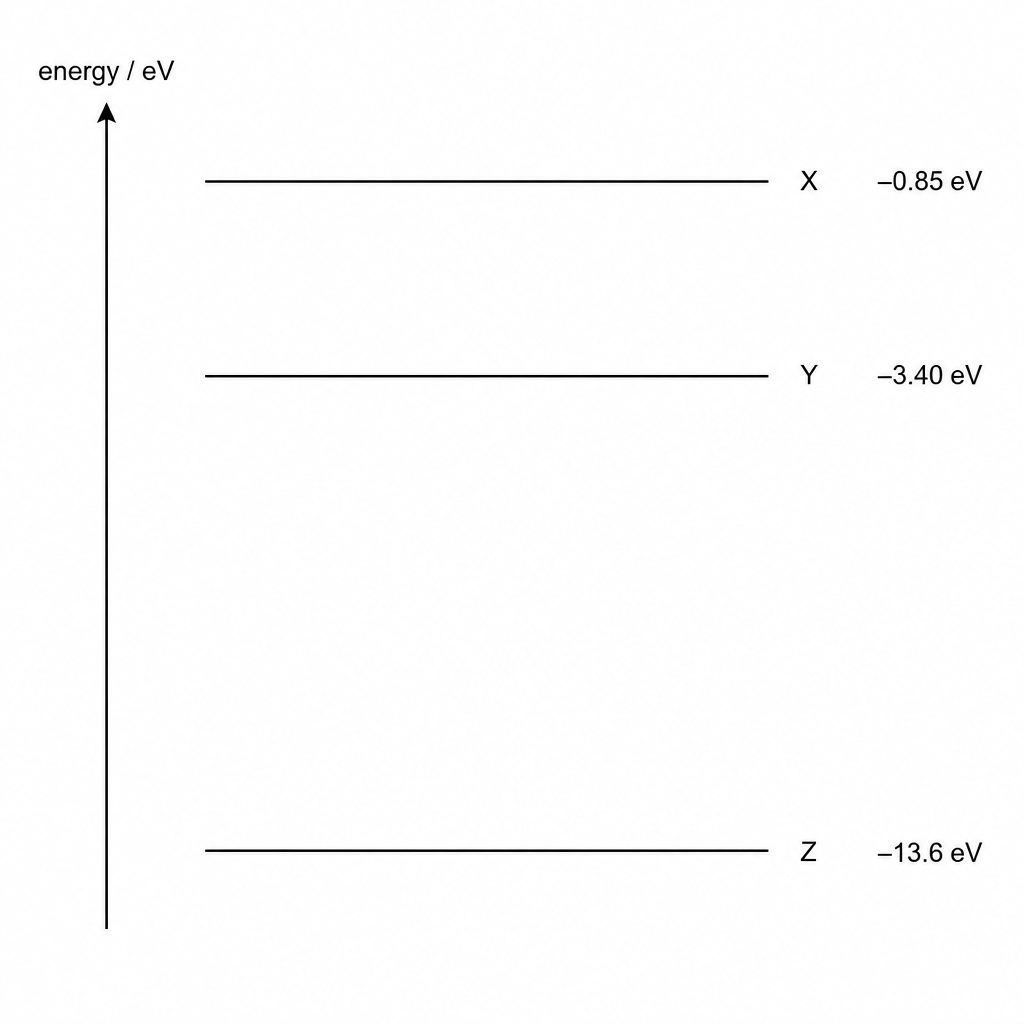
Explain why these energy levels are represented as negative values.
An electron makes a transition from level Y to level X.
Calculate the energy gained by this electron in eV\text{eV}eV.
Calculate the wavelength in nm\text{nm}nm of the photon absorbed by this electron. (Use h=6.63×10⁻³⁴ J sh = 6.63 \times 10^{-34}\text{ J s}h=6.63×10⁻³⁴ J s and c=3.00×10⁸ m s−1c = 3.00 \times 10^8\text{ m s}^{-1}c=3.00×10⁸ m s−1)
Light from a distant galaxy is passed through a spectrometer. A prominent hydrogen-beta absorption line, which has a laboratory wavelength of 486.1 nm486.1\text{ nm}486.1 nm, is observed at a wavelength of 512.3 nm512.3\text{ nm}512.3 nm in the spectrum of the galaxy.
State how an absorption line is produced in the spectrum.
Calculate the recession velocity of the galaxy.

