Integration
123456789101112131415161718192021222324252627282930313233343536373839404142434445464748495051525354555657585960616263646566676869707172737475767778798081828384858687888990919293949596979899100101102103104105106107108109110111112113114115116117118119120121122123124125126127128129130131132133134135136137138139140141142143144145146147148149150151152153154155156157158159160161162163164165166167168169170171172173174175176177178179180181182183184185186187188189190191192193194195196197198199200201202203204205206207208209210211212213214215216217218219220221222223224225226227228229230231232233234235236237238239240241242243244245246247248249250251252253254255256257258259260261262263264265266267268269270271272273274275276277278279280281282283284285286287288289290291292293294295296297298299300301302303304305306307308309310311312313314315316317318319320321322323324325326327328329330331332333334335336337338339340341342343344345346347348349350351352353354355356357358359360361362363364365366367368369370371372373374375376377378379380381382383384385386387388389390391392393394395396397398399400401402403404405406407408409410411412413414415416417418419420421422423424425426427428429430431432433434435436437438439440441442443444445446447448449450451452453454455456457458459460461462463464465466467468469470471472473474475476477478479480481482483484485486487488489490491492493494495496497498499500501502503504505506507508509510511512513514515516517518519520521522523524525526527528529530531532533
Question 147
The curve C has the parametric equations
x=ln(t+4)y=1t+3t>−3 x = \ln(t+4) \quad y = \frac{1}{t+3} \quad t > -3 x=ln(t+4)y=t+31t>−3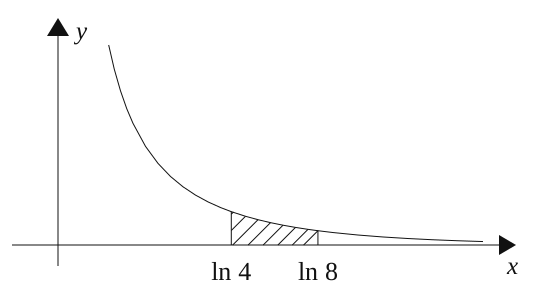
The finite region R between by the curve C and the x x\,x axis is bounded by the the lines with equations x=ln4x = \ln 4x=ln4 and x=ln8x = \ln 8x=ln8
a.[4]
Show that the area of R is given by the integral ∫041(t+3)(t+4) dt\displaystyle \int_0^4 \frac{1}{(t+3)(t+4)}\,dt∫04(t+3)(t+4)1dt
b.[6]
Hence find an exact value for this area
Integration Questions
864 exam-style questions on Edexcel A Level Maths Integration, covering 11.1 Integrating Standard Functions, 11.2 Integrating f(ax + b), 11.3 Using Trigonometric Identities, 11.4 Reverse Chain Rule, 11.5 Integration by Substitution, 11.6 Integration by Parts, 11.7 Partial Fractions, 11.8 Finding Areas, 11.9 The Trapezium Rule, 11.10 Solving Differential Equations, and 11.11 Modelling with Differential Equations. Each one has a worked solution and a mark scheme showing where the marks go.