In 2023, strict new limits on the volume of groundwater that can be legally pumped for agricultural irrigation in several semi-arid regions came into force. These pumping limits, officially known as Annual Extraction Limits (AELs), were established to prevent permanent depletion of critical aquifers.
The measures saw AELs for deep-well extraction drop by 40% across several major agricultural basins, while reduced pumping limits were also established for other delicate alluvial aquifers.
However, there were small increases permitted for water-efficient drip-irrigation systems and reclaimed water recycling facilities, with allocations for municipal greywater reuse rising by 15%.
A regional agricultural analyst remarked: "Science-based assessments indicate that high-capacity irrigation wells are extracting water at an unsustainable rate. Lowering the pumping caps is a vital regulatory response to prevent irreversible aquifer compaction and catastrophic land subsidence."
The long-term success of these measures depends heavily on rigorous smart-meter monitoring and international cooperation (where aquifers cross borders) to prevent illegal drilling and unauthorized extraction into national food supply chains.
| Country/Region | Excess extraction relative to sustainable recharge rate (%) | Excess annual groundwater extraction (million cubic metres) |
|---|---|---|
| India (Northwest) | 48.5 | 18400 |
| United States (High Plains) | 36.2 | 12900 |
| China (North Plain) | 29.8 | 9100 |
| Pakistan (Punjab) | 24.5 | 7600 |
| Iran (Central) | 22.1 | 5800 |
| Saudi Arabia (Al-Ahsa) | 16.3 | 2400 |
| Mexico (Bajío) | 11.8 | 1750 |
| Spain (Segura) | 6.2 | 450 |
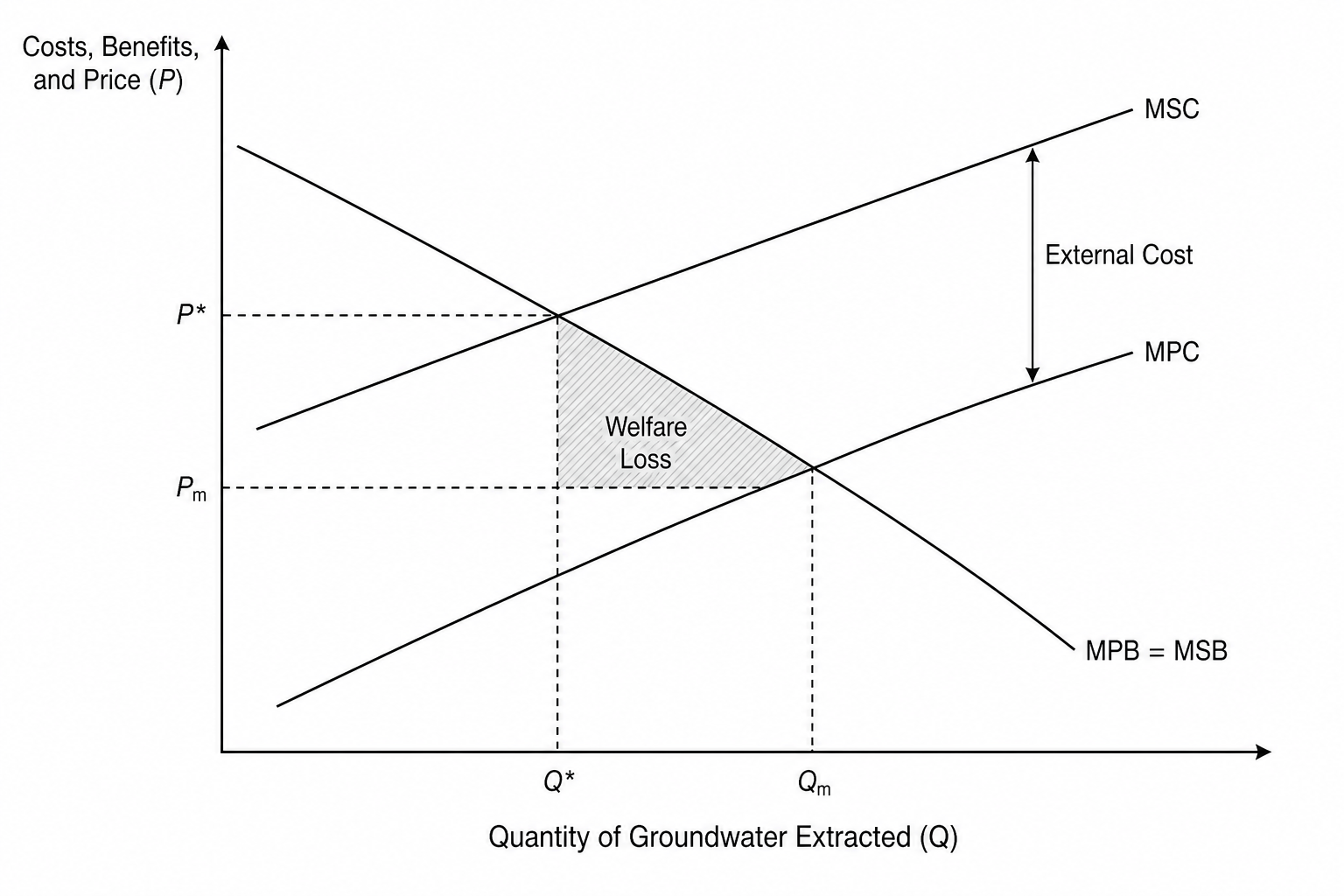
The 'tragedy of the commons' occurs when there are common access resources (CARs). These are natural resources over which no private property rights have been established. Consequently, it is difficult or impossible to exclude individuals from exploiting them. Typical CARs include global fisheries, international waters, the atmosphere, and subterranean aquifers. Because groundwater basins are so expansive and hidden underground, it is highly challenging for governments or local water authorities to establish exclusive ownership and detect unauthorized drilling.
Economists point out that in the absence of private property rights, agricultural conglomerates and individual farmers act in their own self-interest, maximizing short-term crop yields by pumping as much water as possible. This rapid extraction is highly unsustainable, leading to severe negative externalities of production. These external costs include dry domestic wells, soil salinization, irreversible loss of aquifer storage capacity, and the destruction of local wetland ecosystems. This dynamic defines the 'tragedy of the commons', where individual gains lead to collective ruin.
Addressing this issue is extremely difficult because global demand for water-intensive cash crops like almonds, cotton, and alfalfa continues to grow. These globalized ecological threats require more than simple local pumping quotas; they necessitate robust legal frameworks, regional water pricing models, and direct market-based mechanisms.
Other than imposing water extraction quotas (such as AELs), evaluate the policy options which could be used to reduce market failure resulting from groundwater depletion in intensive agriculture. Use at least one appropriate diagram in your answer.