With reference to Figure 1 and Extract A, discuss the benefits of introducing a system of differential green subsidies where the government provides different levels of financial support for different energy-efficiency installations.
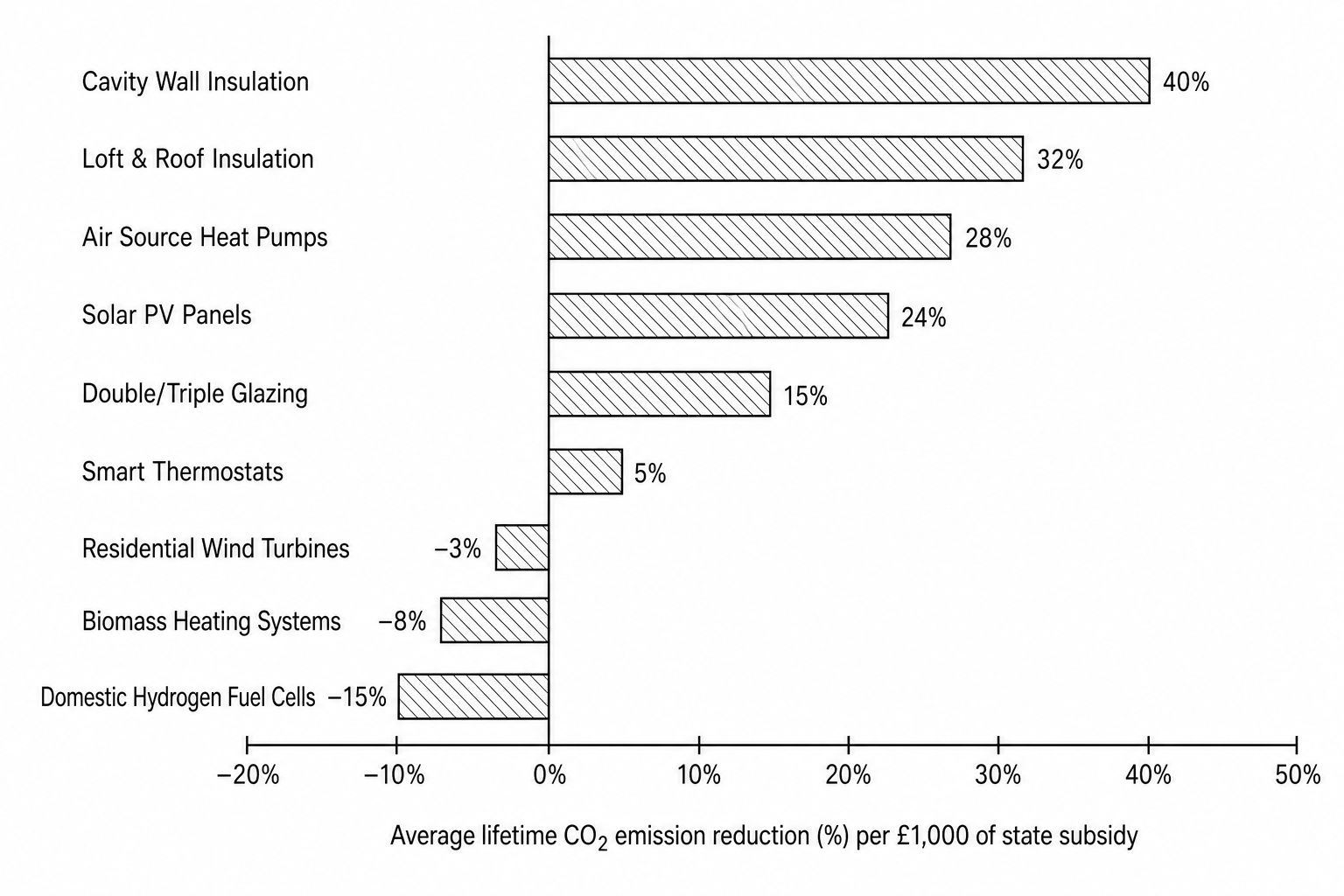
| Technology Type | Emission Reduction (%) |
|---|---|
| Cavity Wall Insulation | 40% |
| Loft & Roof Insulation | 32% |
| Air Source Heat Pumps | 28% |
| Solar PV Panels | 24% |
| Double/Triple Glazing | 15% |
| Smart Thermostats | 5% |
| Residential Wind Turbines | -3% |
| Biomass Heating Systems | -8% |
| Domestic Hydrogen Fuel Cells | -15% |
The environmental returns of retrofitting residential properties are substantial. In 2023, the median lifetime energy savings for upgraded properties was £9,500 higher than that of non-upgraded properties. This cost-saving premium ensures that household energy bills are permanently lowered, while also boosting overall economic productivity and reducing national carbon emissions.
However, public funding for green home schemes has become highly unsustainable. The average homeowner retrofitting an older property now incurs approximately £48,000 of debt under comprehensive upgrade packages, and interest rates on green loans have risen. Many households install technologies where the actual lifetime carbon savings are lower than the upfront public investment, meaning the government receives a poor environmental return on taxpayers' money.
The Department for Energy Security and Net Zero estimates that approximately 42% of the value of green retrofit loans will never be fully repaid. Total outstanding green loan debt reached £145 billion in 2022 and is projected to escalate to £195 billion by 2028.
To address this, some policy experts suggest abandoning flat-rate green grants (which are capped at £9,250 per installation for most domestic properties). Instead, the government could offer differential green subsidies: pricing grants based on their installation cost or their expected environmental return. This would mean that resource-intensive or high-performing upgrades, like Cavity Wall or Loft Insulation, would receive higher grant funding, whereas low-performing systems like Biomass or Hydrogen systems would receive lower or zero subsidies.
Currently, flat-rate grants of £9,250 apply to almost all energy efficiency upgrades. Yet, heat pump and solar PV installations require exceptionally expensive equipment, and solid wall insulation demands intensive, hands-on structural labor.
Economists estimate that the price elasticity of demand (PED) for residential energy-efficiency upgrades is approximately -0.4.
International models offer distinct alternatives. In Australia, the 'Job-Ready Energy' package restructured grants, making low-return installations more expensive for households to encourage uptake of high-demand heat pumps and insulation. Conversely, several European countries, such as Germany, charge no upgrade fees at all, funding home decarbonisation entirely through general taxation.
Despite high costs, green retrofits remain popular, with applications rising to over 720,000 in 2022. However, stark socio-economic disparities persist. Only 21% of households from the most socio-economically deprived areas undertook energy efficiency upgrades in 2022, compared with 52% from the most affluent areas. Behavioral research indicates that low-income homeowners suffer from high debt aversion, making them less likely to apply for green loans even when they hold identical qualifying properties to their wealthier peers.

