Skip to content
MathsGenie logo
Quick links
Open app

Course home

  1. IGCSE
  2. Physics Edexcel
  3. Question bank

Energy transfers

EasyMediumHard
123456789101112131415161718192021222324252627282930313233343536373839404142434445464748495051
Question 42

A student carries out two separate experiments to investigate the transfer of thermal energy.

a.

In the first experiment, she joins a copper cylinder and a wooden cylinder of the same diameter end-to-end. She wraps a sheet of paper tightly around the joint. She then heats the paper at the joint using a Bunsen burner flame. After a short time, she observes a burn mark on one side of the paper, as shown in the diagram.
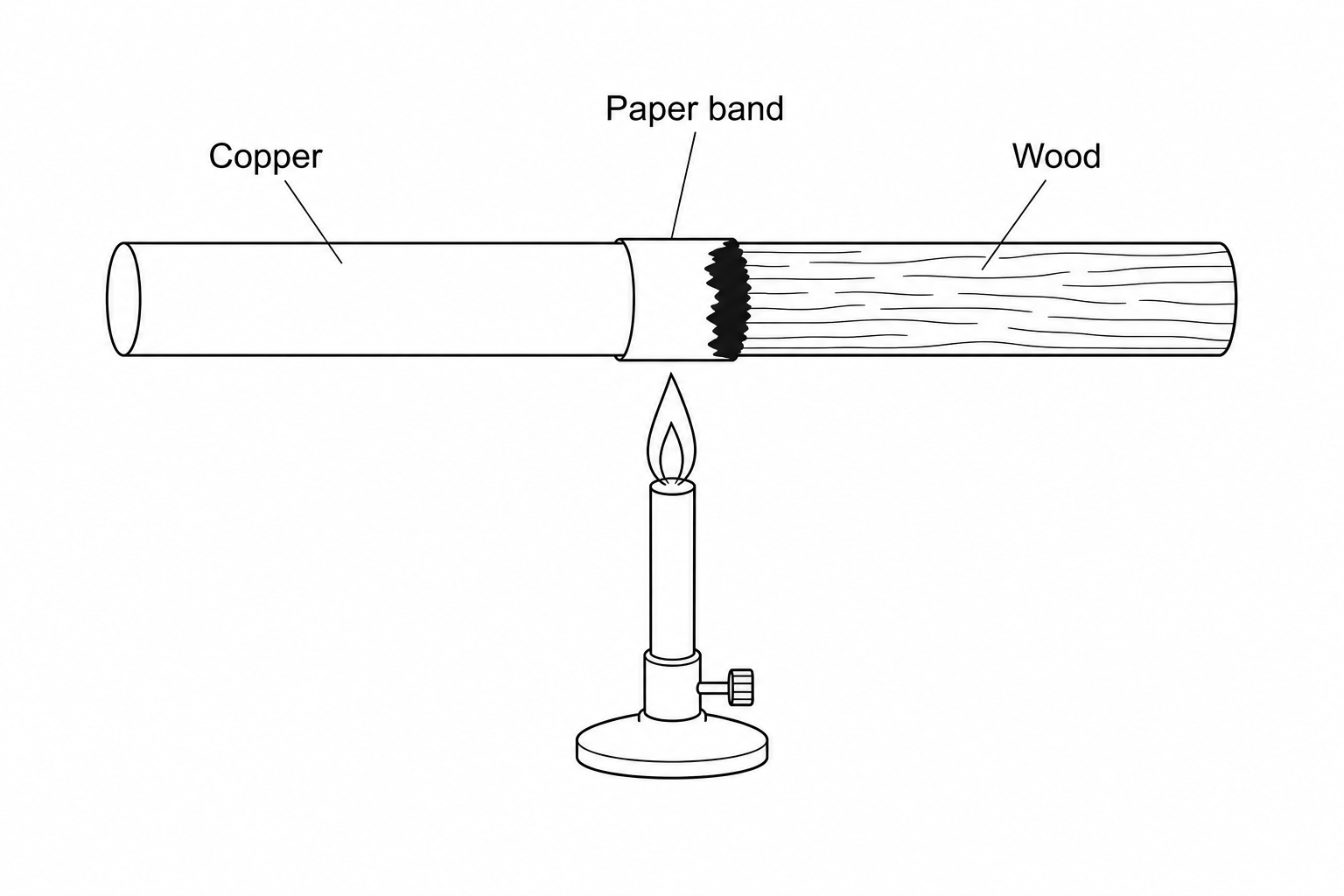
A horizontal rod assembly consisting of a copper cylinder on the left and a wooden cylinder on the right, joined in the center. A white paper collar is wrapped around the central joint. A Bunsen burner flame heats the underside of the paper collar at the joint. A dark, black burn mark has formed on the right side of the paper collar, which is over the wooden cylinder, while the left side of the paper collar, which is over the copper cylinder, remains unburnt and white.

Explain why the paper burns where it is in contact with the wood, but does not burn where it is in contact with the copper.

[2]
b.

In the second experiment, she places a piece of ice at the bottom of a test tube and fills the tube with water. A heavy metal ring is placed on top of the ice to prevent it from floating. She heats the top of the water until it boils.
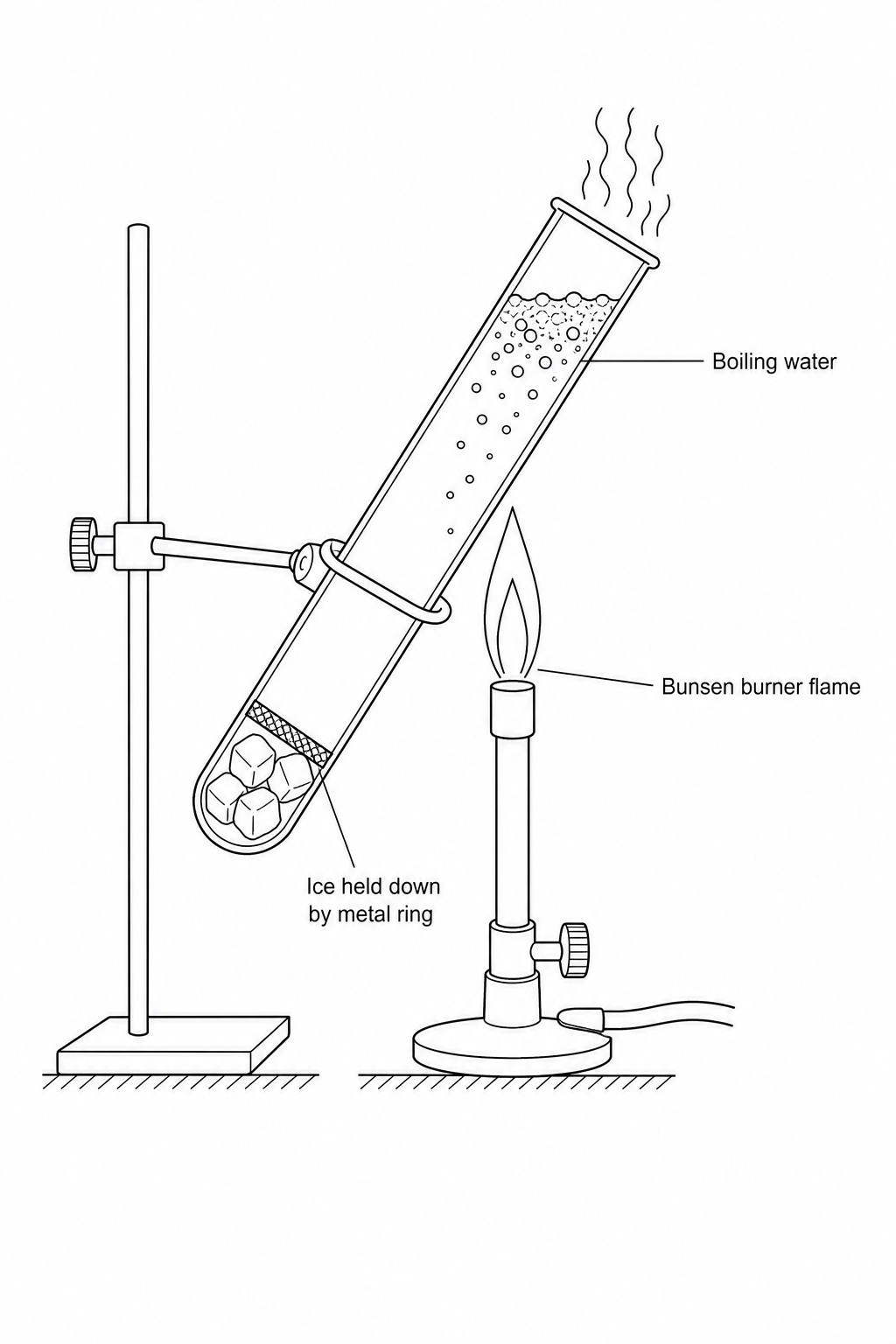
A test tube held at an angle of approximately 45 degrees, filled with water. At the bottom-closed end of the test tube, cubes of ice are kept submerged by a heavy, dark metal ring. A Bunsen burner flame is positioned near the surface of the water at the top-open end of the test tube, causing the water at the top to boil with visible steam bubbles. The ice at the bottom remains completely intact and un-melted.

Explain why the ice at the bottom of the test tube remains frozen while the water at the top is boiling.


[2]

Energy transfers Questions

  1. IGCSE
  2. /Physics
  3. /Energy transfers