Praseodymium, Pr\text{Pr}Pr, is a metal used in specialised glass and high-strength alloys.
Praseodymium can be obtained by reducing its oxide with calcium, Ca\text{Ca}Ca.
Pr2O3+3Ca→2Pr+3CaO \text{Pr}_2\text{O}_3 + 3\text{Ca} \rightarrow 2\text{Pr} + 3\text{CaO} Pr2O3+3Ca→2Pr+3CaOThe table shows the melting points of the substances involved in this reaction.
| Substance | Praseodymium | Praseodymium oxide | Calcium | Calcium oxide |
|---|---|---|---|---|
| Melting point in ∘C{^\circ}\text{C}∘C | 931 | 2184 | 842 | 2572 |
The operating temperature for this reaction is 880∘C880^\circ\text{C}880∘C.
Explain which substance in the table could exist as a liquid at this temperature.
Praseodymium oxide neutralises nitric acid to form praseodymium nitrate, Pr(NO3)3\text{Pr}(\text{NO}_3)_3Pr(NO3)3, and water.
Write a balanced chemical equation for this reaction.
This diagram shows the arrangement of the particles in praseodymium.
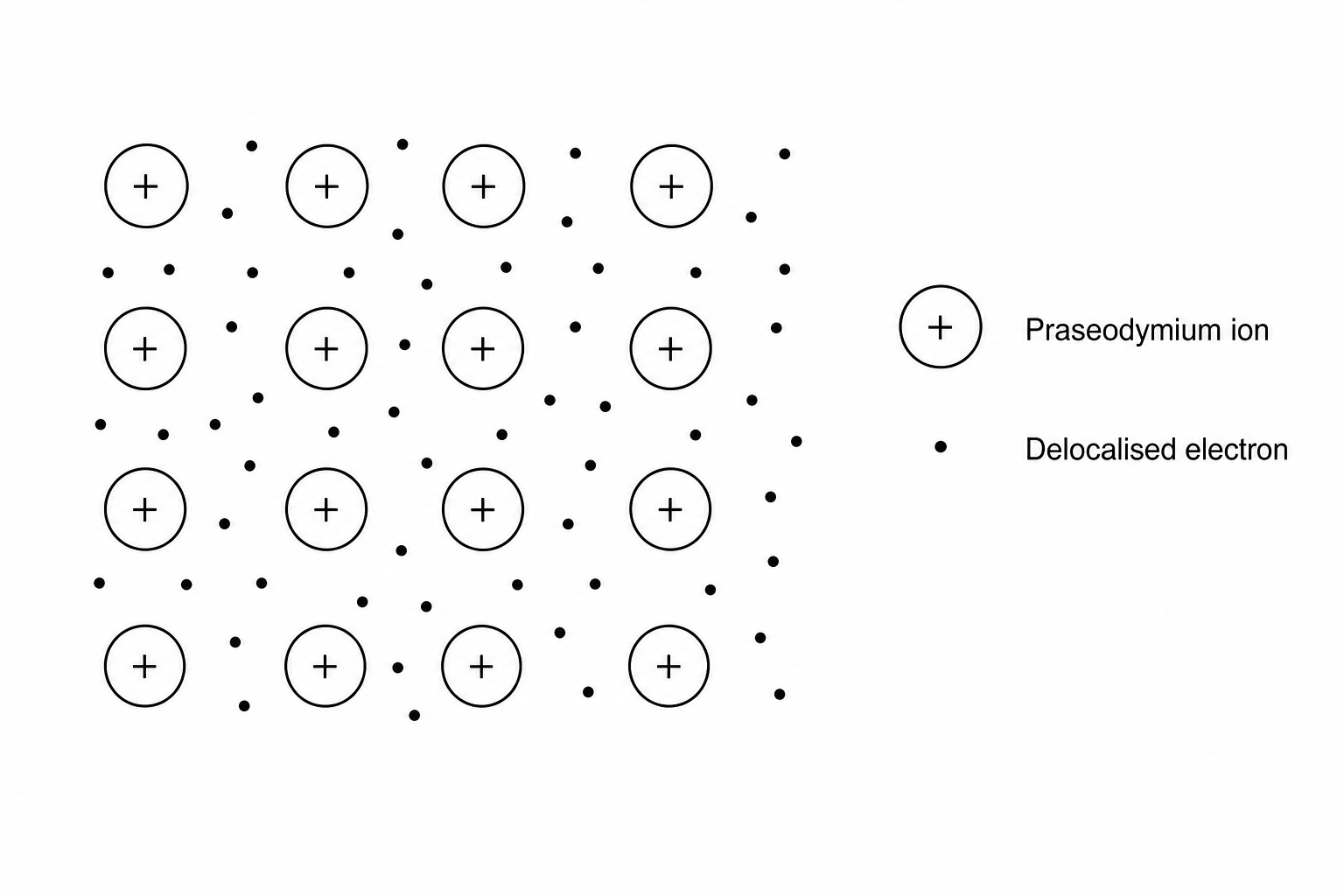
Explain why praseodymium is malleable and is a good conductor of electricity.

