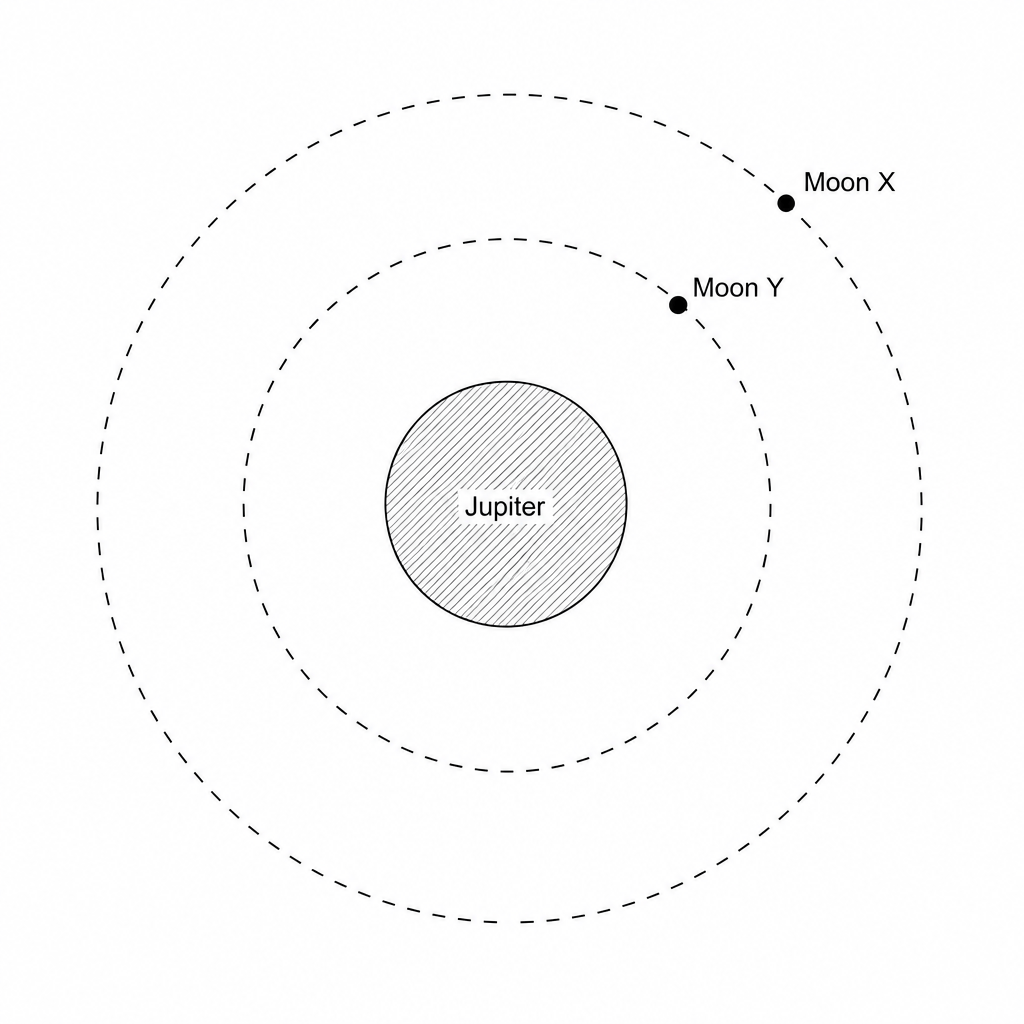
The diagram shows two moons orbiting a giant planet, Jupiter, in circular orbits.
a.[4]
Read the two statements about Moon X:
- The speed of Moon X in its circular orbit is constant.
- The velocity of Moon X is changing.
Explain why both of these statements are correct. Write about forces and motion in your answer.
b.
[2]
The table shows data for the two moons.
| Moon | Radius of orbit (metres) | Time to orbit Jupiter (days) | Mean orbital speed (km/s) |
|---|---|---|---|
| Moon X | 6.71×1086.71 \times 10^86.71×10⁸ | 3.553.553.55 | 13.713.713.7 |
| Moon Y | 4.22×1084.22 \times 10^84.22×10⁸ | 1.771.771.77 | 17.317.317.3 |
Explain why the orbital speed of a moon is greater when the radius of its orbit is smaller.
c.
[3]
The table shows data for the two moons.
| Moon | Radius of orbit (metres) | Time to orbit Jupiter (days) | Mean orbital speed (km/s) |
|---|---|---|---|
| Moon X | 6.71×1086.71 \times 10^86.71×10⁸ | 3.553.553.55 | 13.713.713.7 |
| Moon Y | 4.22×1084.22 \times 10^84.22×10⁸ | 1.771.771.77 | 17.317.317.3 |
Two students analyze the data in the table.
- Student P says: "The time to orbit Jupiter is directly proportional to the radius of the orbit."
- Student Q disagrees.
Use the data in the table to show that Student Q is correct.