A scientific probe is placed into a stable circular parking orbit around Mars to map its surface. During this mission, the probe's rocket engines are turned off, and it moves at a constant speed under the sole influence of Mars's gravitational field.
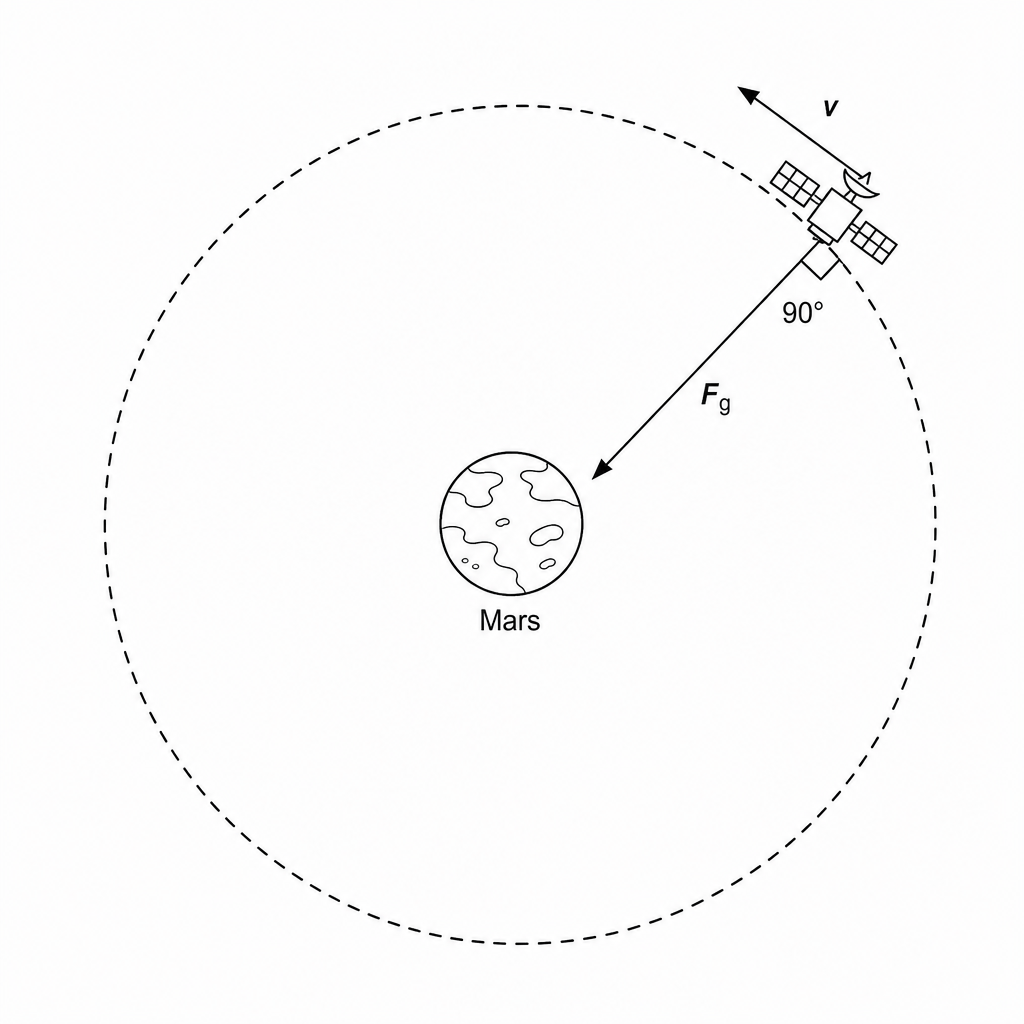
Which of the following statements correctly explains why the velocity of the probe is continuously changing while its kinetic energy remains constant?
The gravitational force is perfectly balanced by an equal and opposite centrifugal force, resulting in zero net force on the probe.
The gravitational force acts in the direction of motion, but because the orbit is closed, the net work done over one complete orbit is zero, keeping the kinetic energy constant.
The gravitational force acts perpendicular to the velocity, doing no work on the probe, but providing a centripetal acceleration that continuously changes its direction.
The gravitational force does positive work to accelerate the probe, which is exactly counterbalanced by negative work done by atmospheric drag in the thin upper atmosphere of Mars.