An ultrasound pulse is sent into a block of material. Figure shows the trace seen on an oscilloscope screen. Pulse P is the pulse sent into the block. Pulses Q and R are pulses reflected from two boundaries inside the block.
Figure: An oscilloscope trace showing an ultrasound pulse sent into a block and the two pulses reflected from boundaries inside it
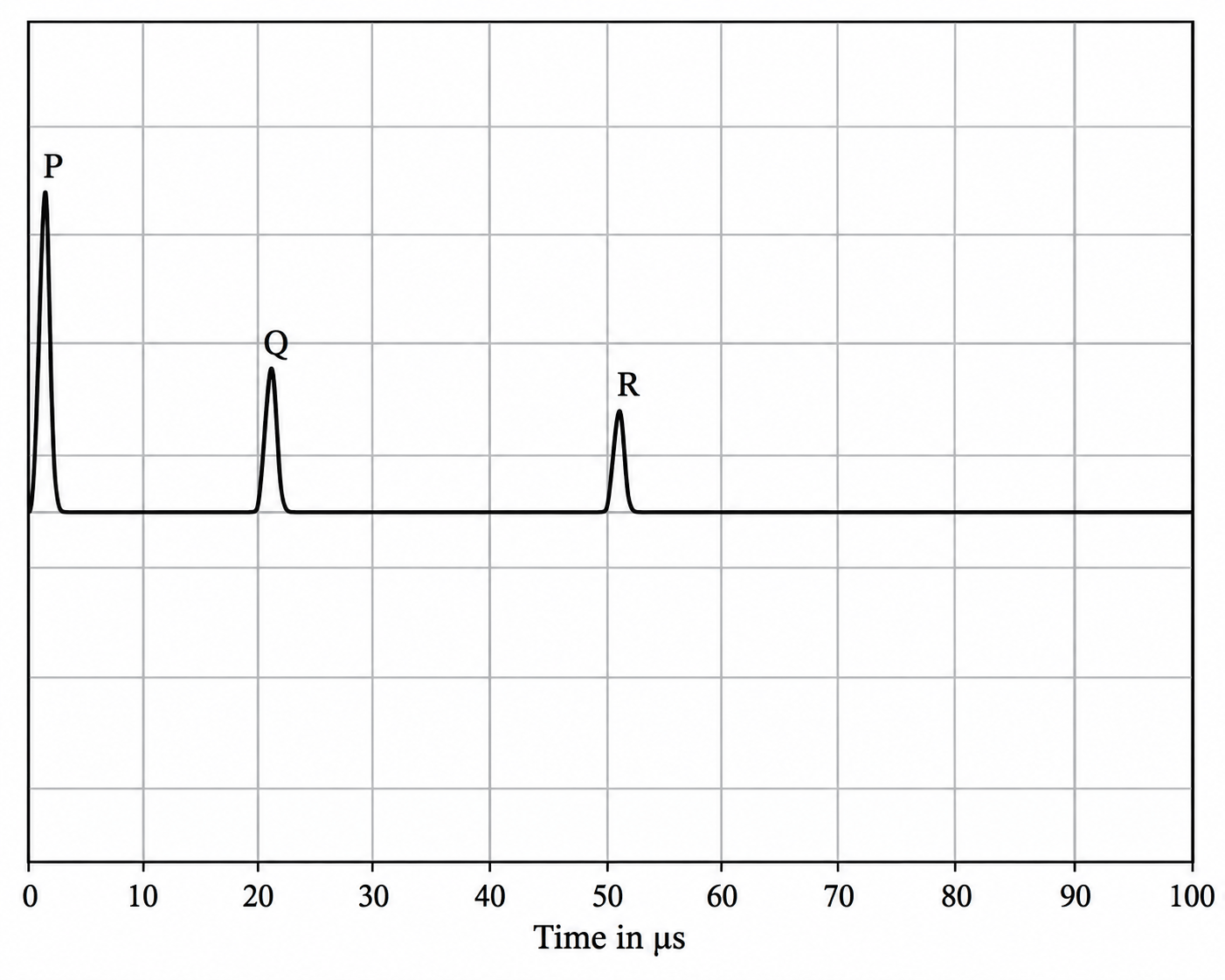
Explain why two reflected pulses, Q and R, are seen.
The speed of ultrasound in the block is 1500 m/s. Use Figure to calculate the depth of the second boundary below the surface of the block.
Explain why pulse R is smaller than pulse Q.
98 exam-style questions on AQA GCSE Physics 6.1 Waves in air, fluids and solids, covering 6.1.1 Transverse and longitudinal waves, 6.1.2 Properties of waves, 6.1.3 Reflection of waves, 6.1.4 Sound waves (HT only), and 6.1.5 Waves for detection and exploration (HT only). Each one has a worked solution and a mark scheme showing where the marks go.

