An investigation was carried out on the motion of high-density ceramic spheres dropped from rest into a tall vertical column filled with viscous silicone oil.
Why does a sphere initially accelerate downwards when released?
Eventually, the sphere stops accelerating and reaches a constant velocity (terminal velocity). Explain why the sphere reaches terminal velocity.
A researcher investigated how the mass of different-sized ceramic spheres affects their terminal velocity in the oil. Figure 1 shows the experimental results.
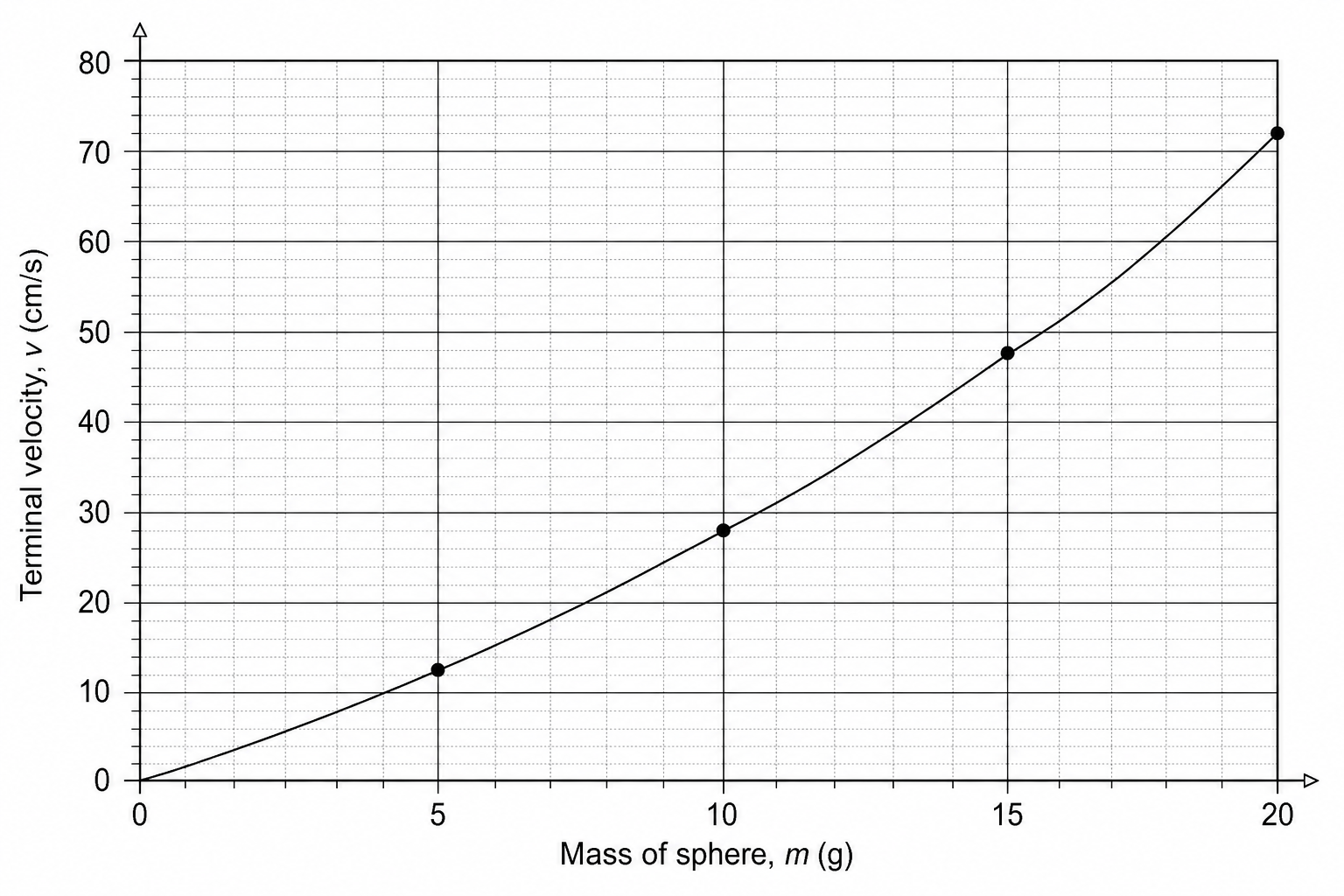
Why does the terminal velocity increase with the mass of the sphere?
Select one option:
- As the mass increases, the radius of the sphere increases.
- As the mass increases, the volume of the sphere increases.
- As the mass increases, the gravitational force (weight) acting on the sphere increases.
Explain the difference in the maximum kinetic energy of a sphere with a mass of 10 g and a sphere with a mass of 20 g.
The kinetic energy of the sphere is measured in joules. Which of the following is equivalent to 1 J?
Select one option:
- 1 N/m2
- 1 N m
- 1 N m2
- 1 N/m
One of the spheres hit the bottom of the cylinder at its terminal velocity of 48 cm/s. The sphere took 0.060 s to come to a complete stop against the bottom surface.
Determine the average force exerted on the sphere as it stopped. Use information from Figure 1.
Forces and motion Questions
Practise AQA GCSE Physics Forces and motion with exam-style questions for Foundation and Higher tier. 83 questions covering Describing motion along a line, Forces, accelerations and Newton's Laws of motion, and Forces and braking, matched to the AQA GCSE Physics (8463) specification and written in Paper 1 and Paper 2 style. Every question includes a full worked solution and mark scheme, so you can see where marks are awarded rather than just whether you got the answer right.