An electric car travels along a straight, flat road.
How is the velocity of the electric car different from its speed?
The car's driving wheels push backwards on the road surface to move the car forward. Explain how Newton's third law of motion applies to this interaction.
The distance-time graph below shows the movement of the electric car during a test run:
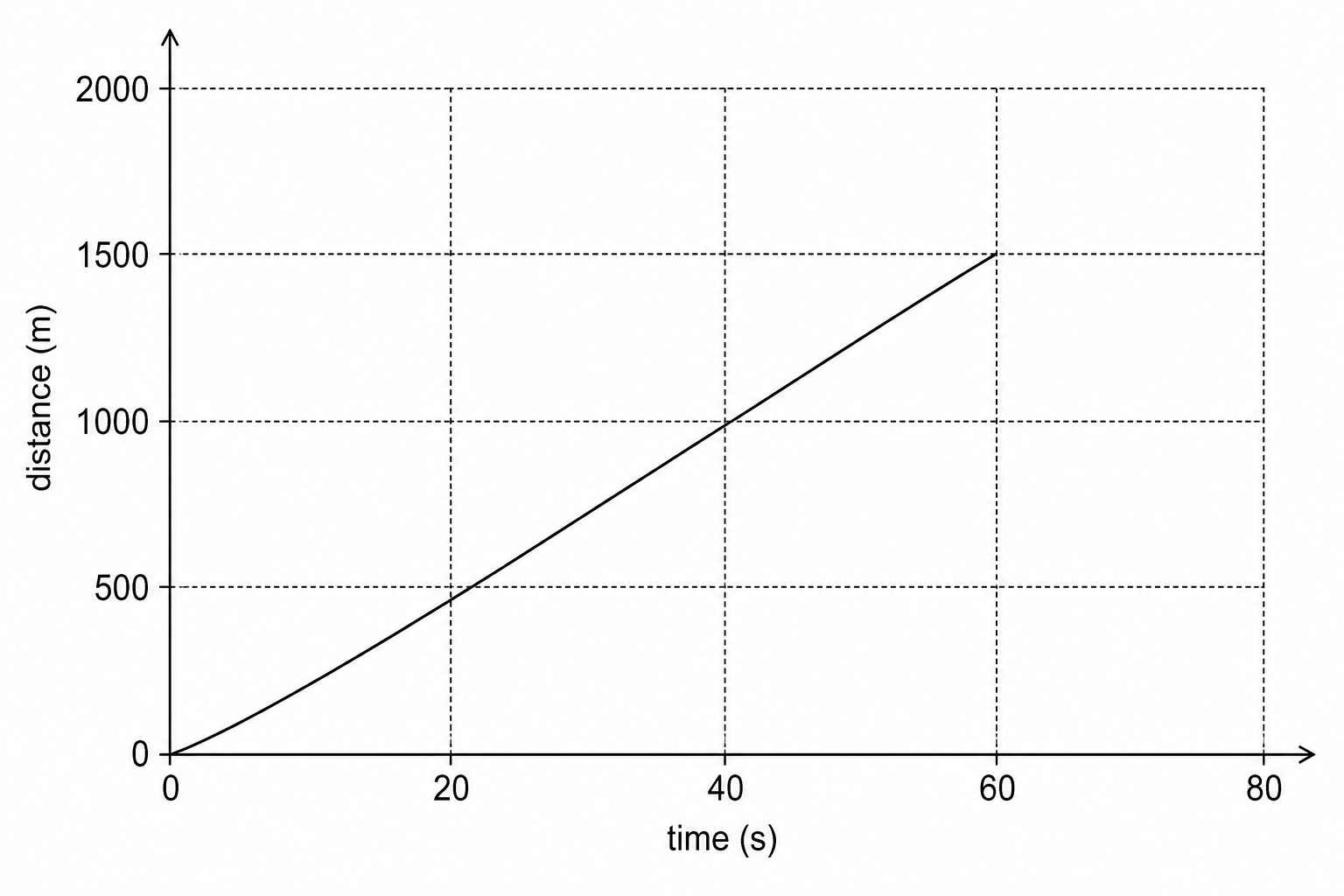
Determine the speed of the electric car.
Write down the equation that links acceleration (aaa), change in velocity (Δv\Delta vΔv), and time taken (ttt).
At a different stage of the run, the car was travelling at a velocity of 32 m/s32\text{ m/s}32 m/s.
The car then decelerated at a constant rate of 1.6 m/s21.6\text{ m/s}^21.6 m/s2.
Calculate the time taken for the car to decelerate from 32 m/s32\text{ m/s}32 m/s to 8 m/s8\text{ m/s}8 m/s.
Write down the equation that links distance (sss), force (FFF), and work done (WWW).
When the car's brakes were fully applied to bring it to a stop, it travelled a distance of 45 m45\text{ m}45 m.
The work done by the braking force to stop the car was 270,000 J270,000\text{ J}270,000 J.
Calculate the mean braking force used to stop the car.
Forces and motion Questions
Practise AQA GCSE Physics Forces and motion with exam-style questions for Foundation and Higher tier. 83 questions covering Describing motion along a line, Forces, accelerations and Newton's Laws of motion, and Forces and braking, matched to the AQA GCSE Physics (8463) specification and written in Paper 1 and Paper 2 style. Every question includes a full worked solution and mark scheme, so you can see where marks are awarded rather than just whether you got the answer right.