Forces and motion

EasyMediumHard
123456789101112131415161718
Question 14
Easy

The International Space Station (ISS) orbits the Earth. The distance-time graph below shows how the distance travelled by the ISS changes with time.
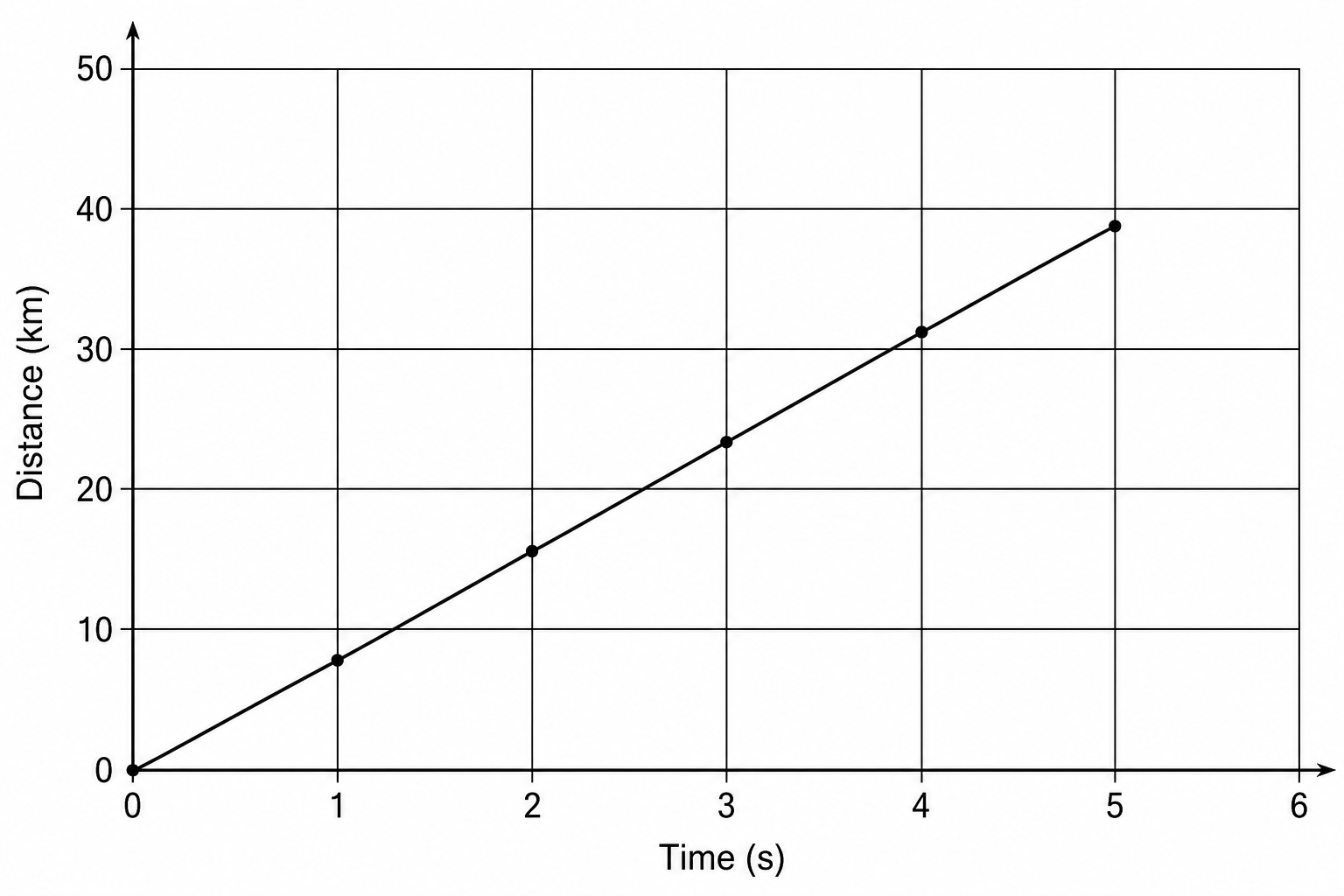
A distance-time graph for the International Space Station. The vertical y-axis is labeled 'Distance in kilometres' and goes from 0 to 50 with major grid lines every 10 units and minor grid lines every 1 unit. The horizontal x-axis is labeled 'Time in seconds' and goes from 0 to 6 with major grid lines every 1 unit and minor grid lines every 0.1 units. A straight line starts at the origin (0,0) and rises with a constant positive gradient, passing exactly through the coordinates (1, 7.7), (2, 15.4), (3, 23.1), (4, 30.8), and (5, 38.5).

The gradient of this line gives the speed of the International Space Station.

Determine the speed of the International Space Station. Give your answer in km/s\text{km/s}km/s.

[2]

Forces and motion Questions

  1. GCSE
  2. /Physics
  3. /Forces and motion