An automated sorting system at a recycling plant uses spherical plastic float sensors in a water bath.
Four different spherical float sensors, labeled W, X, Y, and Z, have the same volume but are made of different composite materials. They are shown floating in a water channel below.
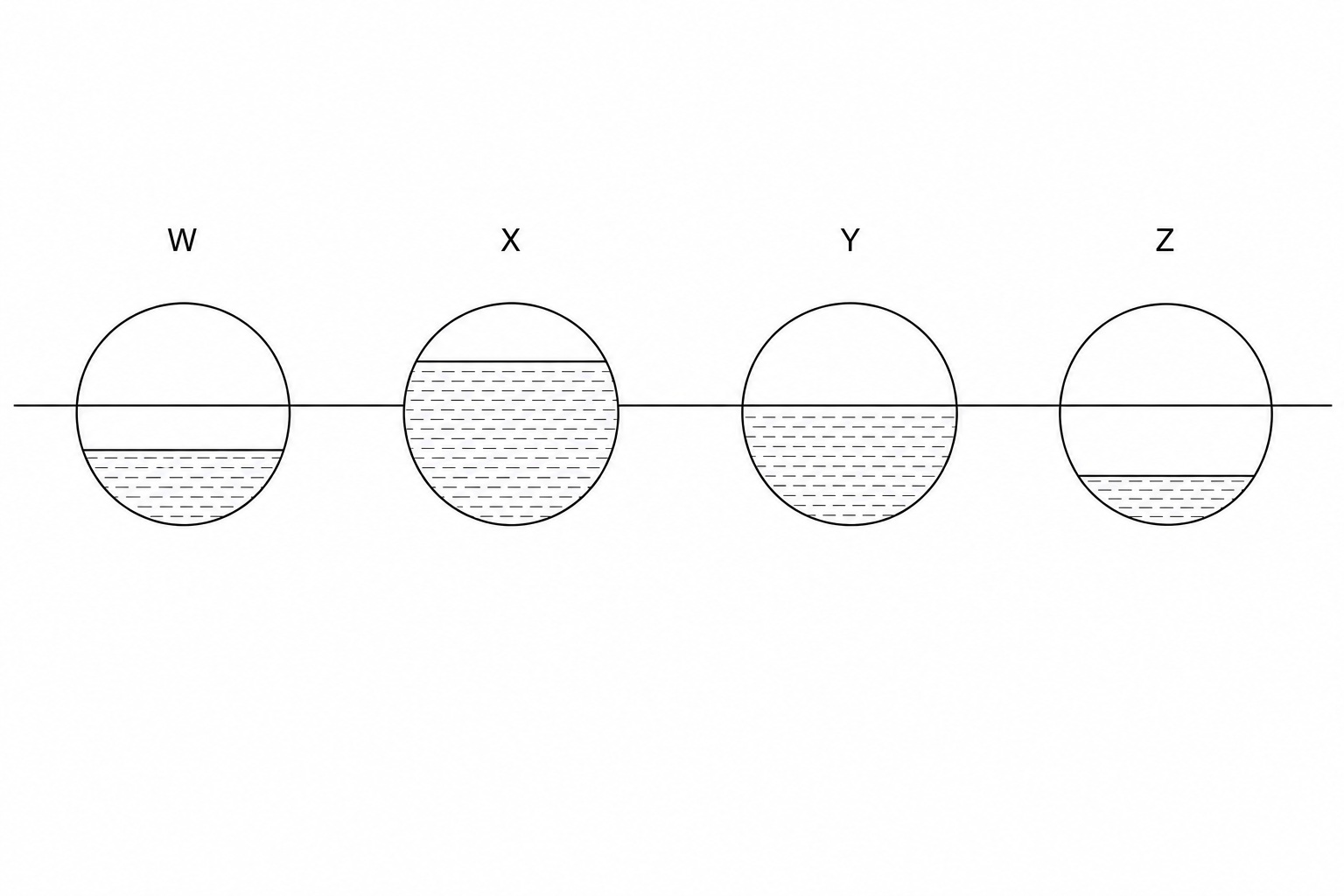
Which sensor has the largest weight?
One of the sensors has a mass of 12 kg12\text{ kg}12 kg. The gravitational field strength is 9.8 N/kg9.8\text{ N/kg}9.8 N/kg. Calculate the weight of this sensor. Use the equation: weight=mass×gravitational field strength\text{weight} = \text{mass} \times \text{gravitational field strength}weight=mass×gravitational field strength
When floating in the water tank, the two vertical forces acting on the sensor are the weight downwards and the upthrust upwards. How does the size of the upthrust compare to the weight of the sensor?
- The upthrust is greater than the weight.
- The upthrust is less than the weight.
- The upthrust is equal to the weight.
Write down the equation which links acceleration, mass, and resultant force.
A conveyor-belt tether pulls the sensor through the water. A horizontal resultant force of 15.6 N15.6\text{ N}15.6 N acts on the sensor. Calculate the acceleration of the sensor if its mass is 12 kg12\text{ kg}12 kg.