Forces and motion

EasyMediumHard
12345678910111213141516171819202122232425262728293031323334353637383940414243444546474849505152535455565758596061626364
Question 56
Medium

A student drops a small ball from a height. The ball falls, hits the ground, and bounces back upwards.
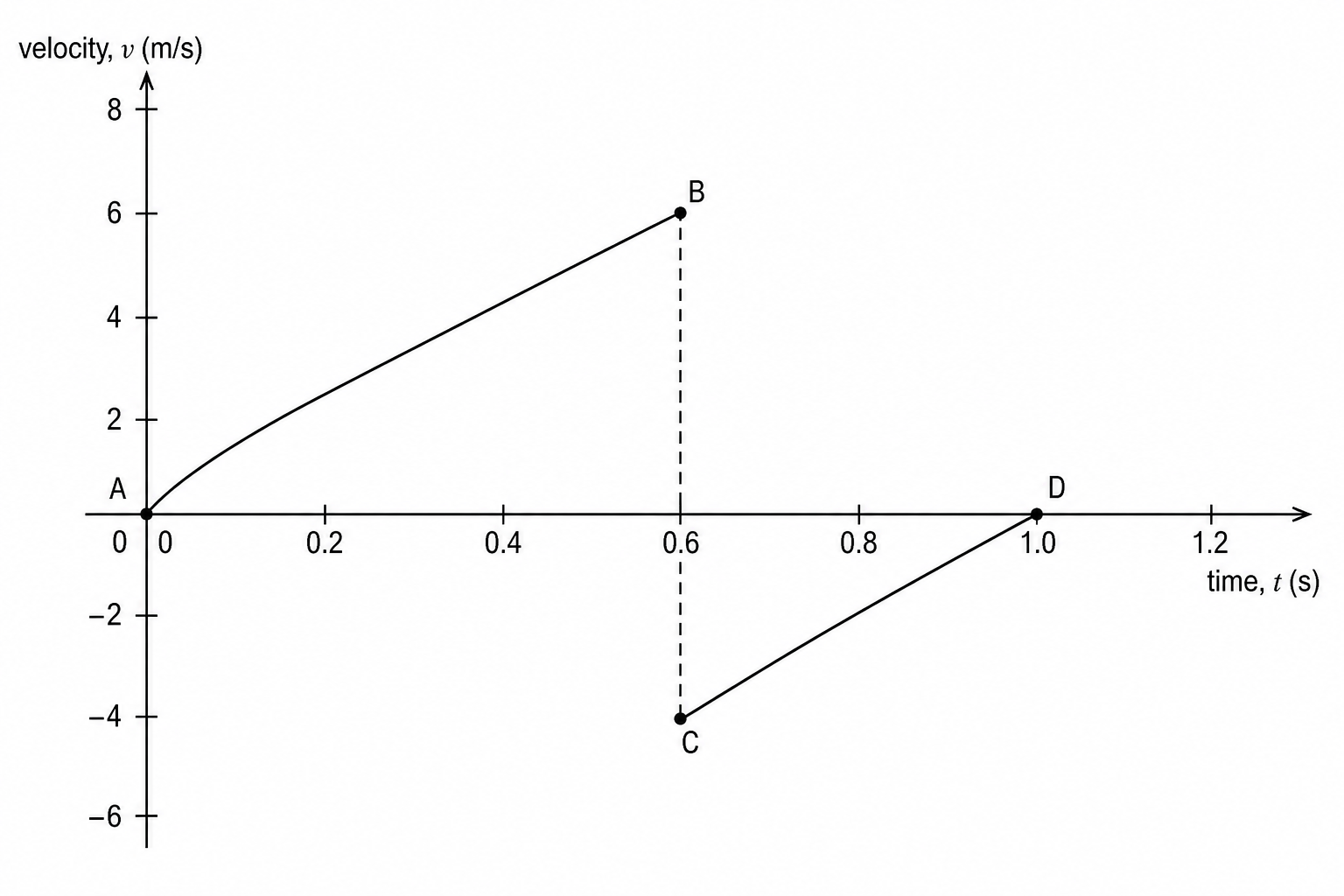
A velocity-time graph showing the motion of a bouncing ball. The vertical axis is 'Velocity in m/s' from -6 to 8. The horizontal axis is 'Time in seconds' from 0.0 to 1.2 with divisions of 0.2 seconds. Point A is at (0, 0). A straight line rises from (0, 0) to point B at (0.6, 6). From point B, a vertical line drops instantly to point C at (0.6, -4). From point C, a straight line rises to point D at (1.0, 0).

a.

Describe the motion of the ball between points A and B.

[1]
b.

What direction is the ball moving between points C and D?

[1]
c.

The ball and the Earth form a system. What is meant by 'a system' in physics?

  • A group of objects that interact
  • An object with zero net external force acting on it
  • A collection of objects with different masses
[1]
d.

When the ball hits the ground, energy is transferred from the ball to the Earth and surroundings. Explain how the data in the graph shows this energy transfer.

[3]

Forces and motion Questions

  1. GCSE
  2. /Physics
  3. /Forces and motion