A student investigates the reaction between aqueous sodium thiosulfate and dilute hydrochloric acid at different temperatures.
Na2S2O3(aq)+2HCl(aq)→2NaCl(aq)+S(s)+SO2(g)+H2O(l) \text{Na}_2\text{S}_2\text{O}_3(\text{aq}) + 2\text{HCl}(\text{aq}) \rightarrow 2\text{NaCl}(\text{aq}) + \text{S}(\text{s}) + \text{SO}_2(\text{g}) + \text{H}_2\text{O}(\text{l}) Na2S2O3(aq)+2HCl(aq)→2NaCl(aq)+S(s)+SO2(g)+H2O(l)The diagram below shows the Maxwell-Boltzmann distribution of molecular energies for the reaction mixture at two different temperatures, T1 T_1\,T1 and T2T_2T2, where T2>T1T_2 > T_1T2>T1.
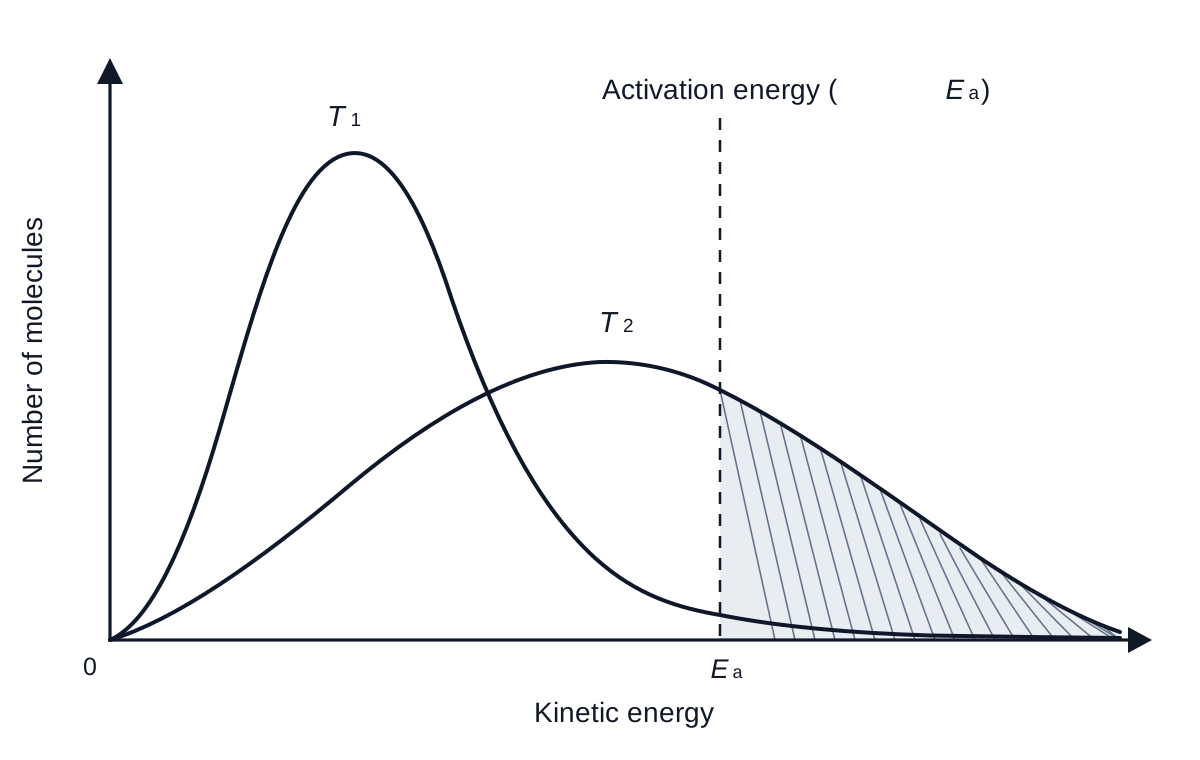
Using your knowledge of collision theory and referring to the Maxwell-Boltzmann distribution, explain how increasing the temperature from T1 T_1\,T1 to T2 T_2\,T2 affects the rate of this reaction.

