Question 6
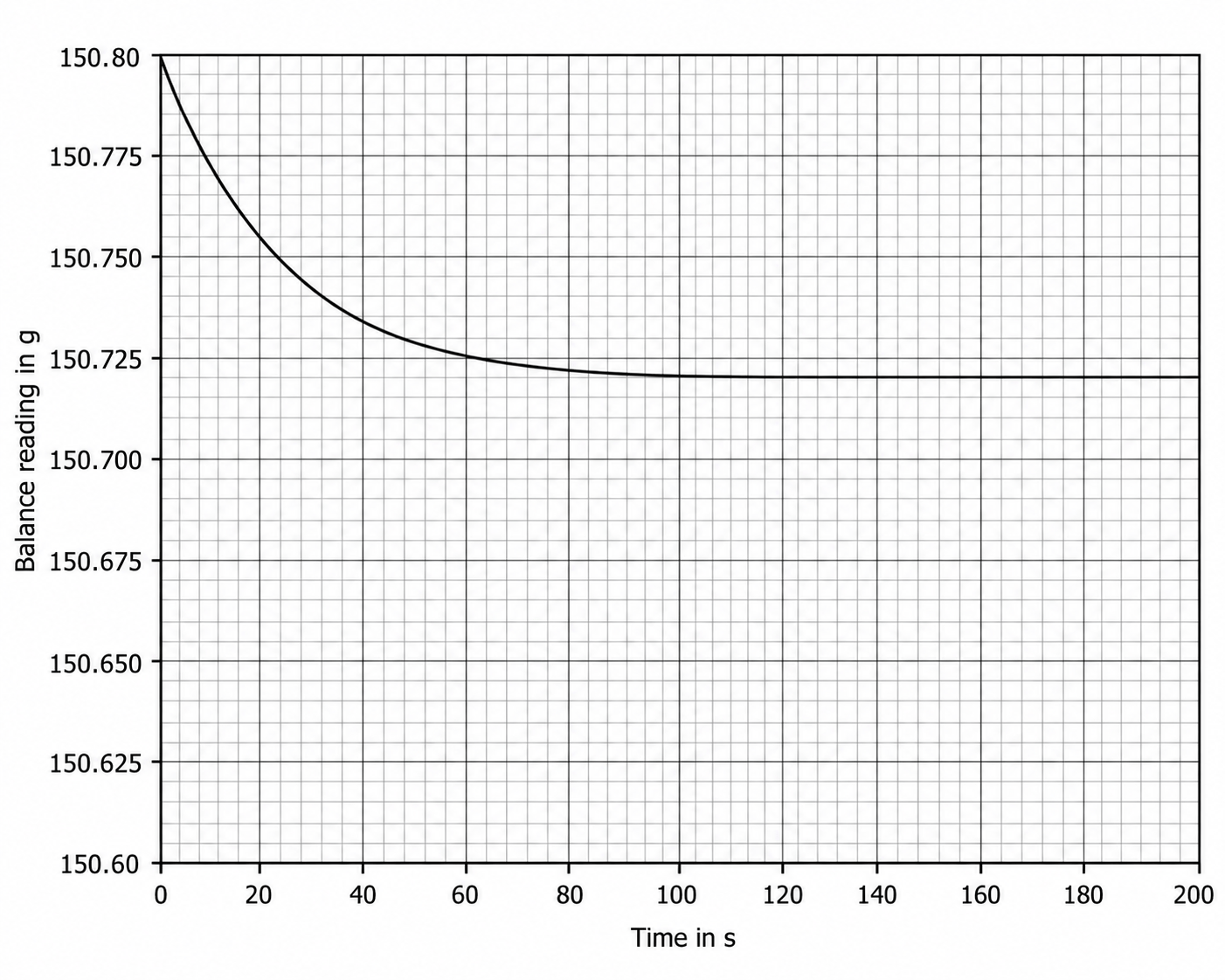
HThe graph shows the total mass of an open reaction vessel and its contents as carbon dioxide escapes. All other mass losses are negligible.
a.[3]
Use the initial and final masses on the graph to calculate the total mass of carbon dioxide released. Explain why the mass becomes constant.
b.[3]
Explain how a tangent to this graph could be used to find the instantaneous rate of carbon dioxide production at 20 s. Include the calculation and the units that would be used; a numerical tangent calculation is not required.
c.[3]
The same amounts of reactants are used at a higher temperature. Predict changes to the initial gradient and final mass, and explain the gradient change using collision theory.
8.1 Rates of reaction Questions
54 exam-style questions on Edexcel GCSE Chemistry 8.1 Rates of reaction, covering 8.1.1 Measuring and interpreting rates of reaction, 8.1.2 Collision theory and the factors affecting rate, and 8.1.3 Catalysts and enzymes. Each one has a worked solution and a mark scheme showing where the marks go.