Question 10
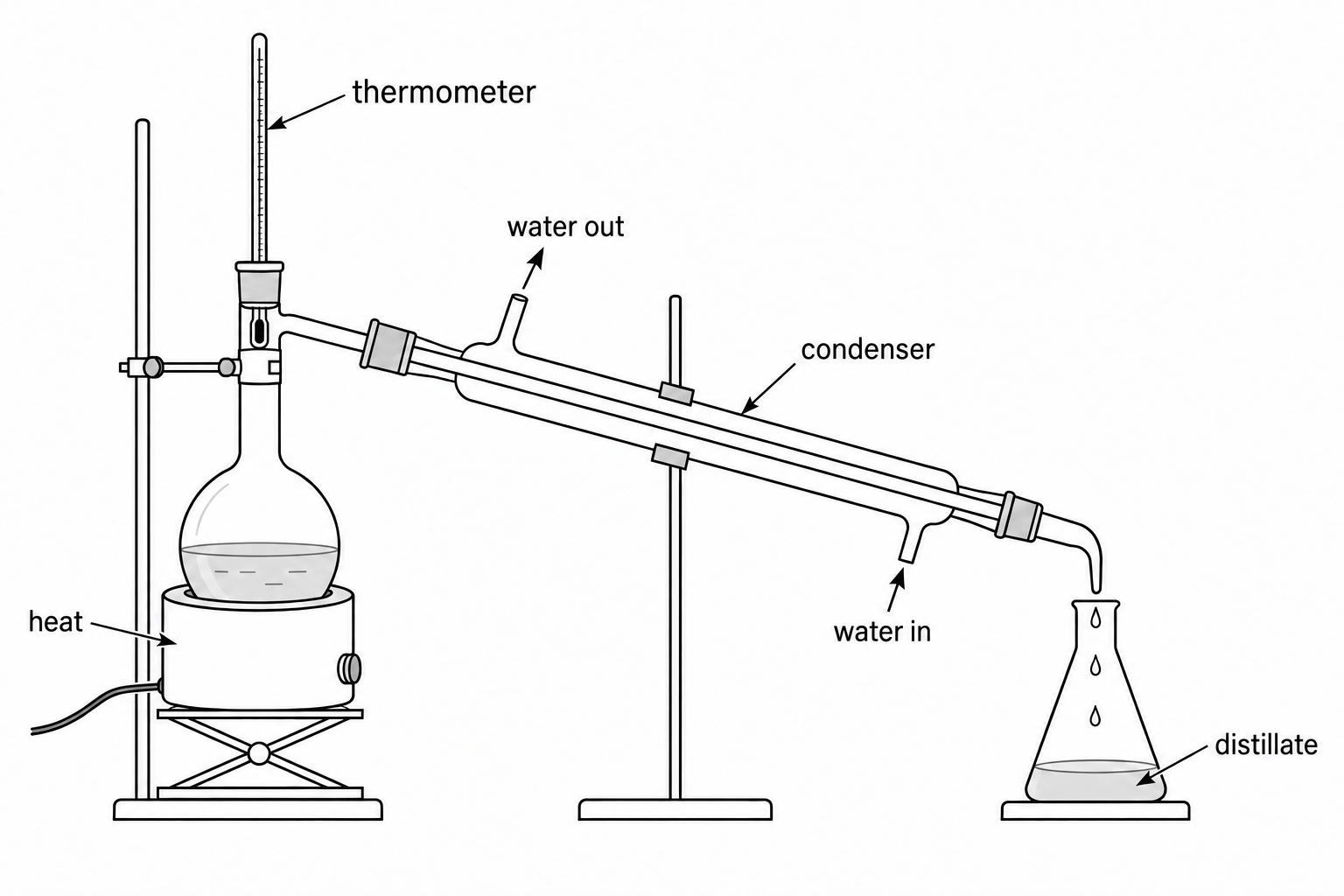
FA pupil plans to use this apparatus to recover water from a mixture of water, dissolved sodium chloride and insoluble sand.
a.[3]
Explain why filtration alone cannot produce pure water from this mixture. State what is retained by the filter and what passes through it.
b.[3]
After filtration, explain how the apparatus in the diagram separates water from sodium chloride. Follow the water from the heated flask to the receiver.
c.[2]
Use the two routes through the condenser in the diagram to explain why cooling water must flow around the vapour tube rather than through it.
3.2 Methods of separating and purifying substances Questions
48 exam-style questions on Edexcel GCSE Chemistry 3.2 Methods of separating and purifying substances, covering 3.2.1 Pure substances and mixtures, 3.2.2 Techniques for separating mixtures, 3.2.3 Paper chromatography and Rf values, and 3.2.4 Making water potable. Each one has a worked solution and a mark scheme showing where the marks go.