Question 8
FA laboratory checks whether a drink colouring, M, contains any of the reference dyes P, Q and R. All four samples are run on the same chromatography paper using the same solvent. The chromatogram is shown. All dyes present are visible.
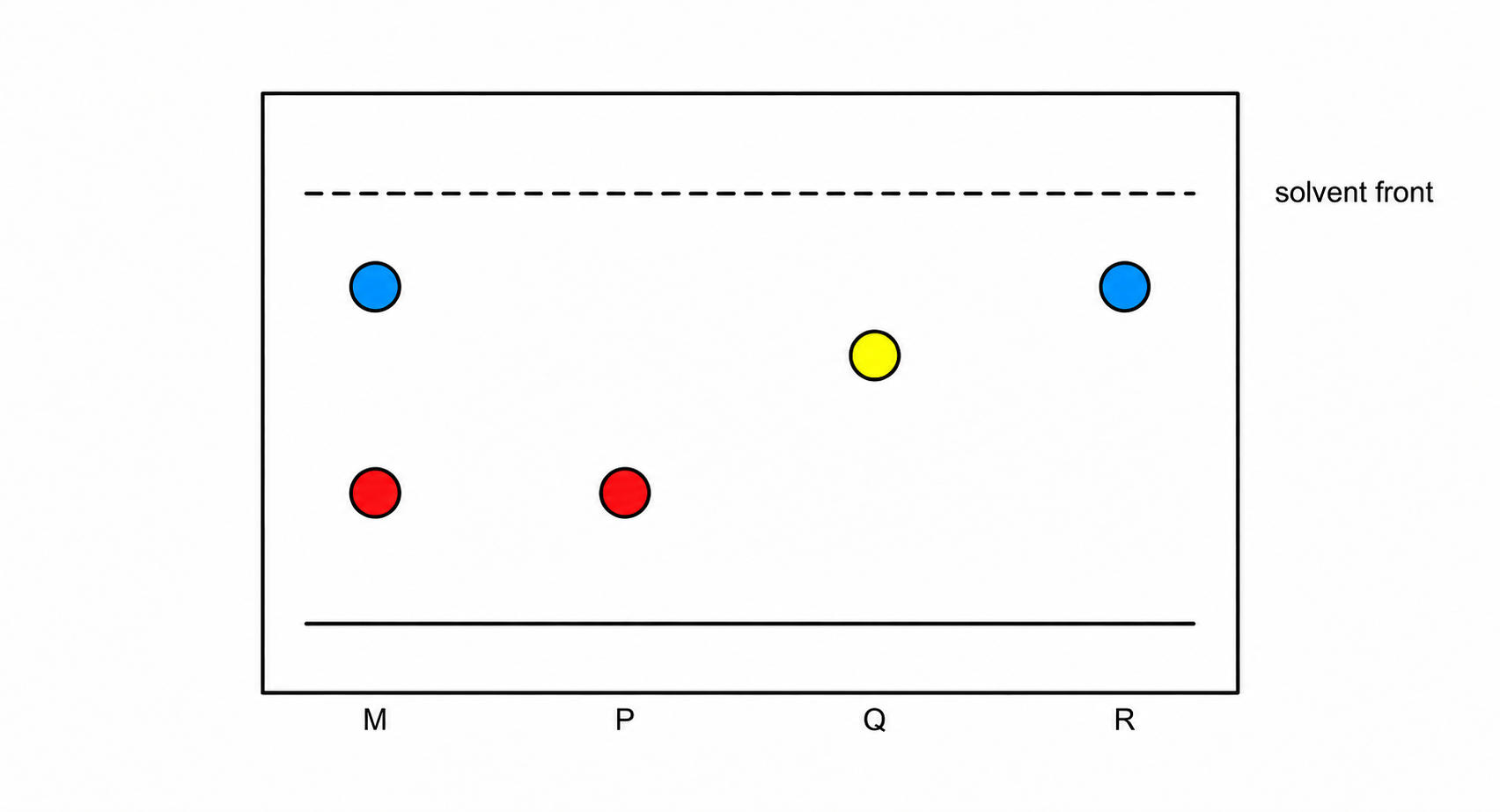
The diagram is schematic. In the actual experiment, the solvent front travels 8.0 cm from the start line and the centre of the upper spot in M travels 6.2 cm.
a.[3]
A student concludes, "M definitely contains P and R, and contains exactly two substances." Evaluate this conclusion using the chromatogram.
b.[2]
Calculate the Rf R_f\,Rf value of the upper spot in M. Give your answer to two decimal places.
c.[3]
The laboratory repeats the experiment using a different solvent. The upper spot in M separates into two spots, but R still produces one spot. Explain what this shows about the first experiment and why the second solvent improves the separation. State what comparison in the second chromatogram would provide further evidence that M contains R.
d.[2]
In a third experiment, the start line is below the surface of the solvent when the paper is placed in the container. Explain why this could prevent a valid comparison between M and the reference dyes.
3.2 Methods of separating and purifying substances Questions
48 exam-style questions on Edexcel GCSE Chemistry 3.2 Methods of separating and purifying substances, covering 3.2.1 Pure substances and mixtures, 3.2.2 Techniques for separating mixtures, 3.2.3 Paper chromatography and Rf values, and 3.2.4 Making water potable. Each one has a worked solution and a mark scheme showing where the marks go.