Question 18
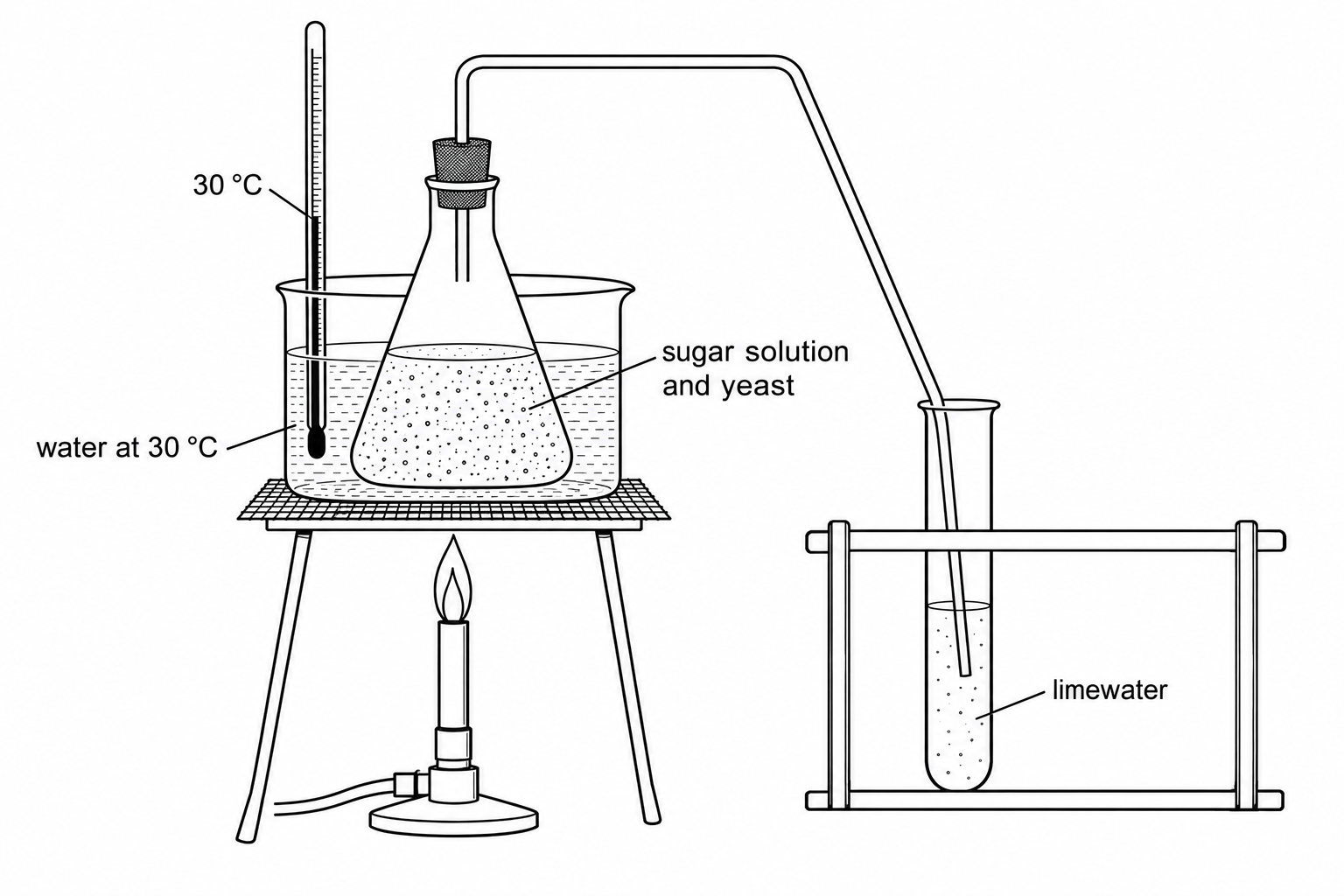
FFigure shows the apparatus a student used to ferment a sugar solution to produce ethanol.
Figure: Apparatus used to ferment a sugar solution to produce ethanol
a.[1]
Use Figure to give the temperature of the water in the beaker.
b.[1]
Name the gas that turns the limewater cloudy.
c.[2]
The flask is closed with a bung. Explain why air must be kept out of the flask.
d.[2]
Explain why the water is kept at 30 ∘C30\ ^\circ\text{C}30 ∘C and not at 80 ∘C80\ ^\circ\text{C}80 ∘C.