Leaf discs can be used to study photosynthesis. In an experiment, the air is removed from the airspace inside leaf discs using a syringe with sodium bicarbonate solution, which causes the discs to sink to the bottom of a beaker of water.
Fig. 22.1 shows how the leaf discs rise to the surface when they photosynthesize and produce gas bubbles.
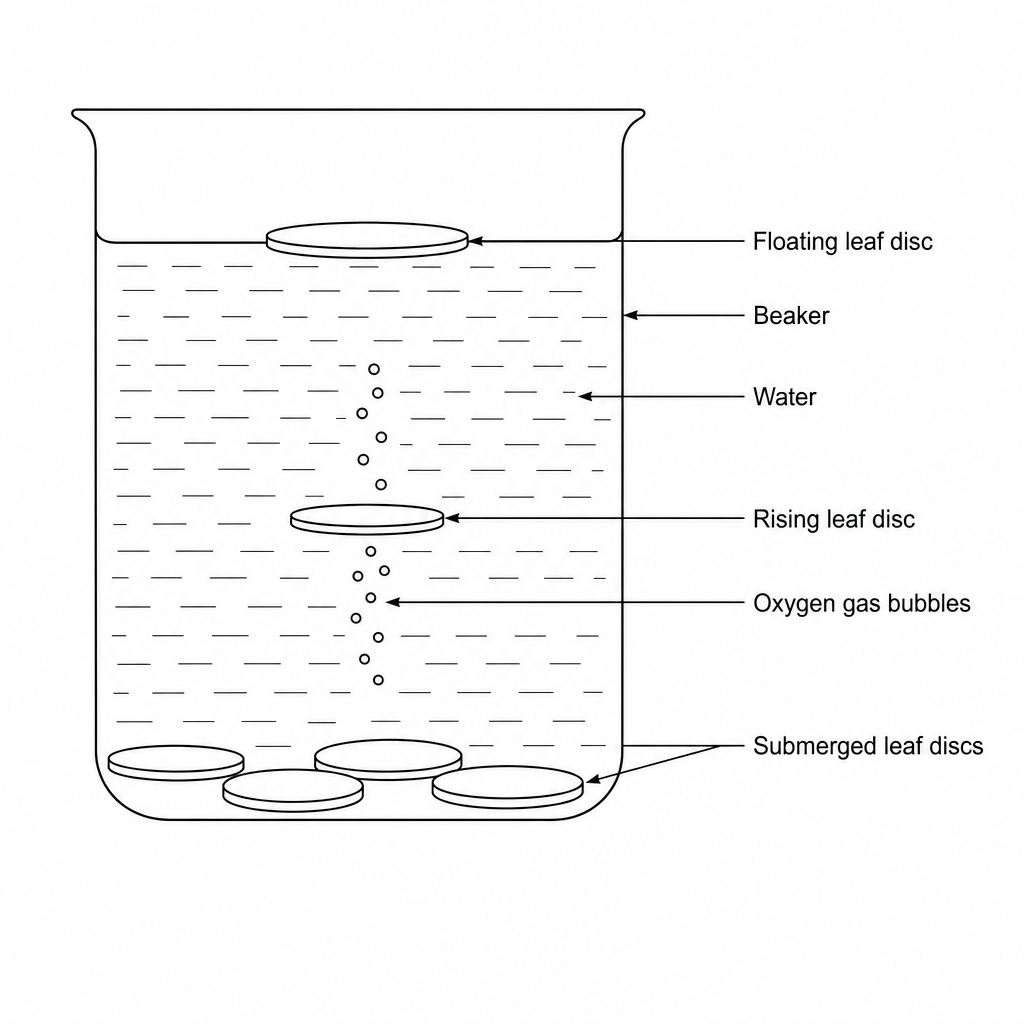
Fig. 22.1
Scientists test the effect of a chemical that stops a specific biological process in the leaf cells. When this chemical is added, they find that the sunken leaf discs do not rise even under bright light.
Which biological process is stopped by the chemical? Tick (✓\checkmark✓) one box.
[ ] Active transport [ ] Aerobic respiration [ ] Photosynthesis [ ] Transpiration
Explain why the leaf discs did not rise.
The scientists then investigate how exposure to light affects the leaf discs over a 30-minute period.
- In Experiment 1, the leaf discs are exposed to 15 minutes of light, followed by 15 minutes of darkness.
- In Experiment 2, the leaf discs are exposed to continuous light for 30 minutes.
They record the number of floating leaf discs over time. Fig. 22.2 shows their results.
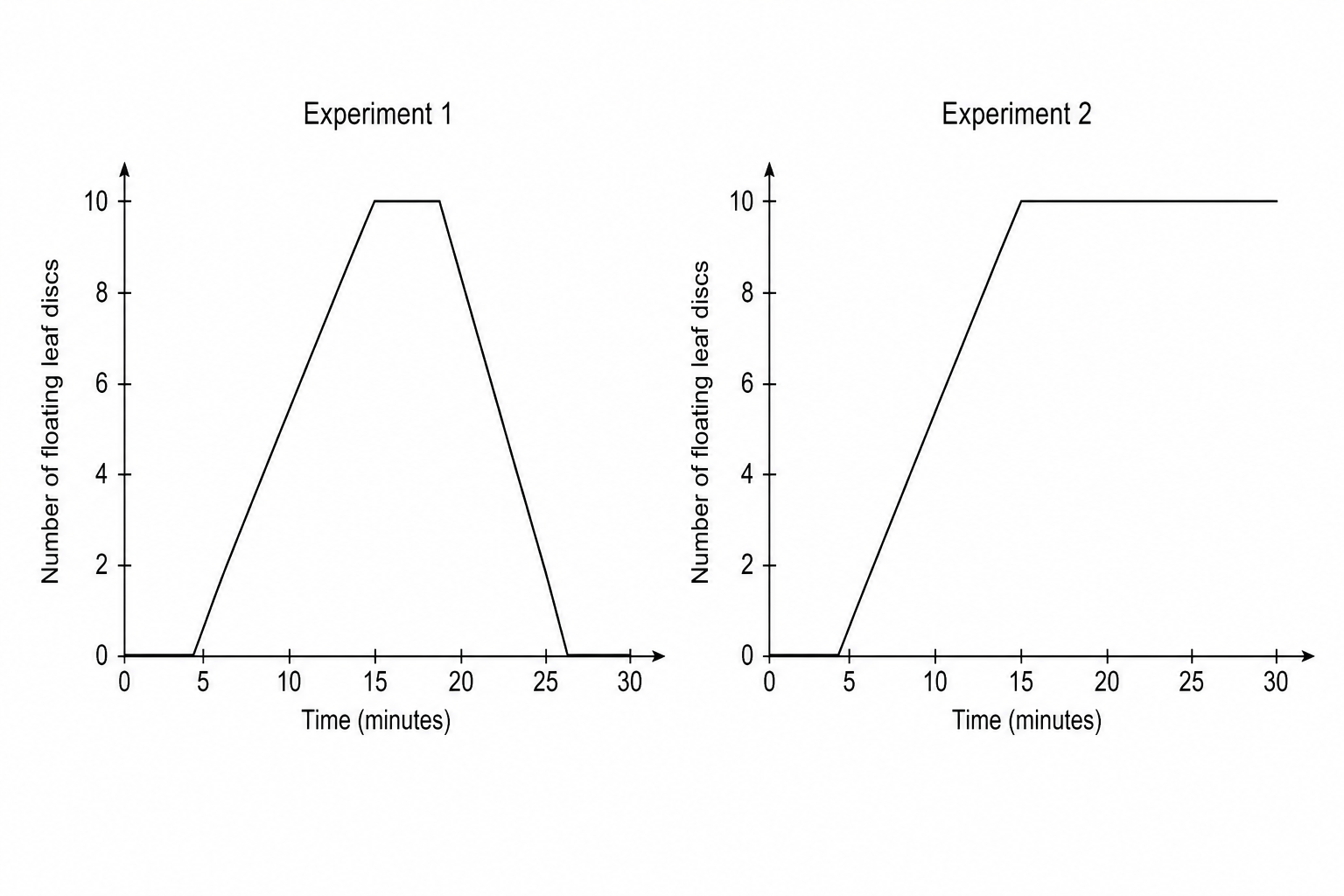
Fig. 22.2
What conclusion can be made from Experiment 1 about the effect of light on the floating of the leaf discs?
Suggest an explanation for the differences between the two graphs.
Light is one environmental factor that affects plants. Explain how increasing the temperature of the water from 10∘C10^\circ\text{C}10∘C to 45∘C45^\circ\text{C}45∘C can affect the rates of plant processes like photosynthesis.