A student makes the following statement:
'During the daytime, a photosynthetic leaf cell completely halts aerobic respiration in its mitochondria because the ATP produced by photophosphorylation in the chloroplasts is more than sufficient to power all active transport and metabolic reactions throughout the cell.'
Explain why the student's statement is not correct.
Scientists investigating the mechanism of ATP production during the light-dependent stage of photosynthesis proposed a model:
- Hydrogen ions (H+\text{H}^+H+) are actively pumped into the thylakoid lumen inside the thylakoid membrane, as shown in Fig. 1.1.
- This establishes a high concentration of free hydrogen ions (a proton gradient) across the membrane.
- The passive diffusion of these ions back into the stroma through ATP synthase drives the synthesis of ATP.
To test whether the concentration gradient of free hydrogen ions is necessary for ATP production, the scientists treated isolated chloroplasts with ammonium chloride (NH4Cl\text{NH}_4\text{Cl}NH4Cl). Ammonium ions act as a chemical buffer inside the thylakoid lumen, binding to free hydrogen ions to prevent a high concentration of free H+\text{H}^+H+ from accumulating, as shown in Fig. 1.2.
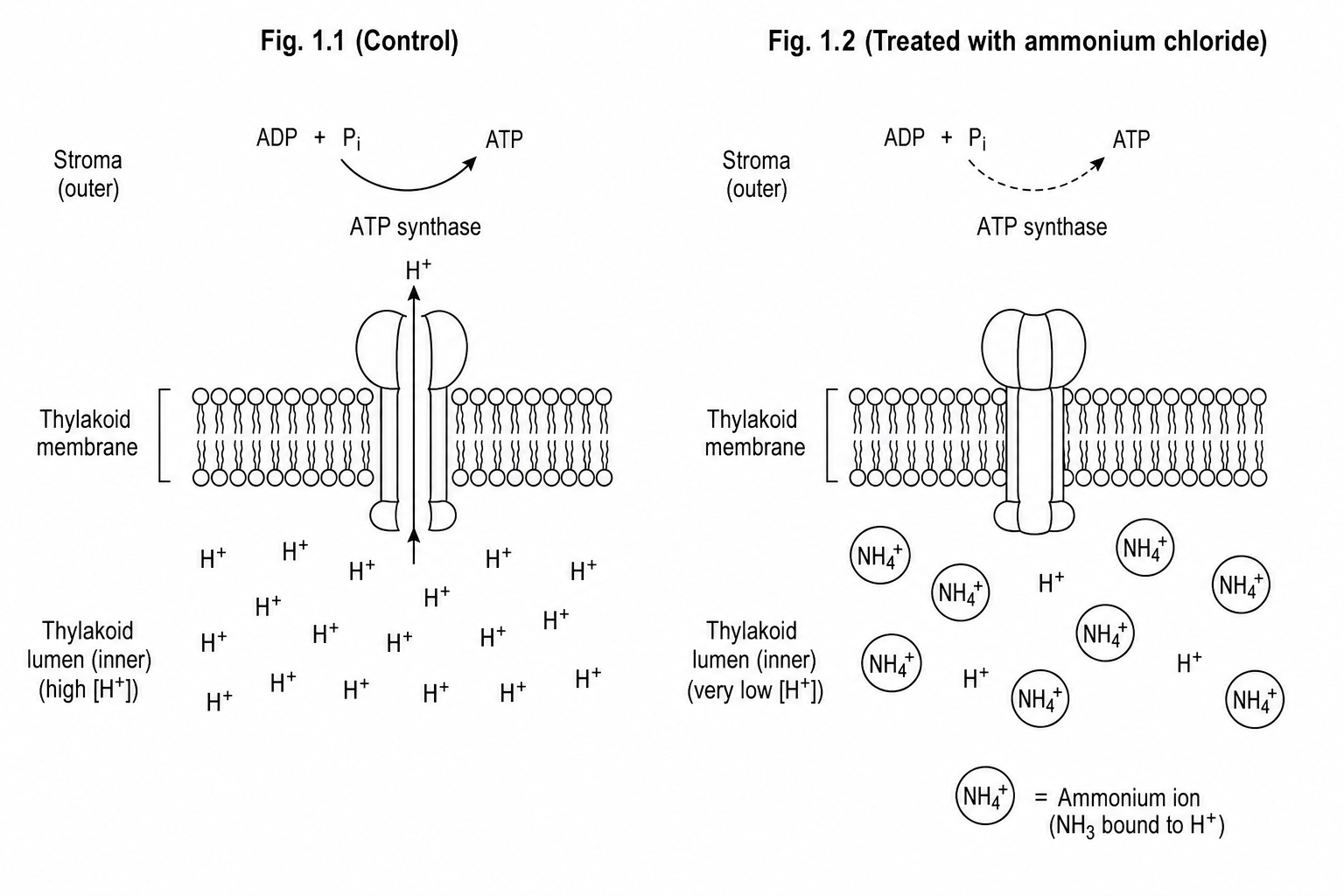
The result of their experiment showed that when ammonium chloride was present, ATP production fell to zero.
Explain how this result shows that their model is correct.