Immobilised algal beads, containing green microalgae suspended in sodium alginate, are often used to study photosynthesis. when placed in a beaker of dilute sodium hydrogencarbonate solution and exposed to light, the beads begin to rise to the surface.
Scientists run an experiment where they add a metabolic inhibitor to the beaker. This chemical stops a specific biological process in the microalgae, and they observe that the algal beads do not rise.
Which biological process is affected by the chemical?
- Diffusion
- Osmosis
- Photosynthesis
- Respiration
Explain why the algal beads did not rise after the chemical was added.
The scientists then investigate how light exposure affects the height of the algal beads in a column of liquid.
- In Experiment A, the algal beads are exposed to 8 hours of light followed by 16 hours of darkness.
- In Experiment B, the algal beads are exposed to continuous light for 24 hours.
They measure the height of the beads in the container over a 24-hour period. The results are shown in the graphs below:
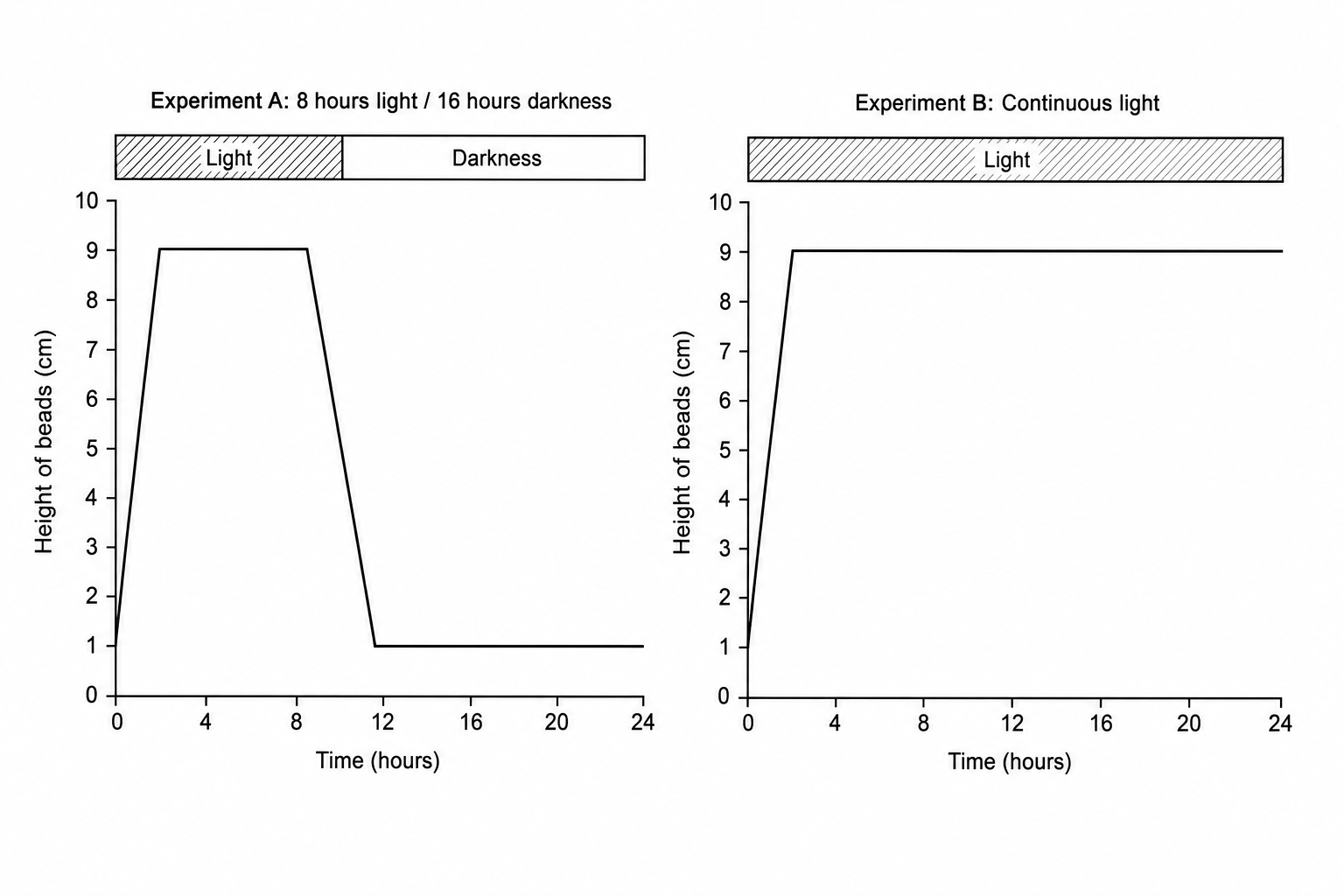
What conclusion can be made from Experiment A about the effect of light on the position of the algal beads?
Suggest an explanation for the differences in the position of the beads between the two experiments after 12 hours.
Light is one environmental factor that affects plants. Explain how increasing the temperature from 10∘C10^\circ\text{C}10∘C to 45∘C45^\circ\text{C}45∘C can affect the rate of photosynthesis in these microalgae.