A researcher investigated the antibacterial efficacy of two novel synthetic compounds using agar plates seeded with a culture of Staphylococcus aureus.
A sterile paper disc saturated with Compound A-3 was placed in the center of the first plate, and a disc saturated with Compound B-7 was placed in the center of the second plate.
Following a 24-hour incubation period, the resulting circular zones of inhibition were measured, as illustrated in the diagram below.
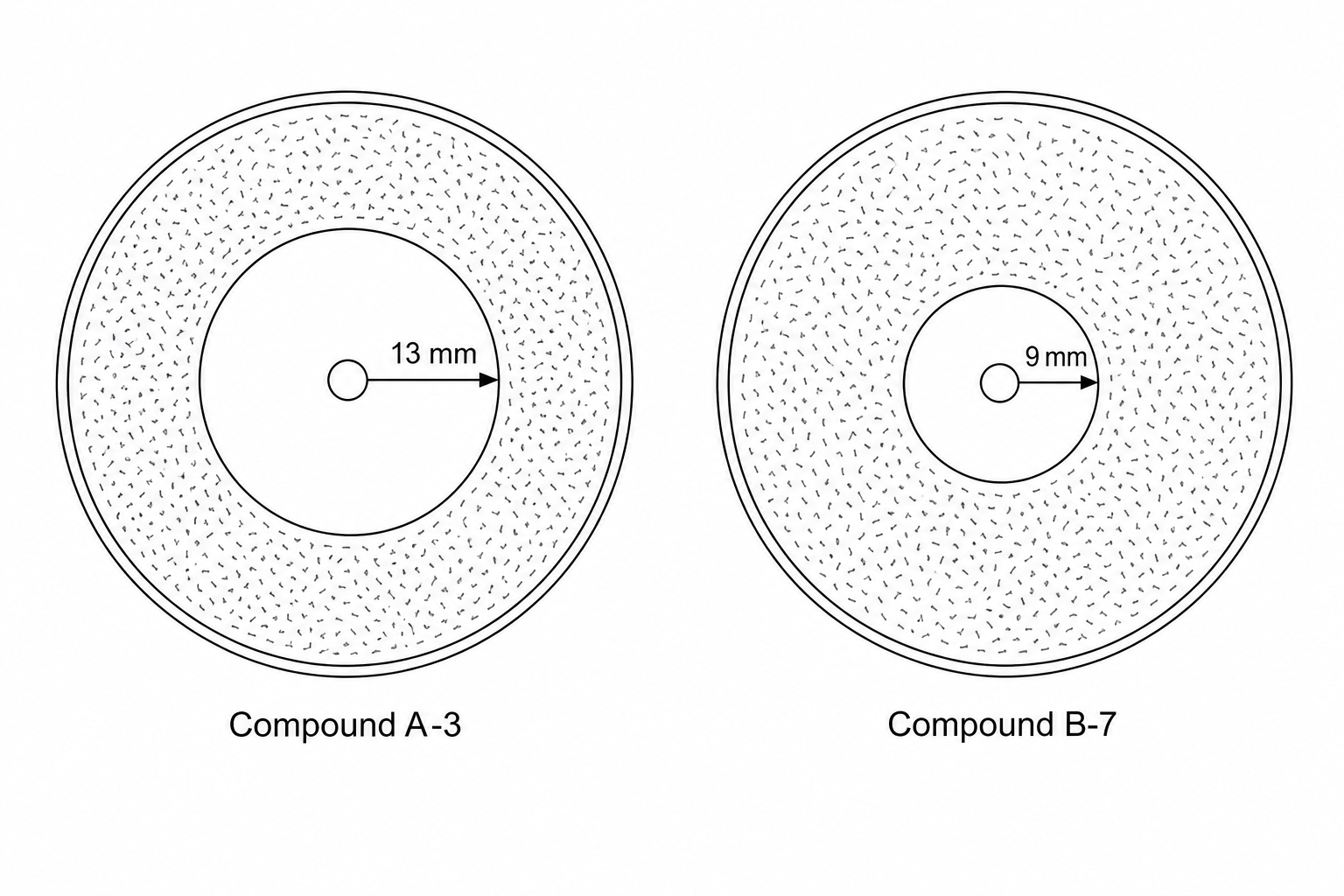
| Compound A-3 | Compound B-7 |
| radius of zone of inhibition = 13 mm | radius of zone of inhibition = 9 mm |
The area of a circle is calculated using the equation:
Area=πr2 \text{Area} = \pi r^2 Area=πr2Calculate the area of the zone of inhibition for Compound A-3.
Use π=3.14\pi = 3.14π=3.14. Give your answer to 3 significant figures.

