Skip to content
MathsGenie logo
Open app

Course home

  1. GCSE
  2. Biology Edexcel
  3. Question bank

Antibiotics, culturing microorganisms and monoclonal antibodies

EasyMediumHard
1234567891011121314151617181920212223242526272829303132
Question 20

A student investigated the antimicrobial properties of tea tree oil.

They placed a filter paper disc soaked in tea tree oil dissolved in ethanol (disc X) on one half of an agar plate spread with bacteria.

A control filter paper disc soaked only in ethanol (disc Y) was placed on the other half of the agar plate.

The plate was incubated at 25 °C for 48 hours. The results are shown below.
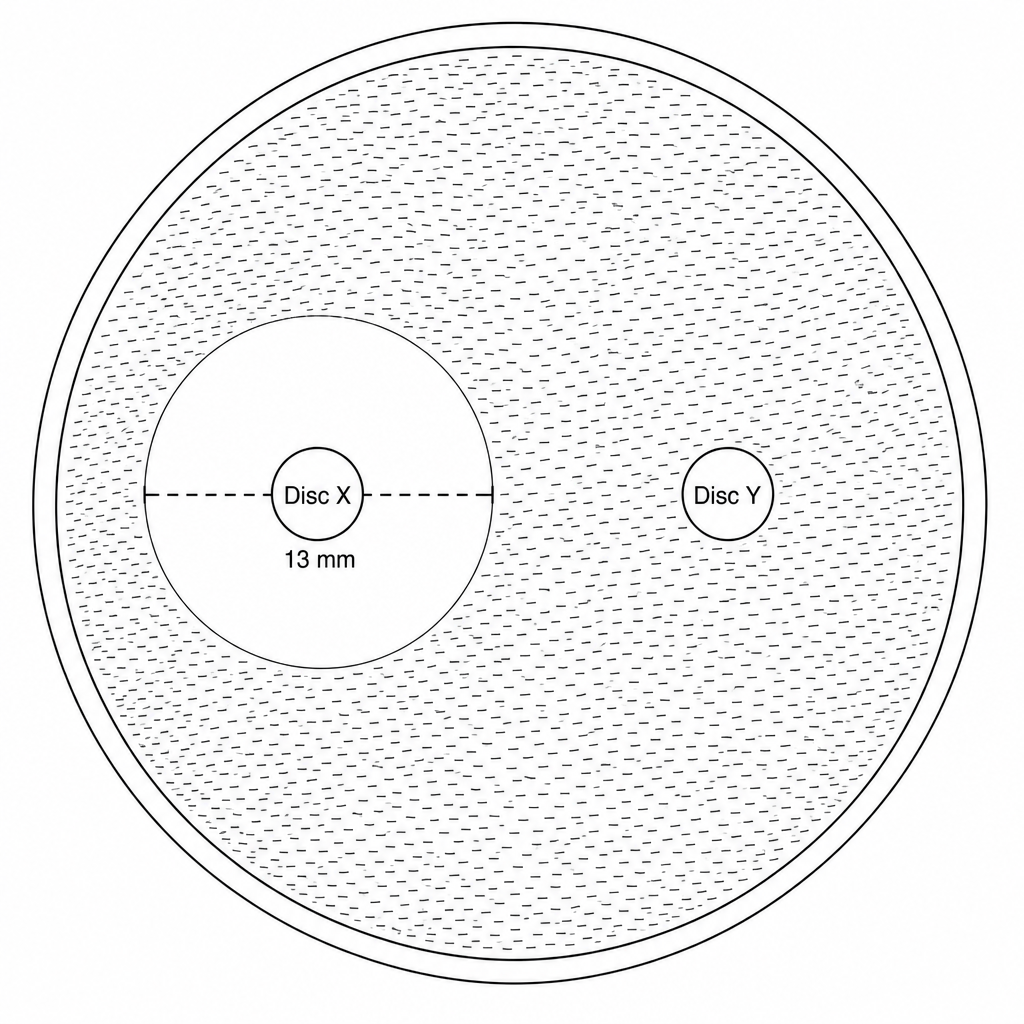
An agar plate showing a lawn of bacterial growth. On the left side, disc X has a distinct, clear circular zone of inhibition around it. On the right side, disc Y has no clear zone around it, with bacterial growth reaching the edge of the disc.

The diameter of the zone of inhibition around disc X is 13 mm.

Calculate the area of this zone of inhibition. Use the equation:

Area=πr2 \text{Area} = \pi r^2 Area=πr2

Use a value of 3.14 for π\piπ.

Give your answer to 1 decimal place and include the unit.

[3]

Antibiotics, culturing microorganisms and monoclonal antibodies Questions

  1. GCSE
  2. /Biology
  3. /Antibiotics, culturing microorganisms and monoclonal antibodies
