

Zero Index GCSE Maths Explained
Zero index GCSE maths explained clearly. Learn the rule, follow step-by-step worked examples, avoid common errors and practise exam questions today.
A zero index can feel like a trap. Imagine a student called Sam who has remembered that indices involve repeated multiplication. Each time Sam sees 808^080, the same thought appears: there are no eights to multiply, so the answer must be 000.
It sounds plausible. It is also the mistake that keeps costing Sam marks.
The essential rule for zero index GCSE maths is simple:
a0=1where a≠0 a^0=1 \qquad \text{where } a\ne 0 a0=1where a=0Any non-zero number or expression raised to the power of zero equals 111. The base does not become zero, and the answer is not the base. Once Sam understands why the rule works, it stops feeling like an arbitrary fact and starts becoming difficult to forget.
The zero index checklist
When you see a power of zero:
- identify the complete base;
- check that the base is non-zero;
- replace the whole power with 111;
- pay attention to brackets and signs;
- simplify the rest of the expression.
You can learn and practise this rule on MathsGenie's GCSE Indices lesson and Question Bank. There is also a dedicated OCR GCSE Indices revision page for students following that specification.
Why does a zero index equal one?
The clearest explanation comes from the division law for indices:
aman=am−n \frac{a^m}{a^n}=a^{m-n} anam=am−nNow divide a non-zero power by itself. For example:
7373=73−3=70 \frac{7^3}{7^3}=7^{3-3}=7^0 7373=73−3=70But any non-zero quantity divided by itself equals 111:
7373=343343=1 \frac{7^3}{7^3}=\frac{343}{343}=1 7373=343343=1Therefore:
70=1 7^0=1 70=1This works for every non-zero base. More generally:
anan=an−n=a0 \frac{a^n}{a^n}=a^{n-n}=a^0 anan=an−n=a0and
anan=1 \frac{a^n}{a^n}=1 anan=1so:
a0=1 a^0=1 a0=1This is the moment when it clicks for Sam. The zero is not telling you that the value is zero. It records what happens when equal indices are subtracted.
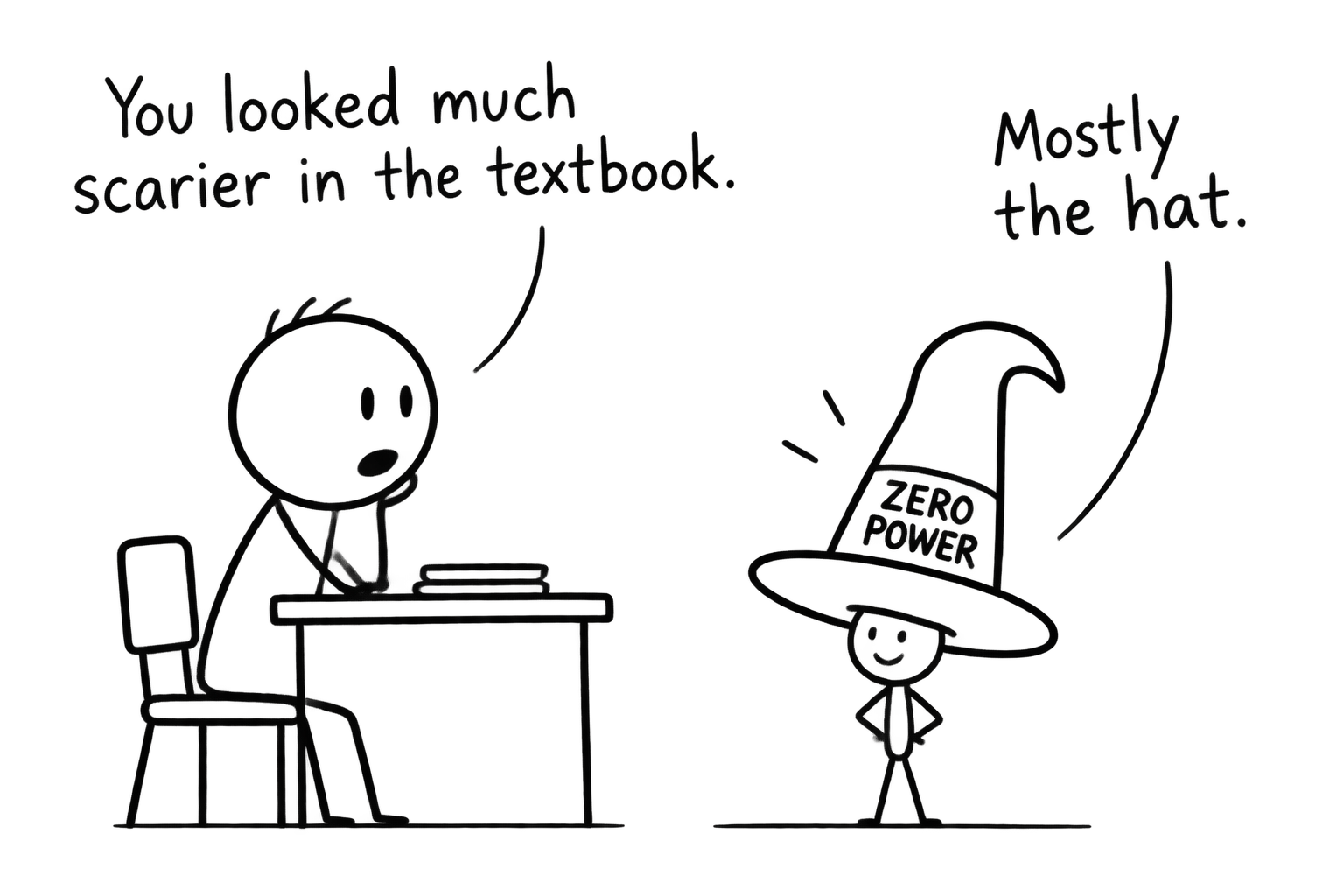 A student discovers that zero powers are less frightening than they look
Zero index worked examples
The rule is short, but GCSE questions test whether you can recognise the base and apply the rule inside larger expressions.
A positive integer base
Evaluate:
120 12^0 120The base is 121212, which is non-zero. Therefore:
120=1 12^0=1 120=1A negative base in brackets
Evaluate:
(−4)0 (-4)^0 (−4)0The brackets show that the entire base is −4-4−4. Since −4≠0-4\ne0−4=0:
(−4)0=1 (-4)^0=1 (−4)0=1A negative base makes no difference when the complete base is raised to the power of zero.
A fractional base
Evaluate:
(37)0 \left(\frac{3}{7}\right)^0 (73)0The fraction is non-zero, so:
(37)0=1 \left(\frac{3}{7}\right)^0=1 (73)0=1An algebraic base
Simplify:
(2x)0 (2x)^0 (2x)0The complete expression 2x2x2x is the base. Therefore:
(2x)0=1provided x≠0 (2x)^0=1 \qquad \text{provided } x\ne0 (2x)0=1provided x=0At GCSE, a question may simply expect the answer 111, but the condition matters mathematically because the zero-index rule applies only to a non-zero base.
A zero index within an expression
Simplify:
5x0+2 5x^0+2 5x0+2Only xxx is raised to the power of zero. Assuming x≠0x\ne0x=0:
x0=1 x^0=1 x0=1Substitute this into the expression:
5x0+2=5(1)+2=7 5x^0+2=5(1)+2=7 5x0+2=5(1)+2=7Sam's earlier instinct might have produced 222 by replacing x0x^0x0 with 000. The correct replacement is 111.
Combining a zero index with another power
Evaluate:
90+23 9^0+2^3 90+23Work out each power:
90=1 9^0=1 90=1and
23=8 2^3=8 23=8Therefore:
90+23=1+8=9 9^0+2^3=1+8=9 90+23=1+8=9Open the MathsGenie Indices lesson and Question Bank when you are ready to turn this four-step method into regular practice.
Brackets, signs and the complete base
The most subtle zero index questions often test notation rather than difficult calculation. Compare these expressions:
(−5)0 (-5)^0 (−5)0and
−50 -5^0 −50In the first expression, the brackets make −5-5−5 the base:
(−5)0=1 (-5)^0=1 (−5)0=1In the second expression, the index applies to 555 before the negative sign is used:
−50=−(50)=−1 -5^0=-(5^0)=-1 −50=−(50)=−1The expressions look similar, but they are not equivalent. Brackets decide whether the negative sign belongs to the base.
The same care is needed with coefficients. In:
4x0 4x^0 4x0only xxx has index zero, so:
4x0=4(1)=4 4x^0=4(1)=4 4x0=4(1)=4However, in:
(4x)0 (4x)^0 (4x)0the whole expression is raised to the power of zero:
(4x)0=1where x≠0 (4x)^0=1 \qquad \text{where } x\ne0 (4x)0=1where x=0Common zero index mistakes
Giving zero as the answer
The most common error is writing:
a0=0 a^0=0 a0=0This confuses the index with the value. For every non-zero base, the correct rule is:
a0=1 a^0=1 a0=1Ignoring brackets
Do not assume that (−3)0(-3)^0(−3)0 and −30-3^0−30 mean the same thing. Read the brackets before applying the rule.
Changing the coefficient as well
In 6x06x^06x0, the zero index belongs only to xxx. The answer is:
6x0=6(1)=6 6x^0=6(1)=6 6x0=6(1)=6It is not 111 because the coefficient 666 is outside the power.
Applying the rule to a zero base
The rule is not a0=1a^0=1a0=1 for every possible value of aaa. It requires:
a≠0 a\ne0 a=0The expression 000^000 is not treated as an ordinary zero-index calculation at GCSE. Do not automatically replace it with 111.
Mixing up zero and negative indices
A negative index means take a reciprocal:
a−n=1an a^{-n}=\frac{1}{a^n} a−n=an1A zero index has a different result:
a0=1 a^0=1 a0=1If you are connecting these ideas, MathsGenie's guide to fractional and negative indices explains reciprocals and roots, while the GCSE Fractional and Negative Indices lesson provides further practice.
Exam-style zero index questions
Try these without looking at the answers first.
Questions
- Evaluate 15015^0150.
- Evaluate (−9)0(-9)^0(−9)0.
- Evaluate (25)0\left(\frac{2}{5}\right)^0(52)0.
- Simplify 6a0+36a^0+36a0+3, where a≠0a\ne0a=0.
- Evaluate −(80)-(8^0)−(80).
- Simplify 3434\frac{3^4}{3^4}3434 using an index law.
- Simplify (5y)0+2y0(5y)^0+2y^0(5y)0+2y0, where y≠0y\ne0y=0.
Answers
- 150=115^0=1150=1
- (−9)0=1(-9)^0=1(−9)0=1
- (25)0=1\left(\frac{2}{5}\right)^0=1(52)0=1
- 6a0+3=6(1)+3=96a^0+3=6(1)+3=96a0+3=6(1)+3=9
- −(80)=−(1)=−1-(8^0)=-(1)=-1−(80)=−(1)=−1
- 3434=34−4=30=1\frac{3^4}{3^4}=3^{4-4}=3^0=13434=34−4=30=1
- (5y)0+2y0=1+2(1)=3(5y)^0+2y^0=1+2(1)=3(5y)0+2y0=1+2(1)=3
Check any lost marks against the checklist. Most errors will come from replacing the power with 000, overlooking a bracket or applying the index to the wrong part of an expression.
Turn understanding into reliable marks
Sam's problem changes when the zero index becomes a reasoned rule rather than a fact to guess under pressure. Knowing the rule is the first step; recognising it accurately in mixed exam questions takes practice. Start the MathsGenie Indices lesson and Question Bank and practise until every non-zero base raised to zero immediately becomes 111.















