Year 13 A-Level Maths Mocks and Predicted Grades
Year 13 A-Level Maths mocks and predicted grades explained, with practical revision advice, a worked example and a plan for your next targeted practice paper.
A mock result can make the future feel suddenly smaller. Imagine a sixth-form student opening their A-Level Maths paper and immediately wondering whether the grade will change their university options. With Year 13 A-Level Maths mocks and predicted grades, the essential distinction is this: mocks provide evidence of current performance; predicted grades reflect what your school or college believes you are likely to achieve. One result does not automatically determine the other.
Your school’s policy and the timing of your UCAS application matter. The useful next step is to understand how your result will be used, then turn the marked paper into a focused revision plan.
What to check when your mock comes back
Before drawing conclusions from the letter on the front, establish:
- Which topics and parts of the specification were assessed.
- How your school set the mock grade boundaries.
- Whether the result informs your UCAS prediction, an internal tracking grade, or both.
- What evidence your teacher would need to review a prediction.
- Whether your UCAS application has already been submitted.
These questions separate decisions you can influence from assumptions that only increase the pressure.
How mocks influence predicted grades
UCAS describes a predicted grade as the qualification grade your school or college believes you are likely to achieve in positive circumstances. Universities consider predictions alongside other application information.
A mock offers useful evidence because it tests independent work under time pressure. However, schools decide how to weigh it alongside other assessments and teachers’ professional judgement. There is no universal rule saying a particular mock grade must produce the same prediction.
Timing changes the conversation. Some Year 13 mocks take place after UCAS predictions have been submitted. UCAS cannot amend predicted grades once an application has been sent. If that applies to you, discuss any concerns with your school’s UCAS adviser and ask what communication with your chosen universities may be appropriate.
For our hypothetical student, the first productive conversation is therefore specific: “Which evidence informed my prediction, and what does this mock tell us I should improve?”
Read the marks before reading your future
A total mark compresses several different problems into one number. Lost marks might come from unfamiliar content, weak algebra, incomplete explanations or running out of time. Each needs a different response.
Go through the paper with the mark scheme and classify each substantial loss:
- Knowledge: you did not know the relevant method or condition.
- Execution: you recognised the method but made an algebraic or numerical error.
- Interpretation: you misunderstood the model, wording or requested conclusion.
- Timing: you could solve the question later but did not reach it effectively.
Then identify repeated patterns. Several errors involving negative powers may deserve more attention than one unusually difficult final question.
Use the relevant specification and resources for your board. MathsGenie’s Edexcel A Level Maths revision resources, for example, organise pure maths, statistics and mechanics so that a vague concern can become a named revision task.
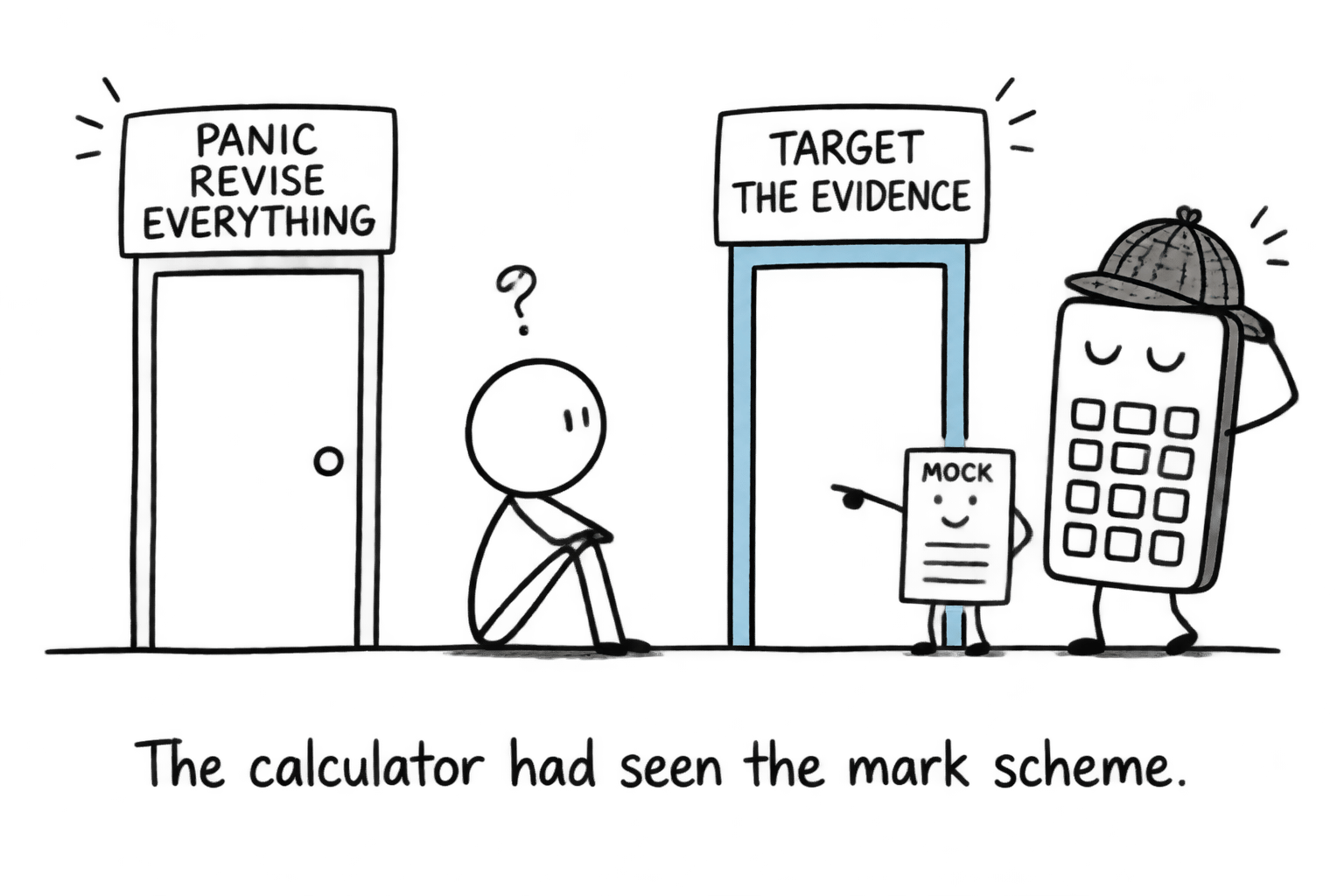 Stick-figure comic about choosing targeted revision after a maths mock, featuring a calculator dressed as a detective
A worked example: finding the gap behind an error
Suppose a mock asks you to find the stationary points of
f(x)=x3−3x2−9x+5.f(x)=x^3-3x^2-9x+5.f(x)=x3−3x2−9x+5.Differentiate and set the derivative equal to zero:
f′(x)=3x2−6x−9=3(x−3)(x+1)=0.f'(x)=3x^2-6x-9=3(x-3)(x+1)=0.f′(x)=3x2−6x−9=3(x−3)(x+1)=0.Therefore,
x=3orx=−1.x=3\quad\text{or}\quad x=-1.x=3orx=−1.Substituting into the original function gives
f(3)=−22,f(−1)=10.f(3)=-22,\qquad f(-1)=10.f(3)=−22,f(−1)=10.The stationary points are (3,−22)(3,-22)(3,−22) and (−1,10)(-1,10)(−1,10). To classify them, use
f′′(x)=6x−6.f''(x)=6x-6.f′′(x)=6x−6.Since f′′(3)=12>0f''(3)=12>0f′′(3)=12>0, (3,−22)(3,-22)(3,−22) is a local minimum. Since f′′(−1)=−12<0f''(-1)=-12<0f′′(−1)=−12<0, (−1,10)(-1,10)(−1,10) is a local maximum.
Now consider what your working reveals. Correct differentiation followed by incorrect factorisation suggests an algebra problem. Finding both values of xxx but omitting coordinates suggests an incomplete response to the question. Classifying points using the sign of the first derivative at the stationary points suggests a conceptual misunderstanding.
Those are different revision tasks. Select similar questions from the A Level Maths question bank, then check whether you can complete a fresh question without prompts.
Build a revision cycle around the evidence
Our student now has something more useful than “revise differentiation”: a precise weakness and a way to test it.
Start with a revision lesson on the missing idea. Attempt practice questions independently before opening worked solutions or video explanations where available. Afterwards, close the solution and reconstruct the method yourself. Watching a correct solution can feel reassuring without proving you can reproduce it.
Next, mix the repaired topic with other material. A worksheet announces which method to use; a mock requires you to choose. Use A Level past papers and mark schemes to practise that decision under timed conditions.
Keep the revision planner simple: record the weakness, the practice task and a later retest. Short mini tests can check individual repairs between longer papers. Measure progress through independent solutions and fewer repeated errors, rather than hours spent at your desk.
Common mistakes during mock season
Treating a mock boundary as a guaranteed summer boundary. Ask how your school established it. A restricted topic test and a complete examination series are different assessments.
Requesting a higher prediction without supporting evidence. Bring marked assessments, corrected work and fresh independent attempts. Ask about the school’s review process without assuming a change is guaranteed.
Revising only the weakest topic. Repair the gap, but maintain coverage across pure maths, statistics and mechanics.
Treating predicted papers as forecasts. They provide additional practice; they cannot establish which questions will appear in your examination.
Using the wrong paper format. Check your board’s specification and your school’s mock instructions. Internal mocks may assess less content or use different timings from the final papers.
Turn the next paper into a useful test
A disappointing result deserves attention, but it does not need to dictate every revision decision. The marked script gives you a starting point: identify the gap, practise the method and test it again independently.
Use MathsGenie’s A Level exam builder to select your subject and exam board, then build a targeted practice paper in Mock Exam Builder. Choose questions that revisit your main weaknesses while retaining some familiar material. Sit it under the appropriate conditions and review the working carefully.
That gives your next conversation with your teacher something concrete: evidence of what you can now do.