How to Prepare for GCSE Maths Mocks
How to prepare for GCSE Maths mocks with targeted revision, timed practice, exam technique and a calm plan that turns mistakes into measurable progress.
November can change the atmosphere around GCSE Maths. Lessons continue, homework accumulates and suddenly the December mock timetable appears. A paper labelled “mock” can feel less like practice and more like a prediction.
It is not. If you are wondering how to prepare for GCSE Maths mocks, the most effective approach is simple: identify the topics most likely to cost you marks, practise them deliberately, complete timed exam questions and use every mistake to decide what to revise next. A mock is a diagnostic, not a verdict.
That distinction matters. A disappointing result can reveal gaps while there is still time to close them. A strong result can show which habits are working. Either way, the paper gives you useful information.
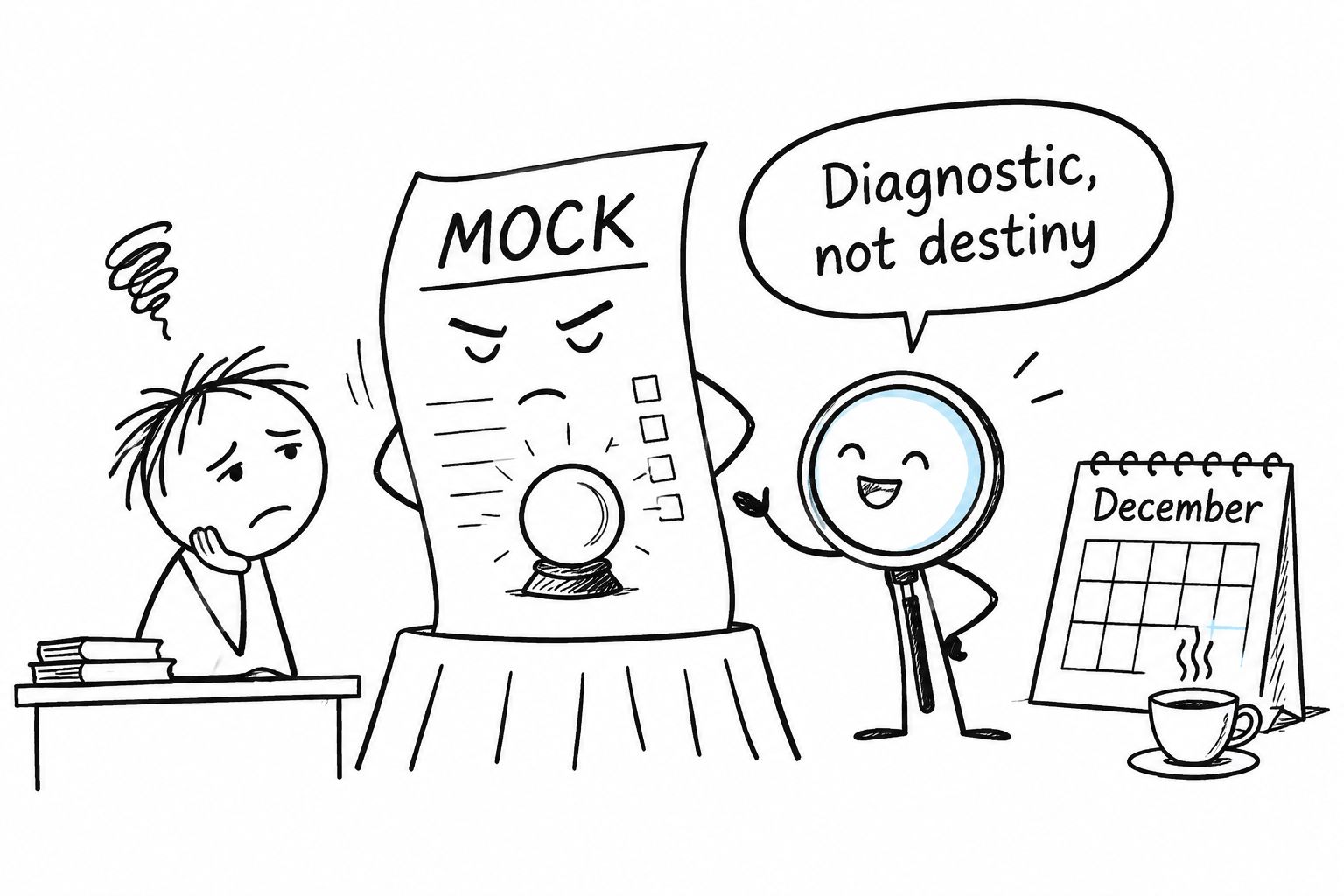 A GCSE student discovers that a mock is a diagnostic, not destiny
Your GCSE Maths mocks checklist
Before building a revision timetable, find out exactly what your school intends to assess. Mock arrangements vary, so ask your teacher about the exam board, tier, papers, content covered and whether each paper is calculator or non-calculator.
Your preparation checklist should include:
- Confirm your exam board and foundation or higher tier.
- Check the dates, duration and calculator requirements for each paper.
- List your secure, uncertain and weak topics.
- Revise weak topics using short lessons and focused questions.
- Complete exam-style questions without notes.
- Sit at least one paper, or a substantial section, under timed conditions.
- Mark your work carefully and record why marks were lost.
- Revisit mistakes several days later without looking at the solution.
- Prepare your calculator and equipment before the mock.
- Protect sleep and avoid an exhausting final-night revision session.
The GCSE Maths revision hub lets you select your exam board and find relevant revision materials. MathsGenie covers Edexcel, AQA, OCR, Eduqas, WJEC and CCEA, but your teacher remains the best source for the precise content of your school mock.
Start November with a diagnosis
Imagine a Year 11 student opening a revision guide on the first Saturday of November. They begin at page one because it feels organised. Two hours later, they have revised topics they already understand and avoided the algebra that actually worries them.
This is a common trap. Revision time feels productive, but it is not targeted.
Begin with a short mixed assessment, previous test or set of exam-style questions. Mark it and sort each topic into three groups:
- Secure: you can answer independently and explain your method.
- Uncertain: you sometimes succeed but make errors or need prompts.
- Weak: you do not yet know how to begin.
Spend most of your time on the uncertain and weak groups, while briefly returning to secure topics so they remain familiar. If your school follows AQA, use the AQA GCSE Maths revision resources. Edexcel students can organise their exam practice through the Edexcel GCSE Maths past papers.
A diagnostic only helps when you are honest. Looking at a solution and thinking “I would have done that” is not the same as producing the method independently.
Build a realistic revision plan
A good plan is usually smaller than students expect. You do not need to revise every topic every evening. You need repeated, focused sessions that you can sustain alongside other subjects.
The MathsGenie revision planner can help turn the weeks before the mock into a day-by-day schedule. A practical weekly pattern might include:
- two sessions on weak topics;
- one mixed session covering older material;
- one timed set of exam questions;
- one short session correcting previous mistakes.
Each session should have a clear purpose. “Revise maths” is vague. “Complete ratio questions, mark them and retry every incorrect question” is actionable.
For Year 10 students, the mock may only include content taught so far. For Year 11 students, it may cover a broader part of the specification. Do not assume that every school uses the same mock paper or content list.
Parents can help by asking process-based questions. “Which mistake are you fixing today?” is often more useful than “How many hours have you revised?” A calm routine, a suitable workspace and encouragement to take breaks can be more valuable than constant monitoring.
Use a learn, practise, check cycle
Reading notes can create familiarity, but the exam asks you to retrieve methods and apply them independently. Effective GCSE Maths revision therefore needs three stages.
Learn the method
Use a revision lesson or video solution to understand the idea. Pause when necessary and write down the key steps in your own words. Avoid copying a complete solution without thinking about why each step works.
Practise without support
Close the notes and answer several questions. Start with direct applications, then progress to less familiar exam-style problems. If you become stuck, identify the exact point of difficulty before returning to the explanation.
Check and return
Mark the questions, correct errors and attempt similar problems later. Delayed reattempts matter because an immediate retry may test your short-term memory of the solution rather than your understanding.
MathsGenie brings together revision lessons, practice questions, mini tests, mark schemes and video solutions. The free GCSE past-paper collection is particularly useful once you are ready to combine topics.
Practise the conditions, not just the content
By late November, revision should begin to resemble the experience of the mock. Completing questions at a desk with a timer feels different from working casually with notes nearby.
Choose an uninterrupted period, remove your phone and use only the equipment permitted in the exam. Read each question fully, show your working and move on when you have been stuck for too long. Leave space and return later.
For calculator practice, use the calculator you expect to take into school. Become comfortable entering brackets, fractions, powers and roots, but always follow your school’s instructions about approved equipment. For non-calculator work, practise written arithmetic and estimation rather than relying on mental guesswork.
Do not begin with full papers if they feel overwhelming. Start with a timed section, then increase the length as your concentration improves. The goal is to make exam conditions familiar rather than frightening.
Turn marking into the next revision plan
The most valuable part of a practice paper often happens after the timer stops. Mark schemes show where credit is awarded, while video solutions can reveal why a method works.
For every lost mark, identify the reason:
- Knowledge gap: you did not know the required method.
- Application gap: you knew the topic but could not adapt it.
- Accuracy error: arithmetic, signs or calculator entry went wrong.
- Communication error: working, units or reasoning were incomplete.
- Time-management error: you rushed or did not reach the question.
Keep a short error log with the topic, mistake and action required. “Revise fractions” is too broad. “Practise adding fractions with different denominators” gives you a clear next step.
As December approaches, use the GCSE Mock Exam Builder to create a targeted practice paper from past-paper questions. Instead of repeatedly sitting broad papers, you can concentrate on the areas your diagnosis has uncovered, then sit the paper and mark it.
Common GCSE Maths mock mistakes
Revising only comfortable topics
Familiar questions provide reassurance but limited improvement. Begin each week with one area you would normally avoid.
Completing papers without reviewing them
A score tells you what happened. Analysis tells you what to do next. Always allow time for marking, corrections and reattempts.
Looking at solutions too quickly
Struggling briefly can help you locate the missing idea. Try drawing a diagram, listing known information or recalling a related method before opening the solution.
Treating every error as carelessness
“Careless mistake” is rarely specific enough. Was a negative sign missed? Was the question misread? Did calculator brackets cause the error? Name the cause so that you can change the habit.
Cramming on the final evening
One very long session cannot replace repeated practice. Use the final evening to check equipment, review a short list of reminders and finish at a sensible time.
From the December result to the real exam
When the mock ends, resist the urge to treat the result as a permanent label. The useful questions are not “Am I good at maths?” or “Is this my final grade?” They are “Where did I lose marks?” and “What will I change next?”
That is the quiet value of mock season. November reveals the uncertainty. December turns it into evidence. The months afterwards give you time to respond.
Start with the MathsGenie GCSE Maths resources, identify your weakest areas and then build a targeted paper in the Mock Exam Builder. Your mock does not decide the story. It shows you where the next chapter should begin.