Frustums GCSE Maths: Your Mock Revision Guide
Frustums GCSE maths revision made clear. Learn the cone subtraction method, try two exam-style questions and avoid common mock exam mistakes.

December mocks have a habit of making familiar topics feel unfamiliar. A cone is manageable. Volume is manageable. Then somebody slices the top from the cone, calls the remaining shape a frustum and turns a short calculation into a multi-step problem.
The reassuring truth is that frustums GCSE maths questions are usually built on one simple idea: find the volume of the original large cone, find the volume of the small cone removed, then subtract. The challenge is not a mysterious new formula. It is organising the information carefully.
Your frustums mock revision checklist
Before your mock, make sure you can:
- recognise a frustum as part of a cone or pyramid;
- use the cone volume formula accurately;
- identify perpendicular height rather than slant height;
- find a missing length using similar shapes;
- subtract the small volume from the large volume;
- keep full calculator values until the final answer;
- include cubic units in a volume answer.
Frustums are generally a Higher tier topic. They often connect several skills, particularly ratio, similarity and volume, so revising the surrounding ideas matters too. MathsGenie's similar shapes revision lesson is useful when the missing cone's dimensions are not given directly.
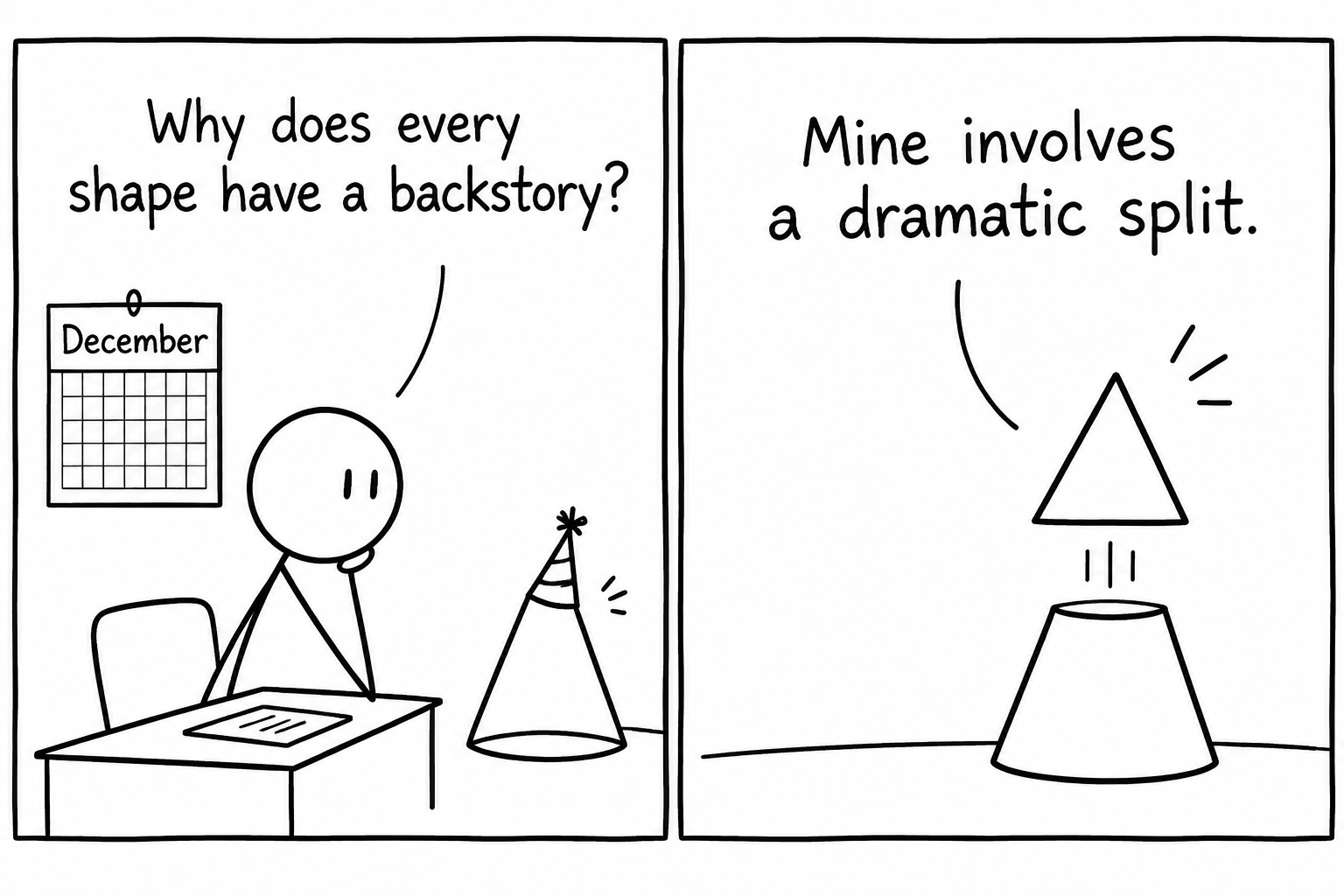 A cone describes its dramatic split to a student revising for December mocks
What is a frustum?
A frustum is the solid left when the top of a cone or pyramid is removed by a cut parallel to its base. Because the cut is parallel, the removed solid is mathematically similar to the original complete solid.
For a conical frustum, imagine rebuilding the pointed top. You now have:
- one large complete cone;
- one smaller similar cone at the top;
- the frustum between them.
This gives the central relationship:
volume of frustum=volume of large cone−volume of small cone\text{volume of frustum}=\text{volume of large cone}-\text{volume of small cone}volume of frustum=volume of large cone−volume of small coneThe volume of a cone is:
V=13πr2hV=\frac{1}{3}\pi r^2hV=31πr2hHere, rrr is the radius of the circular base and hhh is the perpendicular height. The sloping edge is not the height used in this formula.
There is a direct formula for a conical frustum, but GCSE questions are often clearer when you reconstruct the complete cone and subtract. That method also exposes the similarity reasoning for which marks may be available.
A reliable method for frustums GCSE maths questions
Use the following routine whenever you see a frustum.
Reconstruct the full solid
Extend the sloping sides until they meet at a point. Label the large cone, the small missing cone and the frustum. A quick sketch can prevent you from mixing up their dimensions.
Find any missing lengths
The small cone and the complete large cone are similar. Corresponding lengths therefore share one linear scale factor:
small radiuslarge radius=small heightlarge height\frac{\text{small radius}}{\text{large radius}} = \frac{\text{small height}}{\text{large height}}large radiussmall radius=large heightsmall heightBe careful with heights. The large cone's height equals the frustum's height plus the small cone's height.
Calculate both cone volumes
Apply V=13πr2hV=\frac{1}{3}\pi r^2hV=31πr2h separately. Write each substitution clearly so that your method can be followed.
Subtract and round once
Take the small cone's volume from the large cone's volume. Retain the calculator values during the working and round only the final answer as requested.
Exam-style question: dimensions supplied
A conical frustum is formed by removing a cone of radius 3 cm3\text{ cm}3 cm and perpendicular height 4 cm4\text{ cm}4 cm from a larger cone. The larger cone has radius 6 cm6\text{ cm}6 cm and perpendicular height 8 cm8\text{ cm}8 cm. Find the volume of the frustum.
The large cone has volume:
Vlarge=13π(6)2(8)=96πV_{\text{large}}=\frac{1}{3}\pi(6)^2(8)=96\piVlarge=31π(6)2(8)=96πThe small cone has volume:
Vsmall=13π(3)2(4)=12πV_{\text{small}}=\frac{1}{3}\pi(3)^2(4)=12\piVsmall=31π(3)2(4)=12πSubtract:
Vfrustum=96π−12π=84πV_{\text{frustum}}=96\pi-12\pi=84\piVfrustum=96π−12π=84πTherefore:
Vfrustum≈263.9 cm3V_{\text{frustum}}\approx263.9\text{ cm}^3Vfrustum≈263.9 cm3This is the cleanest type of frustum problem because all required dimensions are supplied. Even here, write two separate volume calculations. Trying to combine everything mentally makes an avoidable radius or height error more likely.
Exam-style question: use similar shapes first
A frustum has perpendicular height 6 cm6\text{ cm}6 cm. Its circular ends have radii 4 cm4\text{ cm}4 cm and 10 cm10\text{ cm}10 cm. The frustum was made by removing a small cone from a larger cone. Calculate its volume.
Let the missing small cone's height be x cmx\text{ cm}x cm. The complete large cone then has height (x+6) cm(x+6)\text{ cm}(x+6) cm.
The small and large cones are similar, so corresponding radii and heights have equal ratios:
410=xx+6\frac{4}{10}=\frac{x}{x+6}104=x+6xCross-multiply:
10x=4(x+6)10x=4(x+6)10x=4(x+6) 10x=4x+2410x=4x+2410x=4x+24 6x=246x=246x=24 x=4x=4x=4The small cone has height 4 cm4\text{ cm}4 cm, making the complete large cone's height 10 cm10\text{ cm}10 cm.
Now calculate the volumes:
Vlarge=13π(10)2(10)=1000π3V_{\text{large}}=\frac{1}{3}\pi(10)^2(10)=\frac{1000\pi}{3}Vlarge=31π(10)2(10)=31000π Vsmall=13π(4)2(4)=64π3V_{\text{small}}=\frac{1}{3}\pi(4)^2(4)=\frac{64\pi}{3}Vsmall=31π(4)2(4)=364πTherefore:
Vfrustum=1000π3−64π3=312πV_{\text{frustum}}=\frac{1000\pi}{3}-\frac{64\pi}{3}=312\piVfrustum=31000π−364π=312π Vfrustum≈980.2 cm3V_{\text{frustum}}\approx980.2\text{ cm}^3Vfrustum≈980.2 cm3The important moment was not the final subtraction. It was defining the heights correctly. The complete cone's height was x+6x+6x+6, not simply 666.
How to revise frustums before December mocks
One long session can create recognition without reliable recall. Instead, spread your frustums mock revision across several short attempts.
Start by writing the cone volume formula from memory. Next, practise identifying the two cones and matching corresponding lengths. Then complete mixed questions without notes. Finish with timed frustums exam questions, marking every line against the solution rather than checking only the final number.
A sensible sequence is:
- review the method and formula;
- complete a few focused practice questions;
- correct errors in a different colour;
- retry missed questions two days later;
- include the topic in a mixed mock paper.
This matters because the mock will not announce which fact you need next. Mixed practice trains the decision, not just the calculation. MathsGenie's free revision resources combine lessons, practice questions, mark schemes and video solutions, helping you move from guided work towards independent exam practice.
Common slips examiners see
Using the frustum height as the full cone height
If the missing cone has height xxx and the frustum has height hhh, the complete cone's height is x+hx+hx+h. Label this before building a proportion.
Matching non-corresponding lengths
Radius must be compared with radius, and height with height. Do not compare the small radius with the large height merely because those numbers are easy to see.
Using diameter as radius
If a diameter is supplied, divide it by 222 before using the cone formula. Because the radius is squared, this mistake has a large effect.
Using slant height in the volume formula
The hhh in V=13πr2hV=\frac{1}{3}\pi r^2hV=31πr2h is perpendicular to the circular base. A slant height may require Pythagoras before you can calculate the volume.
Subtracting lengths before calculating volume
You cannot usually subtract radii and heights, then put the differences into the cone formula. Calculate the two complete cone volumes and subtract those volumes.
Rounding during the working
Keep values involving π\piπ exact where possible, or retain the full calculator display. Early rounding can move an otherwise correct answer outside an accepted range.
Forgetting cubic units
Area uses square units; volume uses cubic units. If the measurements are in centimetres, the volume is in cm3\text{cm}^3cm3.
Turn the method into mock marks
A frustum question can look like a test of inspiration. In reality, it rewards a repeatable process: rebuild the cone, use similarity if necessary, calculate two volumes and subtract.
The final stage is to practise that process among other topics, where you must recognise it without a heading giving the method away. Use MathsGenie's Mock Exam Builder to build a targeted practice paper containing frustums and the related skills you need most. Complete it under timed conditions, use the mark scheme to diagnose every slip, then return to the relevant revision lesson or video solution before trying again.