

Year 12 A-Level Maths Mocks: A Revision Plan
Year 12 A-Level Maths mocks: make a focused revision plan, repair weak topics and use targeted exam practice to approach mock season with real confidence.
Mock season has a habit of arriving twice. First as a date on the sixth-form calendar, then as a sudden realisation that the date is next week.
For Year 12 A-Level Maths mocks, the best response is not to revise everything equally. Find out what your school will assess, identify the topics costing you marks, practise those topics, and then complete timed mixed questions. That cycle is more useful than repeatedly reading notes because it turns uncertainty into evidence.
Imagine a Year 12 student called Sam. The scenario is hypothetical, but the problem is familiar. Sam understands lessons when the teacher is at the board, yet struggles to begin unfamiliar questions alone. With three weeks until the mocks, the temptation is to restart the textbook from page one. A better plan starts with diagnosis.
Your Year 12 mock revision checklist
Before opening a question booklet, establish what you are preparing for:
- Ask your teacher which Year 12 pure, statistics and mechanics topics are included.
- Confirm the number of papers, their length and whether a calculator is allowed.
- Complete a short mixed assessment under timed conditions.
- Mark it carefully and record errors by topic and cause.
- Relearn weak methods using revision lessons and worked solutions.
- Practise targeted questions without notes.
- Finish with timed, mixed exam practice.
Mocks are organised by individual schools and colleges, so their content and format can differ. Your teacher's assessment list should take priority over a generic revision checklist. You can then match it to the relevant A Level Maths revision resources on MathsGenie.
Start with evidence, not anxiety
Sam's first instinct is to revise differentiation because it feels difficult. But a short diagnostic paper reveals something more specific: basic differentiation is secure, while tangent questions and mechanics modelling are not.
That distinction matters. “I am bad at differentiation” is too broad to guide revision. “I forget to substitute the point into the gradient function” can be fixed.
After marking a diagnostic paper, classify each lost mark:
- Knowledge: you could not recall a fact, formula or method.
- Application: you knew the method but did not recognise where to use it.
- Accuracy: an algebraic or arithmetic error spoiled a correct approach.
- Communication: insufficient working, missing notation or an unsupported conclusion.
- Timing: you could have solved the question with more time.
Students following Edexcel can use the Edexcel A Level Maths question bank, while AQA students can choose questions from the AQA A Level Maths question bank. Use your own exam board where possible because wording and paper structure vary between specifications.
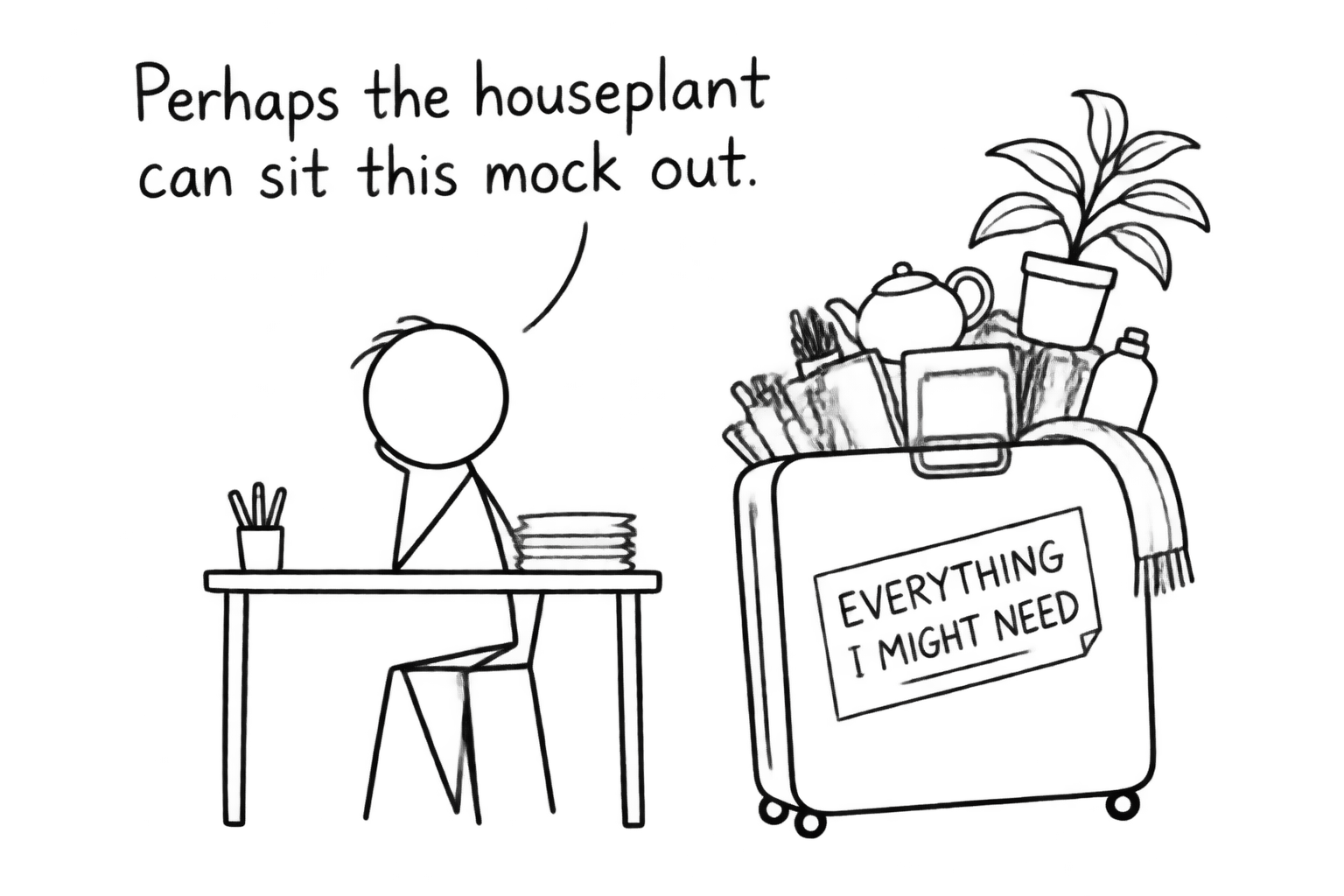 A sixth-form student decides that a houseplant may not be essential mock equipment
Turn weak topics into precise tasks
A long revision list creates the feeling of work without deciding what to do next. Sam replaces vague instructions with tasks that have a finish line.
Instead of “revise calculus”, the plan says:
- complete a differentiation revision lesson;
- answer ten tangent and normal questions;
- mark every answer;
- retry incorrect questions the following day;
- complete a mixed calculus mini test without notes.
MathsGenie's Edexcel A Level exam booklets organise exam questions by topic. If your Year 12 course follows AS content closely, the Edexcel AS Level exam booklets can also help you focus on first-year material. Check the included content against your teacher's mock list.
The principle is simple: learn briefly, practise extensively, and return to mistakes. Watching a video solution can make a method look obvious, but the real test is whether you can reproduce it later with the solution closed.
Worked example: a stationary point
Suppose Sam meets this pure maths question:
Find the coordinates and nature of the stationary point on y=x2−6x+11y=x^2-6x+11y=x2−6x+11.
Differentiate:
dydx=2x−6\frac{dy}{dx}=2x-6dxdy=2x−6At a stationary point, the gradient is zero:
2x−6=02x-6=02x−6=0Therefore:
x=3x=3x=3Substitute x=3x=3x=3 into the original function:
y=32−6(3)+11=9−18+11=2y=3^2-6(3)+11=9-18+11=2y=32−6(3)+11=9−18+11=2The stationary point is (3,2)(3,2)(3,2). Since the coefficient of x2x^2x2 is positive, the graph opens upwards, so (3,2)(3,2)(3,2) is a minimum.
Sam originally stops after finding x=3x=3x=3. The lost mark is not caused by misunderstanding differentiation. It comes from failing to complete the command “find the coordinates and nature”. The repair task is therefore to underline command words and check that every requested result appears in the final answer.
Worked example: modelling motion
Mechanics questions often become easier when the model is written before numbers are substituted.
A particle starts with velocity 4 m s−14\text{ m s}^{-1}4 m s−1 and accelerates uniformly at 3 m s−23\text{ m s}^{-2}3 m s−2 for 555 seconds. Find its displacement.
Identify the quantities:
u=4,a=3,t=5u=4,\qquad a=3,\qquad t=5u=4,a=3,t=5Use:
s=ut+12at2s=ut+\frac{1}{2}at^2s=ut+21at2Substitute:
s=4(5)+12(3)(52)s=4(5)+\frac{1}{2}(3)(5^2)s=4(5)+21(3)(52) s=20+37.5=57.5s=20+37.5=57.5s=20+37.5=57.5The displacement is 57.5 m57.5\text{ m}57.5 m.
The useful habit is not merely remembering a formula. It is identifying known quantities, selecting a relationship containing the required unknown, and retaining units. This approach also makes working easier to follow when a mark scheme awards marks for method.
Move from topic practice to mock conditions
Targeted practice repairs individual weaknesses, but a mock also tests selection, stamina and time management. Once Sam can answer weak-topic questions without support, revision changes shape.
First comes a mixed set covering several areas. Next comes a time-limited section. Finally, Sam completes a full practice paper under realistic conditions: phone away, notes closed and breaks taken only when the paper allows them.
The MathsGenie Mock Exam Builder is particularly useful at this stage because it lets you choose the topics your paper should cover. That is valuable when a school mock assesses only the content taught so far. Build one paper around weak topics, then another with a broader mixture.
If your class is studying binomial expansion, for example, the Edexcel AS binomial problems lesson provides focused revision, exam-style questions and worked solutions before you add the topic to a mixed paper.
Common A-Level maths mock mistakes
Revising only comfortable topics
Confidence can disguise repetition. If most revision time goes towards questions you already answer correctly, your marks are unlikely to move far. Keep some familiar work for fluency, but give priority to recurring errors.
Reading solutions too quickly
A worked solution should be used as feedback, not entertainment. Close it, wait, and solve the question again from the beginning. If you still need prompts, the method is not secure yet.
Ignoring statistics and mechanics
Some students allow pure maths to occupy the entire revision plan. Check your school's assessment coverage and reserve deliberate sessions for every included strand.
Completing papers without analysing them
A score tells you what happened. Error analysis tells you what to do tomorrow. Record the topic, the cause of each lost mark and the next practice task.
Spending too long on one question
During timed practice, learn to leave space and return later. A difficult question should not consume time that could secure several more accessible marks elsewhere.
A calmer final week
By the final week, Sam is no longer trying to “finish maths”. The task is smaller and clearer: retry six recorded errors, complete one mixed paper, review the mark scheme, and refresh essential methods.
That is the quiet advantage of structured A-Level maths revision. Confidence does not need to come from hoping the paper suits you. It can come from seeing evidence that yesterday's errors are answerable today.
Start with your teacher's topic list, use MathsGenie's revision lessons, practice questions, exam booklets, mark schemes and video solutions, then build a targeted practice paper in the Mock Exam Builder. Your mock is not a verdict on your ability. It is a useful snapshot, and every well-chosen question gives you a chance to change what the next snapshot shows.















