

Year 10 Maths Mocks: What to Expect
Year 10 maths mocks: what to expect, how to prepare for each paper, avoid common mistakes and turn teacher feedback into a focused GCSE maths revision plan.
A mock timetable can make ordinary lessons feel like a countdown. If you are wondering about Year 10 maths mocks and what to expect, you will usually sit timed papers covering GCSE content taught so far. Your school decides the dates, topics, length and format.
The result helps teachers identify what you understand and where you need support. It captures one performance at an early stage of the course. Its greatest value is the information it gives you for your next revision session.
Your Year 10 maths mock checklist
Before planning revision, ask your teacher:
- Which exam board and tier are we following?
- Which topics will be assessed?
- How many papers will there be, and how long will they last?
- Which papers allow a calculator?
- What equipment should I bring?
- Will the results inform teaching groups or tier discussions?
Schools organise their own mocks, so your assessment may differ from the complete summer GCSE series. Getting these details first prevents wasted revision.
What the papers may look like
Your mock may use past-paper questions, questions selected by teachers or a paper designed for your school. Expect short questions, longer problems and opportunities to explain your reasoning.
For reference, AQA and Pearson Edexcel GCSE Mathematics each use three written papers: one non-calculator paper and two calculator papers. Each lasts 111 hour 303030 minutes. Your Year 10 mock may use only part of that structure.
Use the GCSE Maths revision hub alongside your teacher’s topic list. If you follow Edexcel, the Edexcel GCSE Maths past papers show how exam questions are phrased. Avoid assuming that every question in a full paper belongs on your revision list.
What mocks reveal about your maths
Knowing a method in class and choosing it independently are different skills. You might recognise a percentage calculation when the topic is announced, then hesitate when it appears inside a longer problem.
Mocks reveal these gaps, alongside recall, accuracy, timing and communication. That explains why reading notes alone can feel reassuring without showing whether you can answer questions independently.
Use the free MathsGenie revision resources for a practical cycle: review a lesson, answer questions without notes, mark them and record what went wrong. Return to the skill later to check whether it has stayed with you.
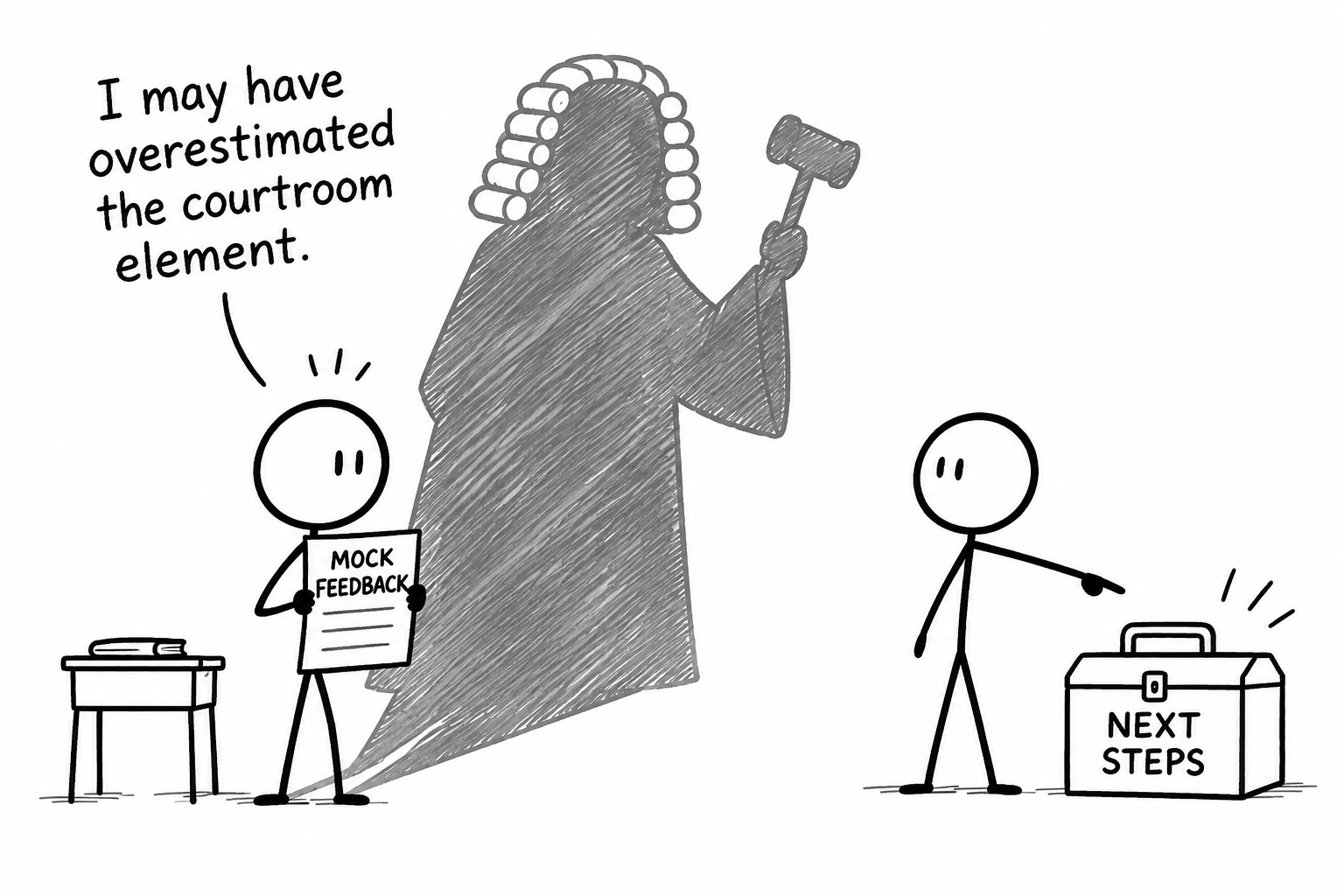 A student discovers that mock feedback is a toolbox rather than a courtroom verdict
Revise without trying to do everything
An enormous topic list can make revision harder to begin. Sort your teacher’s list into three groups:
- Secure: you answer questions accurately without help.
- Developing: you understand the method but need reminders or make mistakes.
- Priority: you cannot yet start typical questions independently.
Give developing and priority topics most of your attention. Keep secure topics fresh with occasional mixed questions, while avoiding the temptation to repeat comfortable work throughout every session.
The MathsGenie revision planner can help organise manageable sessions around your deadline. Include time for reviewing errors as well as answering questions.
When you are ready to combine topics, use the MathsGenie Mock Exam Builder for targeted practice. Match your choices to the content your teacher has confirmed, then attempt the paper under timed conditions. A focused assessment can be more useful than repeatedly tackling material you have not yet learnt.
In the exam room
Read each question carefully before calculating. Notice instructions such as show, explain, estimate and prove. Check the units and any required answer form.
Write clear working on questions worth several marks. Correct intermediate steps may earn method marks even if your final answer is wrong. If you become stuck, attempt a sensible first step and return later. Protect time for questions you can answer.
On calculator papers, enter calculations carefully and check that the result is reasonable. On non-calculator papers, keep arithmetic organised so you can inspect it afterwards.
Reserve time to revisit skipped questions, rounding instructions and copied values. Checking works best when you know what you are looking for.
Turn feedback into a revision plan
When your paper comes back, look beyond the grade. Classify lost marks by their cause:
- Knowledge: you did not know the method.
- Recall: you had learnt it but could not remember it.
- Application: you did not recognise which method to use.
- Accuracy: arithmetic, algebra or calculator work went wrong.
- Exam technique: you misread instructions, omitted working or ran short of time.
Each cause suggests a different response. Knowledge gaps need teaching; recall gaps need retrieval practice. Application improves through varied questions, while accuracy and timing need deliberate checking and timed practice.
Compare your working with teacher feedback and mark schemes. Use video solutions to understand a missing step, then close the solution and try again independently. Choose a small set of priorities before planning your next week.
Common mock exam mistakes
Revising only favourite topics. Use classwork, mini tests and teacher feedback to find weaknesses that deserve attention.
Finishing papers without reviewing them. Mark your answers and redo missed questions. Otherwise, the same errors can survive into your next attempt.
Memorising solutions. Ask why each step works so you can adapt when the wording changes.
Treating one grade as permanent. A mock reflects the content assessed and your performance that day. It does not set a ceiling on your GCSE grade.
Preparing equipment at the last minute. Check pens, pencils, ruler, protractor, compasses and calculator beforehand, following your school’s instructions.
Make the mock useful
A useful mock replaces vague worry with specific tasks. You know which methods need attention, which errors recur and what to practise next.
Start with your weakest assessed topic, review the relevant MathsGenie lesson and complete questions independently. Then return to the Mock Exam Builder for focused practice. Sit the paper, mark it carefully and let the feedback guide your next session. That is how a mock becomes a practical step towards stronger GCSE maths.















