Will Times Tables Checks and SATs Change Too?
Will times tables checks and SATs change too? Read the November 2026 answer on primary tests, GCSE reform timelines and what parents should do now.

Last updated: 3 November 2026
No, times tables checks and SATs are not being abolished. The Year 4 multiplication tables check and national tests at the end of Key Stage 2 will remain, although aspects of primary assessment may be refined as England introduces its revised national curriculum.
That is the definitive answer to the parent asking, “Will times tables checks and SATs change too?” The nuance is that keeping an assessment does not mean freezing every question, access arrangement or test framework forever. The Department for Education (DfE) has chosen continuity, followed by phased updates where necessary.
For parents of current GCSE Maths students, the most important point is simpler: primary assessment reform does not alter the specification your teenager is learning now. They should continue preparing for their existing exam board and tier.
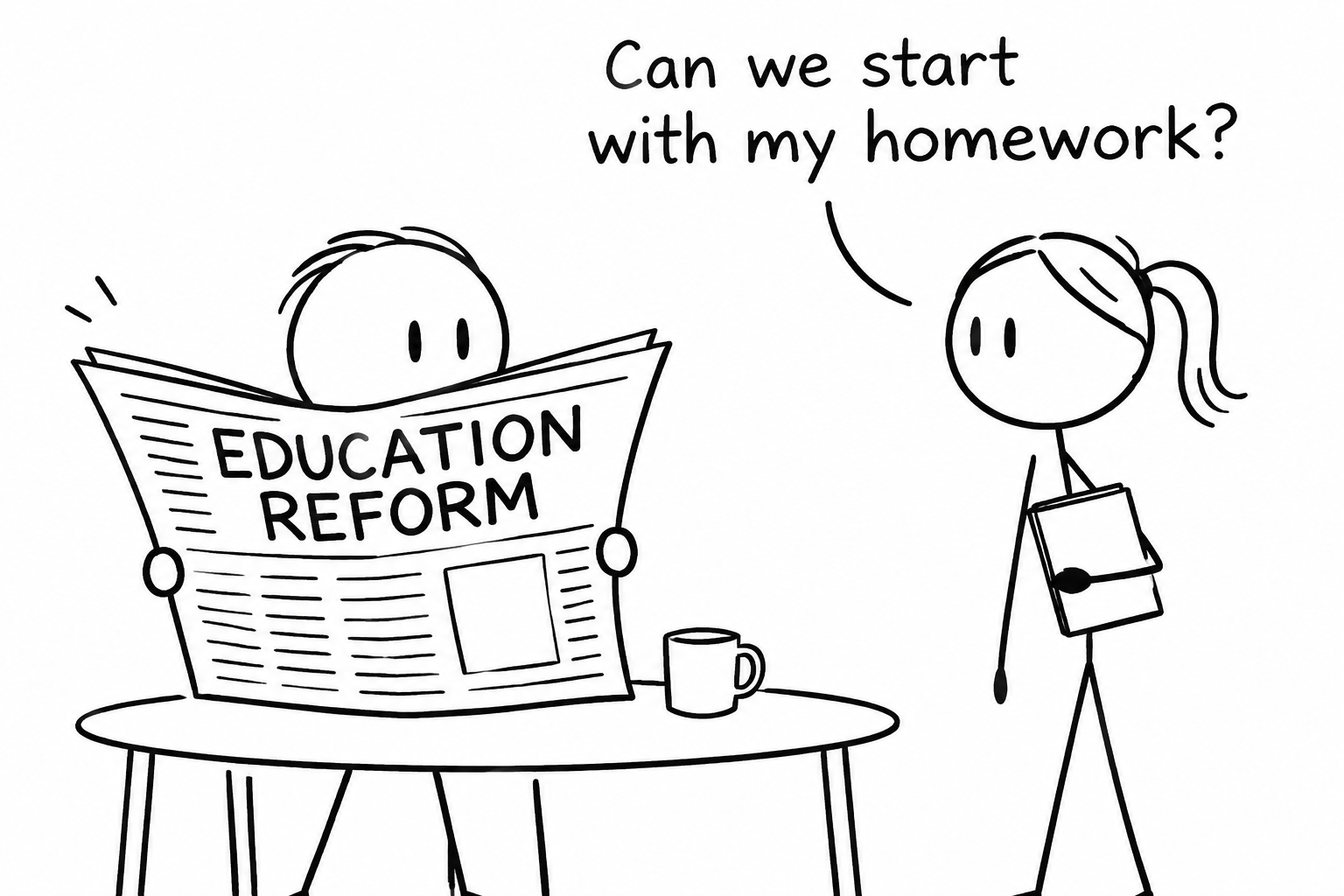 A parent reads an enormous education reform newspaper while a student suggests starting with today's homework
The answer at a glance
Here is the position in England as of November 2026:
- The Year 4 multiplication tables check is being retained.
- Its timed character is being retained because the check is intended to measure fluent recall.
- The DfE and Standards and Testing Agency are considering whether access arrangements can be improved for some pupils with special educational needs and disabilities.
- Key Stage 2 national assessments, commonly called SATs, will continue.
- Primary assessments may be updated in phases to reflect the revised national curriculum.
- The final revised curriculum is expected to be published in spring 2027, with first teaching from September 2028.
- Reformed GCSEs are planned for first teaching in phases from 2029 and 2030.
- Pupils already taking GCSE Maths should keep learning the current specification unless their school or exam board gives formal notice otherwise.
These statements reflect the Curriculum and Assessment Review final report, the government’s November 2025 response, subsequent DfE assessment guidance and Ofqual’s work on current and future GCSE arrangements. They apply to England; assessment systems elsewhere in the UK are governed separately.
What is happening to the times tables check?
The Curriculum and Assessment Review concluded that the multiplication tables check was broadly working well. The government accepted the case for retaining it.
The timed element matters because the assessment is designed to check fluent recall, rather than whether a pupil can eventually calculate an answer using repeated addition or another strategy. Fluency is not the whole of mathematics, but it reduces the mental effort needed for later work.
A pupil who can recall multiplication facts securely has more attention available for fractions, ratio, factorisation and algebra. For example, recognising the common factors of 181818 and 242424 is easier when multiplication facts are readily available:
18=2×32 18 = 2 \times 3^2 18=2×32 24=23×3 24 = 2^3 \times 3 24=23×3This is why times tables remain relevant long after Year 4. They are part of the foundation beneath secondary maths, not merely a primary-school hurdle.
The likely area of refinement is accessibility. The Review recommended exploring whether arrangements could work better for pupils whose special educational needs or disabilities make the check less accessible. That is not the same as removing timing for every pupil. Parents should rely on their child’s school for individual arrangements rather than assuming that a national recommendation automatically creates a particular adjustment.
Will SATs change as part of the curriculum review?
Key Stage 2 assessments will remain, but future versions may be aligned with the revised curriculum. The government has said that changes should be phased so pupils have enough time to learn the new content before being assessed on it.
This distinction matters. There are three separate stages:
- publishing a revised curriculum;
- schools beginning to teach it;
- assessments changing to reflect it.
Those stages do not happen simultaneously. The planned first-teaching date for the revised national curriculum is September 2028, and the DfE has indicated that Key Stage 2 assessment changes will be phased. Until updated frameworks and dates are formally published, schools continue to follow the applicable current assessment arrangements.
The Review recommended replacing the existing grammar, punctuation and spelling test with an assessment focused more strongly on composition and applying grammar and punctuation. The government response did not turn that recommendation into an immediate classroom change. It asked the Standards and Testing Agency to review the assessment, so parents should wait for confirmed test frameworks rather than treating a recommendation as an implemented rule.
A practical plan for parents of GCSE Maths students
News about GCSE reform can make every part of the education system sound as if it is moving at once. It is not. A parent can separate the headlines from the action by following four checks.
Check the student’s cohort
Ask when your child is due to begin and complete GCSE Maths. The government intends updated GCSEs to begin teaching in phases from 2029 and 2030. Therefore, most students already in Key Stage 4 in November 2026 are working towards the current qualifications.
Confirm the exam board and tier
Find out whether the school uses Edexcel, AQA, OCR or Eduqas, and whether the student is currently entered for foundation or higher tier. The GCSE Maths revision area lets families select the relevant exam board rather than revising from a vague national list.
The GCSE Maths topics by exam board and tier guide also helps parents see why a revision list should match both the specification and the student’s tier.
Keep foundational number skills active
A GCSE student does not need to repeat a Year 4 check, but weak multiplication recall can still slow down fractions, percentages and algebra. Suitable starting points include the Multiplication and Division lesson videos, the Factors and Multiples revision guide and the Fractions lesson.
Follow confirmed specifications, not predictions
The DfE sets subject content, while Ofqual regulates qualifications and assessment arrangements in England. Exam boards then publish specifications and supporting materials. A proposed reform, consultation or newspaper headline is not a new specification.
If organising all of that feels unnecessarily complicated, start with Maths Genie’s current GCSE Maths lessons and select the exam board your child is actually following.
How GCSE maths changes fit into the wider picture
The government’s approach to GCSE reform is evolutionary rather than a sudden replacement of the whole system. Its response to the Curriculum and Assessment Review retained subjects, key stages and major national assessments while proposing targeted changes.
Ofqual has also consulted on maintaining formula support for the lifetime of current GCSE Maths specifications. That work is separate from the design of future reformed qualifications. It illustrates an important principle for parents: current assessment decisions and long-term GCSE reform can run alongside one another.
For a student preparing now, the useful questions remain familiar:
- Which topics are on the current specification?
- Which skills are weakest?
- Can the student answer exam-style questions without guidance?
- Can they identify where marks were lost?
GCSE reform may change future content or assessment design, but it does not make present-day practice less valuable. Secure arithmetic, proportional reasoning, algebra and problem-solving will remain central mathematical capabilities.
Common mistakes parents should avoid
Assuming every announced change starts immediately
A review makes recommendations. Government decides which recommendations to accept. The DfE then develops curriculum content, while Ofqual and exam boards complete the qualification and assessment process. Each stage has its own timetable.
Treating SATs and GCSE reform as one policy
They belong to the same broad curriculum review, but they affect different ages and assessment systems. Primary tests can be retained or refined without changing a current GCSE paper.
Moving a student onto speculative material
Current GCSE students should revise their confirmed specification. Switching to unofficial lists of possible future content risks taking time away from topics that will actually be examined.
Dismissing times tables as irrelevant to teenagers
Multiplication recall supports factor work, fraction arithmetic, ratio, percentages and algebra. If the foundations are slow, harder questions consume more working memory than they need to.
Keep today’s revision anchored to today’s course
Parents want to prepare their children for change, but preparation does not mean chasing every possible future rule. It means identifying the qualification in front of the student and helping them practise its content consistently.
You now know where primary assessment and GCSE reform diverge. The remaining gap is turning that clarity into focused weekly revision before fixed exam dates arrive. Start with Maths Genie Lessons for the current specification.