

Will the Post-16 Resit Rule Change? 2026 Update
Will the post-16 resit rule change? The November 2026 position for parents, including current requirements, planned reforms and what students should do.

Last updated: 3 November 2026. This article covers the rules in England. Education policy differs across the UK.
No, the post-16 GCSE maths resit requirement has not been abolished. If your child is entering post-16 education without at least a grade 444 in GCSE Maths, they must normally continue studying maths as part of their programme. However, the route may change for some students: the government plans new Level 1 qualifications to prepare those with a grade 222 or below for a later GCSE resit.
That is the straight answer a parent needs. The nuance is that three different stories are unfolding at once: the present funding rule, proposed post-16 pathways, and wider GCSE reform. Headlines often fold them into one story, making a change of route sound like the end of resits.
The position at a glance
For the 2026-27 academic year:
- the maths and English condition of funding remains in force in England;
- students without a GCSE grade 444 or above must normally continue studying the relevant subject;
- full-time students with a grade 333 in GCSE Maths are expected to study GCSE Maths;
- approved alternatives may be available in particular circumstances, including for lower prior attainment;
- the government intends to introduce new Level 1 preparation-for-GCSE qualifications for students with a grade 222 or below;
- that proposal changes the pathway towards a resit, not the importance of reaching GCSE standard;
- wider GCSE changes are planned, but they do not remove the need to prepare for the current specification now.
This matters because the rule is technically a condition attached to institutional funding. Parents often hear it described as a law forcing every individual teenager to resit. The practical effect is similar for many families, but the more accurate explanation is that schools and colleges must meet Department for Education funding conditions when constructing study programmes.
Why the answer feels harder than it should
Imagine a parent opening three tabs after results day. One reports new GCSE maths changes. Another discusses a new post-16 qualification. A third says that teenagers must continue maths until they achieve a standard pass.
All three can be true.
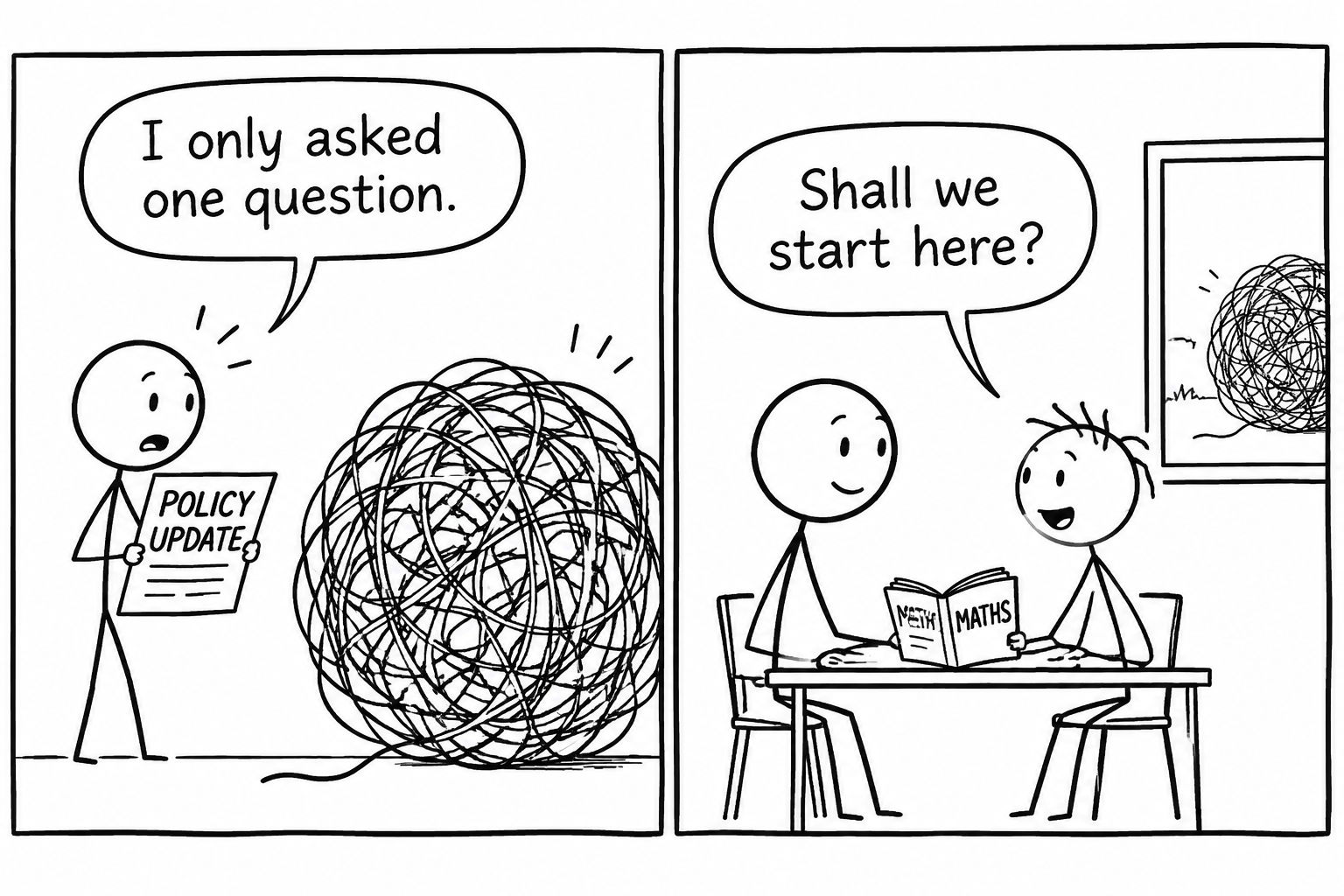 A parent discovers that one education policy question comes with a tangle of updates
The Department for Education's current condition-of-funding guidance answers what providers must do now. The Curriculum and Assessment Review considered what should improve over time. The government's response and post-16 white paper set out the intended direction. Ofqual, meanwhile, regulates qualifications and assessment arrangements rather than deciding the funding policy.
A proposal, a consultation and an implemented rule are not interchangeable. That distinction is the best defence against an alarming headline.
Will the post-16 resit rule change for different grades?
The clearest announced distinction is between students who achieved grade 333 and those who achieved grade 222 or below.
A student with grade 333
Under the 2026-27 condition of funding, a full-time student with grade 333 is generally expected to study GCSE Maths. The policy treats that student as close enough to grade 444 for another GCSE attempt to be the appropriate route.
Parents should therefore plan on the basis that a grade 333 will lead to continued GCSE Maths study and a further exam opportunity, unless the provider confirms that an exception applies.
A student with grade 222 or below
The government has recognised that repeatedly putting a lower-attaining student straight back through the same qualification may not build the foundations they need. Its post-16 white paper announced new Level 1 English and maths qualifications intended to prepare students with grade 222 or below before a later GCSE resit.
A Department for Education consultation on those qualifications followed in 2026. Consultation means details can still be refined. It does not mean a parent should assume that a new qualification is already available at every college.
The direction is nevertheless clear: a more staged path for lower prior attainment, followed by progression towards GCSE, rather than the abandonment of the grade 444 goal.
What GCSE reform does and does not mean
The phrase new GCSE maths can refer to two separate developments.
First, Ofqual has considered assessment arrangements for the lifetime of current GCSE specifications, including formula sheets from 2028 and arrangements for November exams and later resit opportunities. This is about how the current qualification is assessed.
Second, the government's response to the Curriculum and Assessment Review committed to updating GCSEs, with first teaching of reformed qualifications intended from 2029 onwards. The detailed content and assessment arrangements require further development.
Neither development means that a Year 11 student should stop learning the present course. A qualification can be scheduled for future reform while the existing specification remains the qualification being taught and examined.
For a family making decisions today, the sensible rule is simple: revise the specification your child's school or college has confirmed, not a future syllabus that has not yet replaced it.
Once the current route is confirmed, start the appropriate Maths Genie GCSE Lessons rather than waiting for future reforms to settle.
A practical plan for parents
Policy uncertainty can consume attention without improving the next result. A better approach is to separate the questions that require an official answer from the work your child can begin now.
Ask the provider four questions
Contact the school or college and ask:
- Which maths qualification will my child study in 2026-27?
- Is that decision based on their GCSE grade, programme hours or another circumstance?
- When is the intended examination entry?
- Which exam board and tier will they follow?
Ask for the qualification title, not simply whether there will be “maths”. Functional Skills, a future Level 1 preparation qualification and GCSE Maths are different routes.
Keep the result and exam information together
Retain the results statement and note the exam board and tier. A foundation-tier grade 333 and a higher-tier grade 333 produce the same reported grade, but a teacher may use the paper evidence to identify very different gaps.
Begin with diagnosis, not another complete course
A resit student rarely needs every topic explained from the beginning. They need to find where marks are being lost, rebuild those areas and practise retrieving the method without help.
A manageable weekly cycle is:
- choose one weak topic;
- complete a short lesson;
- answer questions without looking at the explanation;
- check errors carefully;
- return to the topic several days later.
Maths Genie organises GCSE Maths revision resources by exam board and provides routes into the current course. Families following Edexcel can use the Edexcel GCSE Maths lessons, while the broader Maths Genie Lessons guide explains the bite-sized lesson format.
Common mistakes parents can avoid
Treating an announcement as an immediate rule change
A review recommendation signals direction. A government response indicates policy intent. A consultation tests detail. Published funding guidance tells providers what applies for a particular academic year. Check the status and date before acting.
Assuming a new pathway means no eventual GCSE resit
The planned Level 1 route is described as preparation for GCSE. It is designed to strengthen foundations before a later resit, not to erase the destination.
Waiting for certainty before revising
The current specification still governs present teaching and exams. Number, ratio, algebra, geometry, probability and statistics will not become wasted learning because policy develops.
Focusing only on the grade boundary
A grade 444 is the policy threshold, but productive revision begins with topic-level evidence. “Three more marks” is not a revision instruction. “Practise rearranging formulae and interpreting cumulative frequency graphs” is.
What parents should believe now
The post-16 resit rule is evolving, but it is not disappearing. Grade 333 students should still expect GCSE Maths study. Students with grade 222 or below may increasingly receive a preparatory Level 1 route before GCSE, subject to final policy and implementation details. Wider GCSE reform is later and does not replace the current specification for students taking it now.
The calm response is to check the provider's confirmed route, record the exam board and start repairing specific gaps. Policy may determine the qualification pathway. Consistent practice still determines how confidently a student can meet it.
Start the current specification now
You now know the difference between today's resit requirement, the proposed Level 1 pathway and future GCSE reform. The remaining gap is turning that clarity into regular work on the specification your child is actually following. Start Maths Genie GCSE Lessons for the current specification.















