

Will GCSE Maths Include Financial Literacy?
Will GCSE maths include financial literacy? Read the November 2026 answer on current exams, planned reforms and what parents should prioritise now.
Last updated: 3 November 2026
Yes, financial education will be strengthened in England's revised curriculum, including mathematical ideas such as interest. But if you are asking will GCSE maths include financial literacy as a new, standalone section, that is not yet confirmed. Detailed content for the reformed GCSE Maths qualification has not been published.
For parents, the immediate priority is clearer: pupils taking the current GCSE already need financial maths skills. They should continue revising their present specification until their school confirms a change. A reform headline does not change what your child needs to practise tonight.
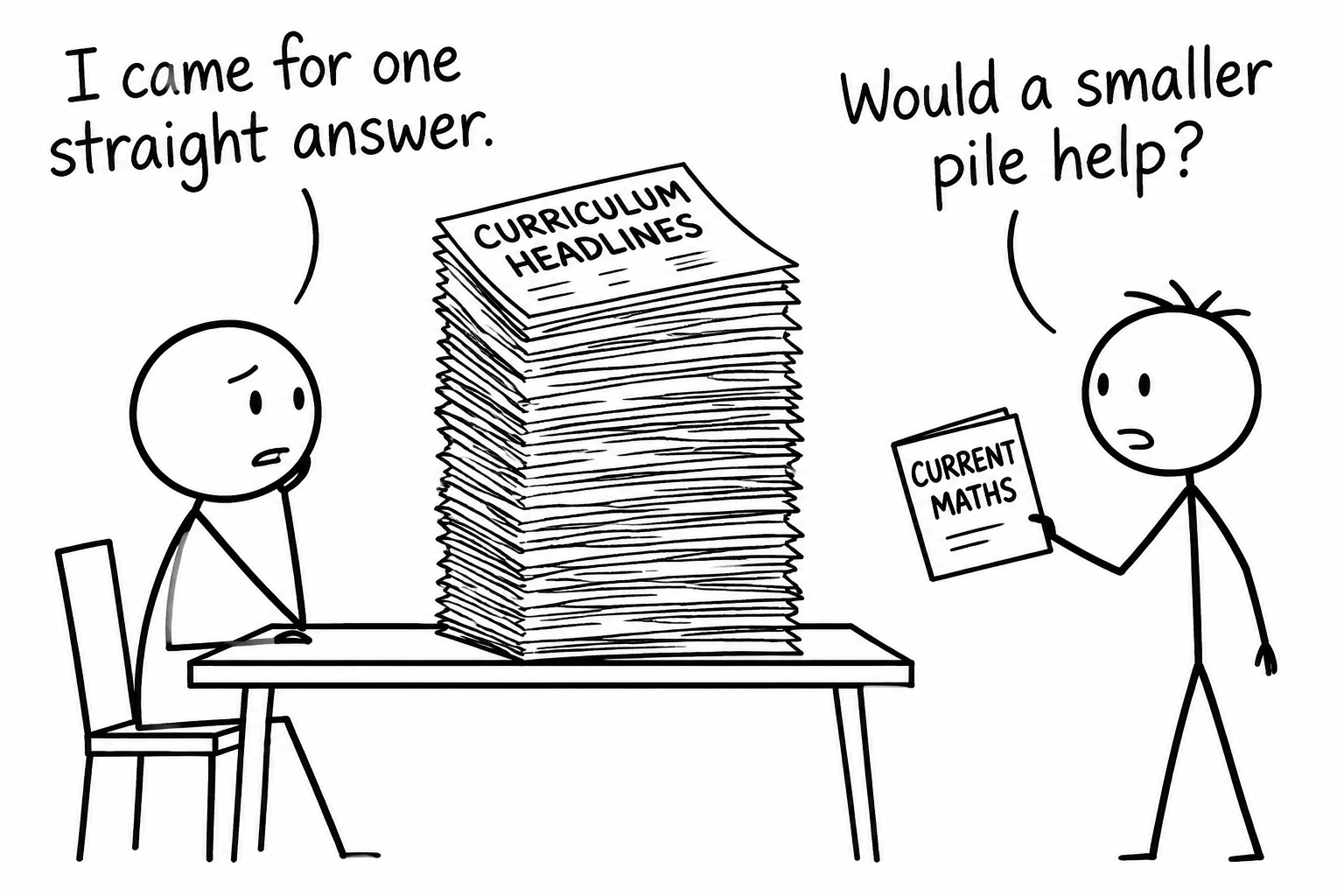 A parent searching through curriculum headlines while a student holds the current maths specification
The answer at a glance
For parents in England, the position in November 2026 is:
- Financial education already appears in maths and citizenship.
- Current GCSE Maths includes percentages, interest, growth and decay, and financial contexts.
- The government has accepted recommendations to strengthen financial education.
- The revised national curriculum is planned for first teaching from September 2028.
- Reformed GCSEs are intended to begin first teaching in phases during 2029 and 2030.
- A separate financial literacy unit or paper has not been confirmed.
These plans concern England. Other UK nations have different curriculum and qualification arrangements.
What financial maths is already in GCSE Maths?
Financial literacy can sound like an entirely new addition. However, current GCSE Mathematics subject content already includes percentages and compound interest. The key stage 4 programme of study also refers to simple interest and applying mathematics in financial contexts.
Depending on the question and specification, pupils may encounter depreciation, exchange rates, best buys, unit pricing and financial information presented in tables or graphs.
The compound-interest model is:
A=P(1+r100)nA=P\left(1+\frac{r}{100}\right)^nA=P(1+100r)nHere, PPP is the original amount, rrr is the percentage rate per period, nnn is the number of periods and AAA is the final amount.
Understanding that model is useful, but broader financial literacy also involves decisions about products, risks and consumer protection. Knowing how to calculate interest does not automatically mean knowing which account suits someone's circumstances.
What the curriculum review recommended
The Curriculum and Assessment Review final report, published in November 2025, recommended a more secure grounding in financial literacy through clearer sequencing across subjects.
The government's response accepted this direction. Mathematical concepts, such as calculating interest, should first be introduced in maths. Citizenship can then explore wider applications, financial products and digital risks, including fraud and scams.
This distinction helps explain the planned changes: maths develops the calculation and reasoning; other curriculum areas develop wider financial understanding. Neither announcement, by itself, establishes the final content or format of future GCSE Maths papers. Detailed subject content and exam-board specifications must follow before reliable predictions are possible.
When could the new GCSE Maths begin?
The published timetable separates curriculum reform from qualification reform. The revised national curriculum is intended to be published by spring 2027 and taught from September 2028. Updated GCSEs are expected to begin first teaching in phases during 2029 and 2030.
Ofqual has also referred to these first-teaching years. However, parents should not assume which phase will include GCSE Maths until it is confirmed.
First teaching also differs from first examination: pupils normally complete a teaching period before sitting the qualification's full exam series.
For pupils already taking GCSE Maths, the practical rule remains unchanged: follow the specification named by the school, whether the board is Edexcel, AQA, OCR or Eduqas.
What parents should prioritise now
Confirm the specification and tier
Ask the school which exam board and specification your child follows, and whether they are preparing for foundation or higher tier. Use that information to choose revision resources.
Reform headlines cannot replace this detail. Current exam questions and mark schemes assess the qualification being taught.
Strengthen the financial maths foundations
Financial questions often place familiar mathematics inside unfamiliar wording. A pupil may calculate percentages confidently but hesitate when the same calculation appears in an investment or shopping comparison.
Prioritise these skills:
- Converting between fractions, decimals and percentages.
- Finding percentages of amounts and calculating percentage change.
- Using multipliers for repeated growth and decay.
- Comparing rates and unit costs.
- Reading questions carefully and stating suitable units.
MathsGenie's AQA percentages lessons support the core methods, while its AQA best-buy lessons develop practical comparisons. For repeated percentage change, use the Edexcel compound interest and depreciation lesson.
Choose the relevant Edexcel GCSE Maths lessons or AQA GCSE Maths lessons to organise revision around identified gaps.
Connect revision with everyday decisions
Conversations about budgeting, borrowing, payslips, tax, pensions and scams can complement exam preparation. Ask which calculation would help with a decision, then discuss what information the calculation leaves out.
For revision, follow a lesson with practice questions, check the working against the mark scheme and revisit errors later. This reveals whether the pupil understands the method independently.
Common mistakes parents should avoid
Assuming there will be a separate paper. No separate financial literacy paper within GCSE Maths has been confirmed.
Waiting for reform before revising money topics. Percentages, interest and financial problem-solving already matter in the present specification.
Treating an announcement as a finished specification. The Department for Education sets subject content, Ofqual regulates qualifications and assessment, and exam boards develop specifications within those requirements.
Teaching only calculator steps. Pupils also need to choose a method, show working and interpret their answer. Ask them to explain why their calculation fits the question.
Keep revision focused on the current qualification
Parents want children prepared for adult life as well as exams. Secure percentages, proportional reasoning and interest calculations support both aims.
Start with your child's current specification, identify one weak financial maths topic and use the relevant MathsGenie lesson. Then practise independently and check mistakes. That gives today's revision a clear purpose while the details of future reform take shape.















