

Will GCSE Maths Get Harder? A 2026 Parent Guide
Will GCSE maths get harder? Read the clear 2026 answer for parents, including confirmed reforms, exam standards and what students should revise now.
Last updated: November 2026. This article will be reviewed annually against Department for Education, Ofqual and Curriculum and Assessment Review publications.
No, GCSE Maths is not about to become harder for students taking the current qualification. They should continue preparing for the specification taught by their school.
That is the straight answer a parent needs when searching will GCSE maths get harder. The more nuanced answer is that reforms are planned in England, with updated GCSEs expected to be taught from 2029 onwards. However, reform does not automatically mean a harder examination, and the detailed content and assessment arrangements for a revised GCSE Maths qualification have not yet been finalised.
Imagine a parent opening one browser tab to check homework and ending up with six tabs about curriculum reform. One headline says examinations will change. Another mentions stronger mathematical foundations. A third talks about reducing assessment time. It is easy to turn separate announcements into one alarming conclusion: GCSE Maths must be getting harder.
It is more useful to separate what is confirmed from what remains undecided.
The answer at a glance
For a parent deciding what to do now, the position is:
- Students currently following GCSE Maths should revise the present specification.
- The current qualification still has foundation and higher tiers and grades 9 to 1.
- Ofqual regulates qualification standards and uses statistical and examiner evidence when awarding grades.
- The 2025 Curriculum and Assessment Review recommended changes to curriculum sequencing and assessment across England.
- The government intends updated GCSEs to be taught from 2029 onwards, following further development and consultation.
- There is not yet a final revised GCSE Maths specification that parents need to prepare for independently.
The practical conclusion is reassuring. Your child will gain more from mastering current topics than from trying to predict an unfinished future qualification.
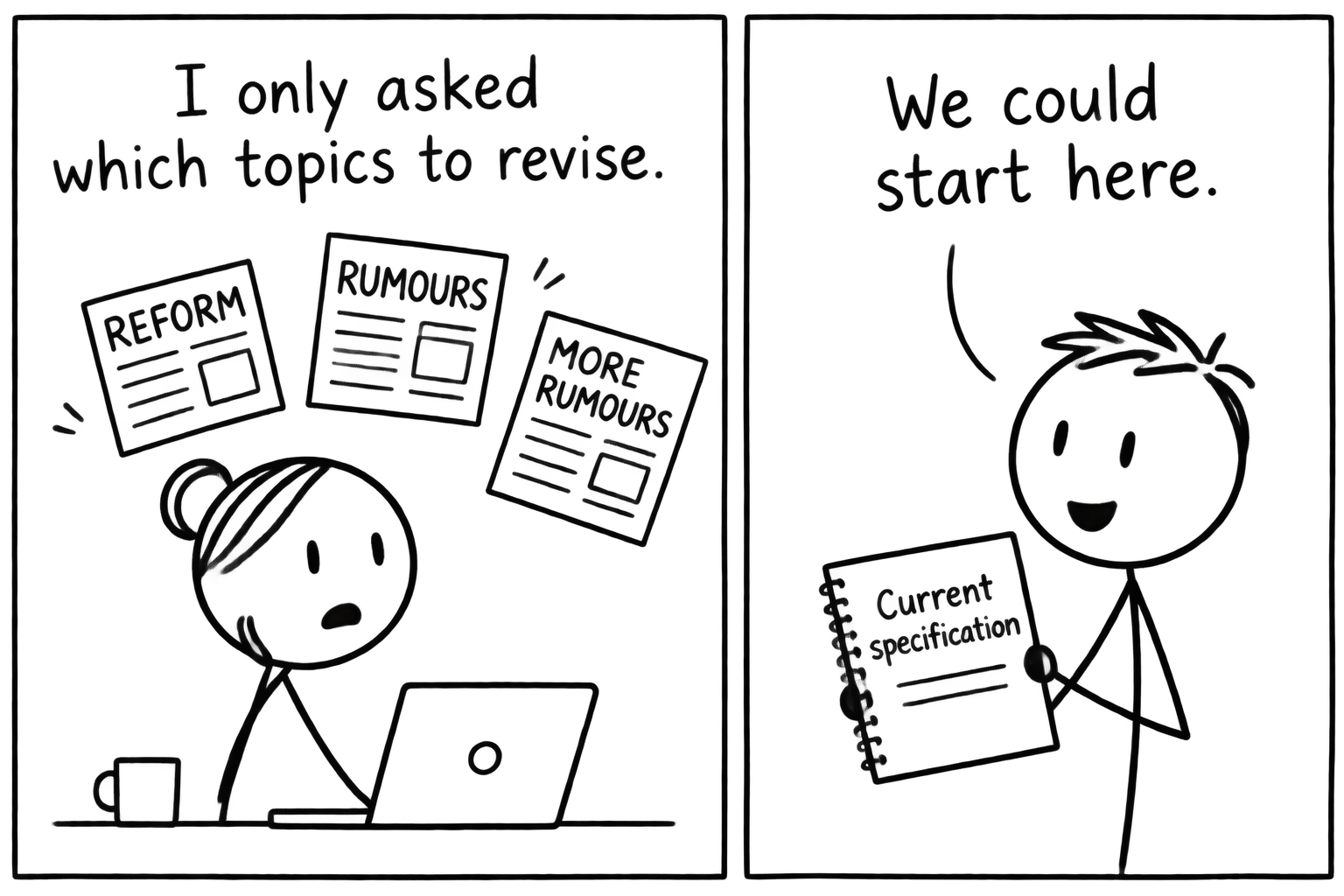 A parent navigates GCSE reform rumours while a student points to the current specification
Why GCSE Maths can feel as though it is getting harder
There are three different ideas that often become mixed together.
The examination paper can feel difficult
An individual paper may contain unfamiliar contexts, multi-step problems or demanding final questions. Difficulty also feels personal. A student who is comfortable with algebra may find a geometry-heavy paper harder than a classmate does.
That does not necessarily mean the qualification standard has risen. Grade boundaries are set after papers have been taken, using examiner judgement and statistical evidence. If a paper proves more demanding overall, the raw mark required for a particular grade may be lower. Parents can see how this varies between examination series through the GCSE grade boundaries guide.
Boundaries are not designed to guarantee an individual student the same grade each year. They help awarding organisations maintain comparable standards while accounting for differences between papers and cohorts.
The present GCSE was itself a substantial reform
The current grades 9 to 1 GCSE Maths qualification was introduced for first teaching in England in 2015, with the first examinations in 2017. It included more demanding content than its predecessor and placed greater emphasis on problem-solving and mathematical reasoning.
That history still shapes the language parents hear. A teacher saying that the “new GCSE” is harder may be referring to the reform introduced more than a decade ago, not to a further immediate change.
Current students can find lessons arranged around the qualification on the Maths Genie GCSE Maths revision page. That is the specification they need to learn unless their school tells them otherwise.
Future reform is being discussed
The Curriculum and Assessment Review published its final report in November 2025. It examined curriculum content, sequencing, inclusion and the volume of assessment. Its direction was not simply to make subjects harder. It sought a clearer, more coherent curriculum while maintaining high expectations.
The government subsequently set out plans for curriculum changes and updated GCSEs. Current plans indicate that revised GCSEs will be introduced for first teaching from 2029 onwards. Before a new GCSE Maths qualification reaches classrooms, subject content and assessment arrangements must be developed, consulted upon and translated into exam-board specifications.
That process matters. Until it is complete, claims about particular topics, paper lengths or grade boundaries should be treated as speculation.
Which students could be affected by GCSE maths changes?
A simple cohort check gives parents more clarity than a dramatic headline.
| Your child’s position in November 2026 | What to focus on |
|---|---|
| Already studying GCSE Maths | The current specification and their school’s chosen exam board |
| Taking GCSE examinations before revised qualifications begin | The current specification |
| In an earlier secondary year and potentially beginning GCSE courses from 2029 | Watch for confirmed information from the school and government |
| Still at primary school | Build secure foundations rather than trying to anticipate an examination specification |
Schools sometimes begin GCSE content before Year 10, so parents should use the school’s course information rather than assuming a national starting date. The key date is when a student begins studying a particular qualification, not simply the year in which reform is announced.
A practical plan for parents now
The best response to uncertainty is not more speculation. It is a short, repeatable check.
Confirm the qualification
Ask the school which exam board and tier your child is following. Edexcel, AQA, OCR and Eduqas specifications overlap substantially, but paper structures and wording can differ. Tier decisions may also change during the course, so treat the school’s current guidance as authoritative.
Identify actual gaps
Look at recent assessments and separate lost marks into three groups:
- knowledge that has not been learned securely;
- a method that the student knew but could not apply;
- avoidable errors involving arithmetic, notation or interpretation.
This is more informative than describing the whole subject as “hard”. A weak score may come from two or three connected gaps rather than a lack of general ability.
Practise at the correct level
Use questions that match the student’s current tier and topics. Edexcel foundation past papers and Edexcel higher past papers can show how knowledge is assessed across a complete paper. Students should also compare their work with mark schemes and video solutions, paying attention to method marks rather than only the final answer.
Predicted papers can provide extra timed practice near an examination series, but they cannot predict exact questions. The Maths Genie predicted papers should therefore complement topic revision, not replace it.
Once you have identified the gaps, use the Maths Genie GCSE Maths lessons for the current specification to turn each weak area into a specific lesson rather than planning around reform rumours.
Review progress calmly
A useful weekly conversation is short: Which topic improved? Which question type still causes trouble? What is the next lesson?
This keeps the discussion within the student’s control. Whether a future specification is slightly broader, shorter or differently sequenced, secure number skills, algebraic fluency, reasoning and accurate problem-solving will remain valuable.
What could a future new GCSE Maths look like?
The honest answer is that the final shape is not yet settled.
Official publications support several broad conclusions. Curriculum coherence and strong foundations are priorities. The review also recommended reducing overall GCSE assessment time by at least 10%10\%10%, although implementation must be considered subject by subject. Financial education has received attention too, but that does not mean a particular set of new GCSE questions has already been approved.
Nor should shorter assessment automatically be interpreted as easier. A shorter set of papers could assess less content, sample content differently or place different demands on each question. Only the eventual subject content, Ofqual conditions and exam-board specifications will allow a meaningful comparison.
When those documents appear, parents should ask better questions than “Is it harder?” Ask instead:
- Has the mathematical content changed?
- Has content moved between key stages?
- Has the balance of knowledge, reasoning and problem-solving changed?
- Will foundation and higher tiers remain in their current form?
- How many papers will students sit, and for how long?
- Which cohort will first take the revised examination?
Those questions convert anxiety into information.
Common mistakes parents can avoid
The first mistake is assuming every curriculum announcement affects a child already on a GCSE course. Qualifications normally require lead time so that schools, teachers and exam boards can prepare.
The second is confusing a difficult mock with a national rise in standards. Schools may deliberately use demanding mocks to expose gaps before the real examinations.
The third is comparing raw marks across different papers without checking grade boundaries. A mark only becomes meaningful when considered alongside the paper, examination series and tier.
The fourth is jumping between resources designed for different specifications. This creates work without necessarily creating progress. Current students need current lessons, suitable practice questions and careful use of mark schemes.
Finally, avoid presenting reform as a threat. A child cannot revise an unpublished specification, but they can improve fractions, algebra, ratio, geometry, probability and statistics today.
Keep revision anchored to what is confirmed
You now have the useful answer: current GCSE students should prepare for the qualification their school is teaching, while parents of younger pupils should watch for confirmed details as the 2029 reform timetable develops. The remaining gap is turning that certainty into regular, topic-by-topic revision before fixed examination dates arrive.
Start the Maths Genie Lessons for the current GCSE specification.















