

Will GCSE Maths Content Get Smaller?
Will GCSE Maths content get smaller? As of November 2026, no reduction is confirmed. Here is what parents need to know about reform and revision.

Last updated: 3 November 2026
No, not for pupils currently preparing for GCSE Maths. If you are asking, “will GCSE Maths content get smaller?”, the practical answer is that your child should continue learning the full content in their exam board’s current specification. England’s curriculum and assessment reforms may eventually change what is taught, but parents should not remove topics from a revision plan unless the exam board formally changes its specification.
That distinction matters. A proposal to revise the curriculum is not the same as confirmed GCSE maths changes, and neither immediately changes the paper sitting on your child’s desk.
The answer at a glance
Here is the position a parent can act on now:
- The present GCSE Maths specifications remain the basis for teaching and assessment.
- No parent should assume that a topic has been removed because reform is being discussed.
- The Curriculum and Assessment Review final report and the government response were published on 5 November 2025.
- The government said that a revised national curriculum would be published in spring 2027.
- Ofqual and the exam boards must still turn any relevant policy changes into qualification and assessment arrangements.
- Pupils should revise the specification for the qualification and exam series they are actually taking.
In short, the future curriculum could be refined, but today’s revision should follow today’s specification.
Why the question is harder than it sounds
Imagine a parent at the kitchen table. One browser tab mentions curriculum reform. Another discusses assessment. A third uses the phrase “less content”. The natural conclusion is that a smaller GCSE must be on its way.
But education reform happens in stages.
First, an independent review makes recommendations. The government then decides which recommendations it accepts and develops curriculum policy. If GCSE subject content needs to change, the Department for Education sets that content in England. Ofqual regulates qualifications and assessment, while awarding organisations such as Edexcel, AQA, OCR and Eduqas produce specifications and papers within the relevant rules.
Each stage can affect the next, but none should be skipped when deciding what a pupil needs to know.
The Curriculum and Assessment Review final report was published alongside the government’s response on 5 November 2025. The Department for Education subsequently explained that the final revised national curriculum was expected in spring 2027. That is a direction of travel, not permission to cross topics off a current GCSE checklist.
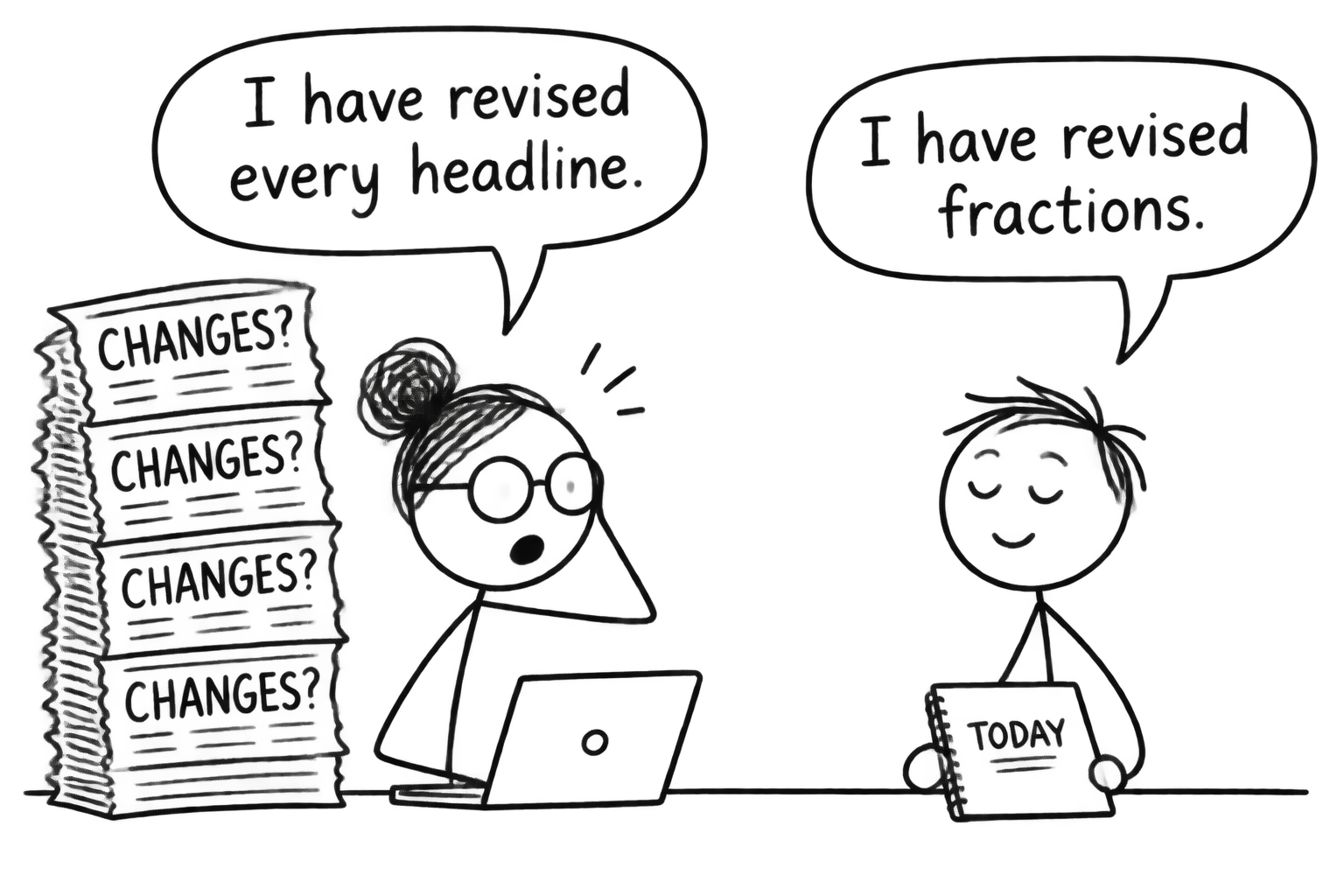 A parent revises headlines while a pupil revises fractions
Could a new GCSE Maths eventually contain less?
It could contain a different balance of material, but “smaller” is too simple a description at this stage.
A curriculum can become more manageable in several ways. Some content might be clarified, reordered or removed. Other ideas might be given more teaching time. Greater emphasis could be placed on secure understanding and applying knowledge. A change may therefore reduce overload without producing a visibly shorter list of topics.
There is another complication. The national curriculum, GCSE subject content and an exam board specification are related, but they are not interchangeable documents. Headlines about a new national curriculum do not automatically tell parents what will appear in a future GCSE Maths examination.
Until revised subject content, specifications and first-teaching dates are confirmed, claims that the new GCSE Maths course will definitely be shorter go beyond the official position.
What the reform timetable means for your child
The safest approach is to place your child into one of three groups.
| Your child’s position | What to do |
|---|---|
| Already studying GCSE Maths | Follow the present exam board specification and the school’s foundation or higher tier course. |
| Starting GCSE study before replacement specifications apply | Expect to study the current course unless the school confirms otherwise. |
| Several years away from GCSE | Watch for the revised curriculum, consultation outcomes, new specifications and confirmed first-teaching dates. |
This avoids the most costly mistake: revising for a possible future qualification rather than the real one.
If your child is already in Year 10 or Year 11, current reform discussions should not distract them from algebra, number, ratio, proportion, geometry, measures, probability and statistics at the level required by their tier and exam board. Their school can confirm the exact specification and examination entry.
Once that specification is known, Maths Genie’s GCSE revision lessons provide a practical route through the content your child needs now, rather than the content a headline suggests may exist later.
A parent’s four-step check
When another story about GCSE reform appears, use this check before changing anything.
Check the publication type
Is it an independent recommendation, a government decision, an Ofqual consultation or a final exam board specification? These documents carry different weight. The word “review” does not mean “implemented”.
Check the date and cohort
Look for first-teaching and first-assessment dates. A change can be confirmed nationally without applying to the cohort currently sitting GCSEs.
Check the exam board specification
Ask the school which board and tier your child is following. Revision should map onto that specification. A general list found online may omit material or include topics from the wrong tier.
Keep learning until removal is official
If a topic appears in the applicable specification, treat it as examinable. Do not drop it because it was absent from one past paper or mentioned in a speculative article.
If setting up that check feels like one more administrative job, start with the Maths Genie Lessons for the current GCSE specification and match each lesson to the course information supplied by your child’s school.
What “less content” would not necessarily mean
Suppose a future specification did become shorter. That would not automatically make the examination easy.
GCSE Maths tests more than whether pupils have encountered a topic. Questions can require them to select a method, connect ideas, interpret unfamiliar information and communicate reasoning. A course with fewer listed statements could still demand deep understanding.
For example, knowing that percentage change can be represented by a multiplier is only the beginning. A pupil may need to recognise that a decrease of 12%12\%12% uses the multiplier
1−12100=0.88.1-\frac{12}{100}=0.88.1−10012=0.88.They might then need to apply the idea in several steps or work backwards. Reducing breadth does not necessarily reduce the reasoning needed within each topic.
That is why strong revision should not become a race to tick off the shortest possible list. It should build accurate methods, retrieval and experience of exam-style decisions.
Common mistakes parents should avoid
Treating a proposal as a final rule
Reviews help shape policy, but recommendations can be accepted, modified or rejected. Wait for confirmed implementation details.
Assuming all UK qualifications change together
Education policy and qualifications differ across the UK. The Curriculum and Assessment Review discussed here concerns England. Always check the system and qualification your child is following.
Dropping topics based on predicted papers
Predicted papers can support practice, but they cannot guarantee which topics will appear. They should supplement full-specification revision, not replace it.
Confusing a curriculum change with immediate exam-board change
An announcement can begin a long process involving curriculum drafting, regulatory work, consultation, specification development and preparation in schools.
Waiting for reform before addressing gaps
A pupil who finds fractions, equations or ratio difficult needs support now. Even where future content changes, secure mathematical foundations remain valuable for GCSE questions and later study.
What parents can do this term
Ask the school for four pieces of information: the exam board, the specification, the tier and the planned examination series. Then compare your child’s recent work with the relevant topic list.
Mark each area as secure, developing or not yet covered. Keep “not yet covered” separate from “weak”; a pupil should not be worried about material their class has not reached. For developing topics, use a revision lesson, answer practice questions and inspect the mark scheme carefully. Return to the topic later rather than treating one successful attempt as permanent mastery.
This plan remains useful even if future reform produces a smaller GCSE. It is based on evidence, dates and your child’s actual qualification rather than prediction.
Follow the course your child is taking
The parent at the kitchen table was looking for a yes or no. The honest answer is now clearer: GCSE Maths may be revised in future, but no smaller course should be assumed for pupils following current specifications. Knowing that is useful; consistently covering the correct material is what turns certainty into progress.
Start with your child’s board and tier, then use one clear lesson at a time to close the gaps before their fixed examination dates. Open Maths Genie Lessons for the current GCSE specification.















