

Will AI Change GCSE Exams? A Parent’s Guide
Will AI change GCSE exams? Not immediately. Learn what is confirmed, what may change from 2029, and how parents can support current maths revision.
Last reviewed: 3 November 2026. This article covers GCSEs regulated by Ofqual in England. Arrangements differ elsewhere in the UK.
No, AI will not suddenly change the GCSE exams that pupils are currently preparing to sit. Longer-term GCSE reform is planned, and artificial intelligence is influencing discussions about curriculum content, coursework and marking. But for today’s GCSE Maths student, the practical instruction is reassuringly simple: follow the current specification and prepare for the assessment arrangements confirmed by the school and exam board.
That is the straight answer to will AI change GCSE exams. The nuance is that AI will probably shape parts of the qualification system over time, but there is no confirmed plan to replace GCSE Maths papers with AI-run examinations or allow pupils to use generative AI to answer them.
Imagine a parent opening a news story about AI marking, another about digital exams and a third about GCSE reform. Each is plausible. Together, they can create the impression that next summer’s exam has already been rewritten. It has not.
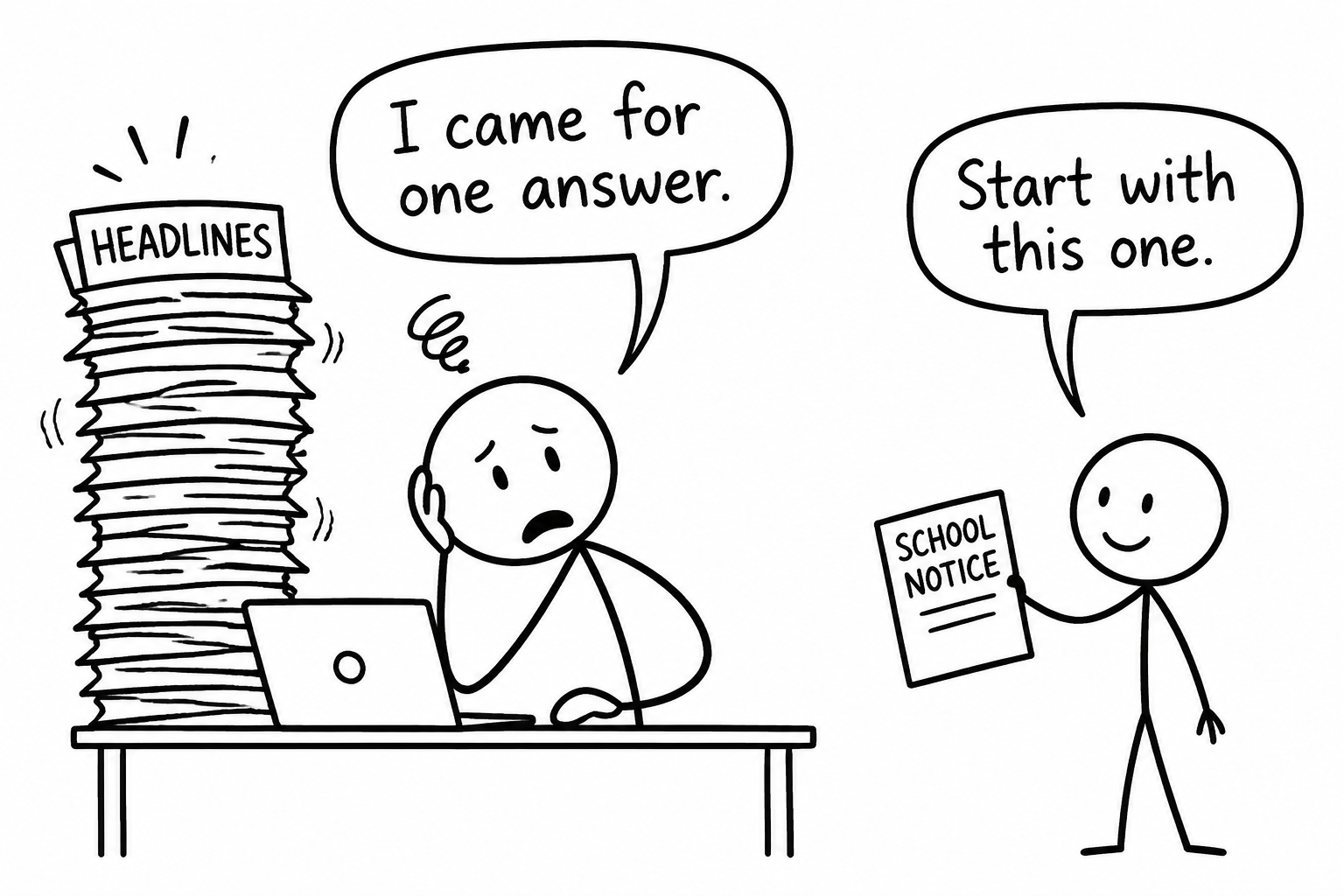 A parent separates AI headlines from the school information that matters
The answer at a glance
Parents can separate the issue into four questions:
- Are GCSEs being abolished? No. The government has committed to retaining GCSEs.
- Will current pupils face an unexpected AI-based Maths exam? No such change has been confirmed.
- Are GCSEs going to be reformed? Yes. Updated GCSEs are planned for first teaching from 2029 onwards, with some subjects following in 2030.
- Will AI affect assessment eventually? Possibly, particularly behind the scenes and in assessments completed outside an exam hall. Any regulated change would still need to protect validity, reliability and fairness.
The most important distinction is between a public discussion, a policy intention and a rule applying to your child’s examination series. They are not the same thing.
What has actually been confirmed?
The Curriculum and Assessment Review published its final report in November 2025. The Department for Education’s response said that the existing structure of subjects, assessments and qualifications, including GCSEs, would be maintained.
The government intends to publish a revised national curriculum in 2027 for first teaching from September 2028. It then plans to update GCSEs in phases, aiming for some revised qualifications to begin teaching in 2029 and the remainder in 2030. Those are first-teaching dates, not dates on which every current pupil’s exam changes.
The response also accepted a modest reduction in total GCSE examination time across a typical programme of eight or nine GCSEs. Detailed subject arrangements must still be developed through the proper regulatory and consultation processes. Parents should therefore avoid turning a system-wide intention into an assumed change to a particular Maths paper.
For a pupil already taking a GCSE course, the relevant documents remain:
- the specification named by the school;
- official information from the exam board;
- the school’s examination guidance;
- confirmed Ofqual decisions applying to that exam series.
This is where the parent in our story finally gets a useful filter. Ask, “Does this announcement apply to my child’s specification and examination year?” If the answer is unclear, it is not yet a revision instruction.
How AI could influence future GCSE exams
AI may change the system gradually rather than dramatically. Three areas deserve attention.
Curriculum content
The government wants education to prepare pupils for a more technology and AI-enabled world. Its response to the review supports stronger teaching of digital literacy and AI, particularly through computing reforms.
That does not mean GCSE Maths will become an examination about chatbots. Future GCSE maths changes could reflect new curriculum priorities, but the confirmed reform timetable comes before final subject specifications. Until those are published, claims about exact new Maths topics are speculation.
Coursework and non-exam assessment
Generative AI creates an obvious authorship problem when work is produced away from direct supervision. The Curriculum and Assessment Review and the government response both recognise risks for non-exam assessment.
GCSE Maths is predominantly assessed through supervised written examination papers, so this concern is more immediate in subjects containing substantial coursework or other non-exam assessment. Even so, it helps explain why GCSE reform is unlikely to mean simply replacing secure exams with unrestricted take-home tasks.
Marking and exam technology
Ofqual is examining how AI could support qualification design and delivery, including marking. Its published position is evidence-led: uses of AI must preserve valid, reliable and trusted qualifications.
This could eventually mean more technology supporting human processes. It does not establish that a chatbot will independently decide your child’s GCSE Maths grade. On-screen assessment is also being explored, but the government has said its introduction must be fair, proportionate and manageable.
Digital assessment and AI are related conversations, not interchangeable ones. A paper displayed on a screen is not automatically marked by AI, while software can support marking even when pupils answer on paper.
A practical plan for parents
When headlines move faster than specifications, use this five-step check:
- Identify the exam board and tier. Find out whether your child takes Edexcel, AQA, OCR or Eduqas, and whether the entry is foundation or higher tier.
- Write down the exam year. A proposal for first teaching in 2029 does not alter an examination taken before that teaching begins.
- Check the source. Give priority to the Department for Education, Ofqual, the relevant exam board and your child’s school.
- Separate teaching from assessment. A school may teach pupils how to use AI responsibly without permitting AI in a supervised GCSE exam.
- Keep revision tied to the current specification. Use current topic lists, appropriate practice questions and papers that match the qualification being taken.
Once you have confirmed the board, tier and year, Maths Genie’s GCSE Maths revision lessons provide a clear route through the current material without asking your child to revise imagined future reforms.
That method gives parents something more valuable than certainty about every future policy. It gives them a reliable decision process today.
What this means for current Maths revision
The risk is not that a pupil will miss a secret AI syllabus. The greater risk is that uncertainty distracts them from the mathematics they already know they need to master.
A sensible weekly routine remains:
- select one current-specification topic;
- revisit the method through a focused lesson;
- answer questions without relying on AI for the reasoning;
- mark the work carefully;
- record errors and return to them later.
AI can sometimes explain an idea or generate extra questions, but its output may be incorrect, poorly pitched or outside the specification. A pupil should not treat an AI answer as an official mark scheme. For assessed work, they must also follow their school’s rules on acceptable use.
The durable skills remain mathematical: choosing a method, showing reasoning, checking whether an answer is plausible and communicating it clearly. Technology may alter the surface of assessment, but those habits survive format changes.
Common mistakes parents should avoid
Revising for an announced reform too early
A policy timeline is not a finished specification. Do not replace current lessons with guessed content for a new GCSE maths qualification.
Assuming every UK announcement applies everywhere
Ofqual regulates qualifications in England. Wales and Northern Ireland have separate arrangements, while Scotland uses a different qualifications system. Check the regulator and qualification relevant to your child.
Treating digital exams as AI exams
On-screen delivery concerns how a candidate receives and answers questions. AI concerns how technology generates, processes or evaluates information. One does not necessarily imply the other.
Letting AI complete the difficult thinking
An answer produced instantly can hide a gap in understanding. In GCSE Maths, independent practice matters because the pupil must reproduce the reasoning under supervised conditions.
Trusting a headline over the school’s confirmed information
Headlines often compress proposals, consultations and decisions into one dramatic sentence. Your child’s school can confirm the board, tier, specification and arrangements that actually apply.
Keep the target steady
The parent seeking a straight answer can now close most of those browser tabs. AI is influencing education policy, and GCSE reform is coming, but current students should prepare for their confirmed qualification rather than a hypothetical AI exam.
Knowing that is calming. Following the specification consistently is what turns calm into readiness. Start the Maths Genie Lessons for the current GCSE Maths specification and help your child practise the material they will actually be assessed on.















