

Will A-Level Maths Change Too? A Parent’s Guide
Will A-Level Maths change too? Yes, but not yet. See the planned timetable, what remains uncertain and what today’s GCSE students should revise.
Updated: 3 November 2026
No, A-Level Maths is not changing for students taking it now or beginning it in the immediate future. But yes, the government intends to update corresponding AS and A Levels after its planned GCSE reforms, with revised qualifications expected to begin later than the new GCSEs.
That is the straight answer to will A-Level Maths change too. The nuance is timing. Following the Curriculum and Assessment Review, the government set out an intention to introduce reformed GCSEs in national curriculum subjects from 2029 and 2030, followed by corresponding A Levels two years later. Ofqual’s published board papers describe the same broad sequence. However, the detailed content and assessment arrangements for a future A-Level Maths qualification have not yet been finalised.
For parents, the practical message is reassuring: your child should continue learning and revising the specification their school is currently teaching. There is no reason to abandon present materials or prepare for an unpublished course.
The answer at a glance
| Parent’s question | Current answer |
|---|---|
| Is A-Level Maths changing immediately? | No. Current students follow the existing specification. |
| Is a future update intended? | Yes. The government plans to update corresponding AS and A Levels after GCSE reform. |
| When could revised A Levels begin? | The stated direction is two years after the related reformed GCSE, with government planning documents referring to 2031 and 2032. |
| Has the new A-Level Maths content been published? | Not in final form. Detailed subject content and assessment arrangements remain to be developed. |
| Should a GCSE student change revision strategy now? | No. They should prepare for their current GCSE specification and build secure algebra, geometry, statistics and problem-solving skills. |
Why the question feels harder than it should
Imagine a parent at the kitchen table, opening one headline about GCSE maths changes, another about curriculum reform and a third about shorter examinations. Their child is in Year 10 and considering Maths at A Level. The natural question is not simply what the government may do one day. It is whether today’s revision book has suddenly become obsolete.
It has not.
Education reform tends to be announced in layers. First comes a review. Then a government response. Later come consultations, revised subject content, regulatory decisions and exam-board specifications. A proposal to reform qualifications is therefore not the same thing as a new paper arriving in an examination hall next summer.
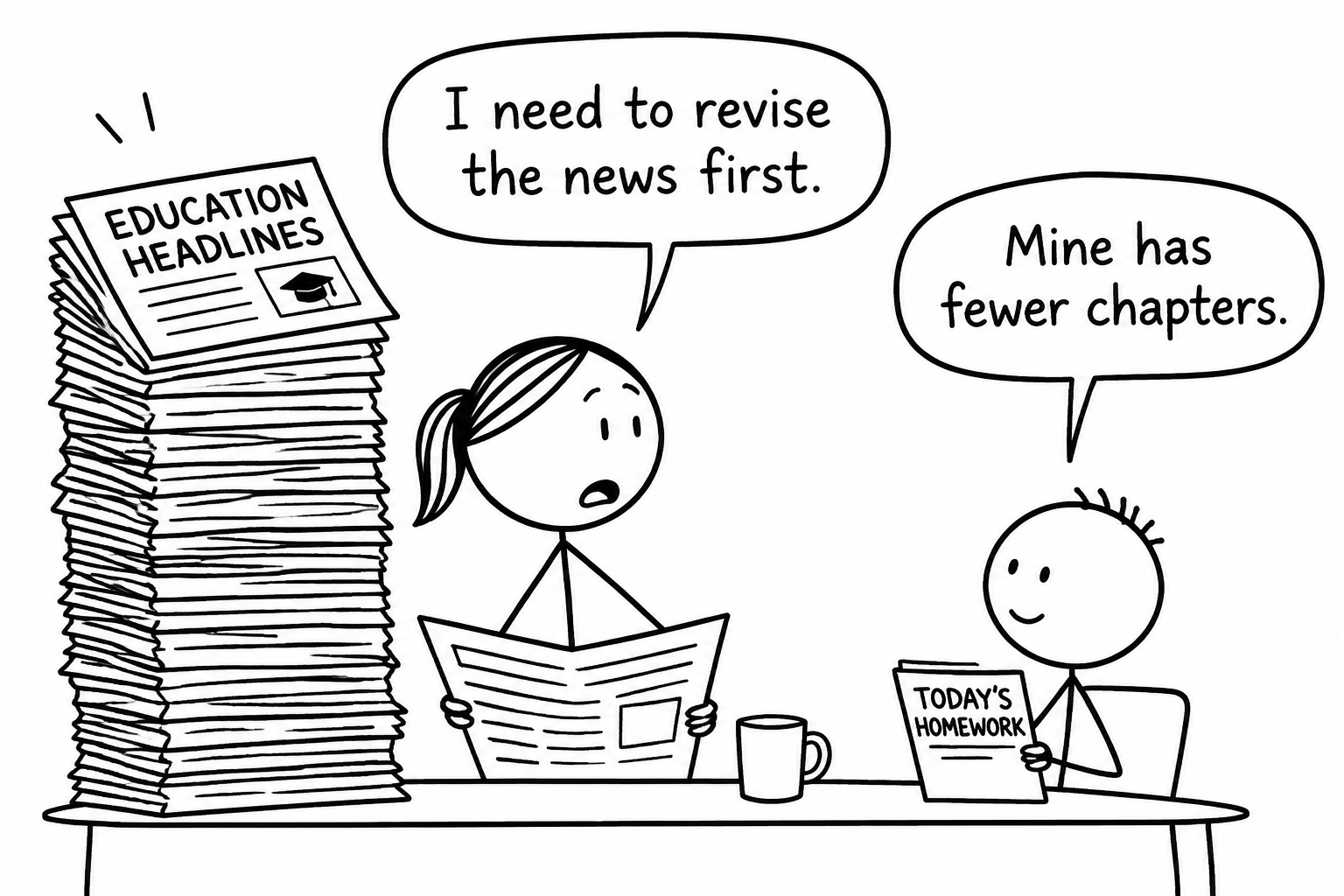 A parent tries to revise education headlines while their child gets on with homework
The Curriculum and Assessment Review published its final report in November 2025. The government’s response accepted a programme of curriculum and qualification change, including updates to GCSEs and corresponding AS and A Levels in national curriculum subjects. Ofqual is involved because it regulates qualifications and assessments in England, but specifications still require further development before schools can teach them.
That distinction matters. Policy direction is established; the exact future A-Level Maths course is not.
How GCSE reform connects to A-Level Maths
The planned sequence reflects a simple curriculum principle: post-16 qualifications should follow logically from what pupils have learned before them.
If the content or emphasis of GCSE Maths changes, A-Level Maths may eventually need adjustments so that it starts from the right foundation. The government response also indicates that corresponding AS and A Levels should be updated after national curriculum subjects and their GCSEs have been revised.
The current broad timetable is:
- revised national curriculum materials and subject requirements are developed first;
- reformed GCSEs in national curriculum subjects begin from 2029 and 2030;
- corresponding A Levels follow two years later, with planning documents referring to 2031 and 2032;
- detailed specifications and assessment materials appear only after development, consultation and regulatory work.
This does not prove that every part of A-Level Maths will be rewritten. Nor does it tell us whether paper length, topic weighting or permitted technology will change. Until the Department for Education, Ofqual and exam boards publish final details, claims about those features would be speculation.
Which students might encounter a new A Level?
A parent can make the national timetable more useful by comparing it with their child’s school year.
A pupil taking GCSEs well before 2029 should expect the current GCSE and, if progressing directly, the existing A-Level Maths course. Pupils who are younger may eventually meet a reformed GCSE and then a corresponding reformed A Level, depending on the final subject-by-subject timetable.
The key phrase is first teaching. This normally identifies the first cohort beginning a qualification, not every pupil already part-way through it. Qualification changes are planned around cohorts so that students are not normally asked to switch specifications in the middle of a course.
Parents should use this checklist:
- confirm the year in which your child will take GCSE Maths;
- ask the school which exam board and specification it currently teaches;
- distinguish a proposed reform date from a confirmed first-teaching date;
- wait for final subject content and an accredited specification before buying future-course materials;
- keep using resources matched to the qualification being taught now.
If organising all of that feels heavier than the mathematics itself, use the Maths Genie GCSE lessons to keep your child focused on the current specification while policy develops.
What should parents do now?
The sensible response is not to predict an unpublished paper. It is to strengthen the knowledge that survives curriculum change.
Algebraic fluency is the clearest example. A student who can rearrange formulae, solve equations, interpret graphs and reason with functions is better prepared for the current A Level and any credible future version. The same principle applies to trigonometry, proof, statistics and multi-step problem solving.
Parents can follow a simple plan:
Check the qualification actually being studied
Find the exam board on school documents or ask the maths department. Edexcel, AQA, OCR and Eduqas materials are not automatically interchangeable, particularly at A Level. Use the specification and school scheme of work as the source of truth.
Revise the present course, not a possible future one
For a GCSE student, work systematically through Maths Genie’s grade-organised GCSE revision lessons. Each topic page brings the explanation and practice into one place, making it easier to identify whether a difficulty is with knowledge, method or examination technique.
Students already progressing towards post-16 study can use the current A-Level Maths lessons. These are designed around the qualification students are actually sitting, rather than predictions about reforms that have not been finalised.
Treat transferable fluency as the bridge
A-Level Maths places substantial demands on algebra. A student may understand a new idea but lose control of a solution through weak manipulation of fractions, indices or equations. Closing those gaps during GCSE is useful regardless of future specification wording.
Watch official milestones, not rumours
The documents worth watching are Department for Education consultations and responses, Ofqual decisions, and final exam-board specifications. A social-media summary may collapse several stages into the word “change”, making a distant proposal sound immediate.
Maths Genie will continue to organise lessons around the specification students need. Parents do not have to reconstruct a qualification from policy headlines.
What could change, and what remains unknown?
The Curriculum and Assessment Review recommended changes across curriculum and assessment, while the government response established a programme for implementation. It is reasonable to expect some alignment between revised GCSE content and later A Levels.
It is not yet possible to state definitively:
- which A-Level Maths topics will be added, removed or reordered;
- whether the balance of pure maths, statistics and mechanics will alter;
- whether the number or duration of papers will change;
- how assessment objectives or grade boundaries will operate;
- what individual exam-board specifications will contain.
Grade boundaries are particularly unsuitable for advance prediction. They are part of the awarding process for a particular examination series, not a permanent percentage attached to a future qualification.
For now, GCSE past papers remain useful for students preparing for the current course. A paper only becomes outdated for a learner when it no longer matches the specification that learner will sit, not merely because reform has been announced.
Common mistakes parents can avoid
Assuming GCSE reform changes next summer’s examination
A reform announcement and classroom implementation are different events. Always check the first-teaching and first-assessment dates for the relevant cohort.
Buying materials for an imagined specification
Until final content and exam-board specifications exist, a resource claiming to cover the future course cannot reliably reflect it. Spend time on secure foundations instead.
Stopping current past-paper practice
Current papers are still the best representation of the current assessment. Students should combine them with topic practice and careful use of mark schemes.
Focusing on reform instead of readiness
For most families, the immediate question is whether the student has the foundations to succeed at A Level. A secure GCSE grade, especially strong algebraic understanding, matters more now than guessing the wording of a later specification.
Keep today’s student on today’s course
The parent at the kitchen table can now put the headlines aside. A-Level Maths is expected to change eventually, but current students should prepare for the specification their school teaches, and the detailed future course is not yet settled. Knowing that is useful; following a steady revision route is what turns reassurance into progress.
Start the Maths Genie Lessons for the current specification and help your child build the knowledge their course requires now.















