

Why Grade Boundaries Change in GCSE Maths
Why grade boundaries change in GCSE Maths each year, how exam boards keep grades fair, and why focused revision matters more than predictions.
A GCSE student finishes a maths paper, meets their parent outside and asks the question that follows almost every exam: “What mark will I need for a grade 555?”
The honest answer can feel frustrating. Nobody knows yet.
Why grade boundaries change is straightforward: every exam paper is slightly different in difficulty, so exam boards adjust the mark needed for each grade after the papers have been marked. If a paper proves harder, boundaries will usually be lower. If it proves easier, they will usually be higher. This helps keep the standard represented by each grade comparable from one year to the next.
The boundary is not moved to punish a particular year group. It is moved because fairness sometimes requires the mark to change while the standard stays steady.
GCSE maths grade boundaries at a glance
Here is the short version students and parents need to remember:
- Grade boundaries are set for each exam series, not permanently fixed in advance.
- Exam boards use evidence about paper difficulty and student performance.
- A harder paper will generally lead to lower boundaries.
- An easier paper will generally lead to higher boundaries.
- Different exam boards can have different boundaries because their papers are different.
- There is no fixed quota requiring a certain number of students to pass or fail.
- Previous boundaries are useful guides, but they cannot predict the next series exactly.
Students can explore board-specific papers, boundaries and revision materials through the GCSE Maths revision hub.
Why grade boundaries change when specifications stay the same
Exam boards such as Edexcel, AQA, OCR and Eduqas write papers to the requirements of their specifications. They aim to produce a consistent level of demand, but no two sets of questions can be identical.
One paper might include an algebra question that students recognise immediately. Another might assess the same skill through an unfamiliar problem-solving context. Both can cover the specification correctly while producing different results in the exam hall.
The difference is often visible only after thousands of completed scripts have been marked. A question that looked accessible during paper development may prove unexpectedly demanding. Another may attract more full-mark responses than anticipated.
That is why final boundaries cannot simply be announced months before the examination. Exam boards need evidence from the actual series.
Ofqual’s published explanation says that boundaries are set each year to reflect the difficulty of the particular papers and to ensure that earning a grade is not easier or harder merely because of the year in which a student took the qualification. For GCSE Maths, evidence from the National Reference Test can also support the maintenance of standards over time.
A dated example from GCSE Maths
The movement becomes clearer when we look at real figures rather than rumours.
For Edexcel GCSE Maths Foundation, the qualification has a total of 240240240 marks across three papers. In the June 2024 series, the grade 444 boundary shown by Maths Genie was 142142142 marks. In June 2025, it was 144144144 marks. The grade 555 boundary was 175175175 marks in both series.
The grade 444 boundary therefore changed by:
144−142=2 144-142=2 144−142=2That small movement does not mean the value of a grade 444 changed. It means the evidence supported a slightly different raw-mark threshold for maintaining the grade standard in that series.
You can inspect past series using the Edexcel GCSE Maths grade calculator, which places historical boundaries alongside a mark estimate. The GCSE Maths grade boundary history also provides useful context for changes between exam series.
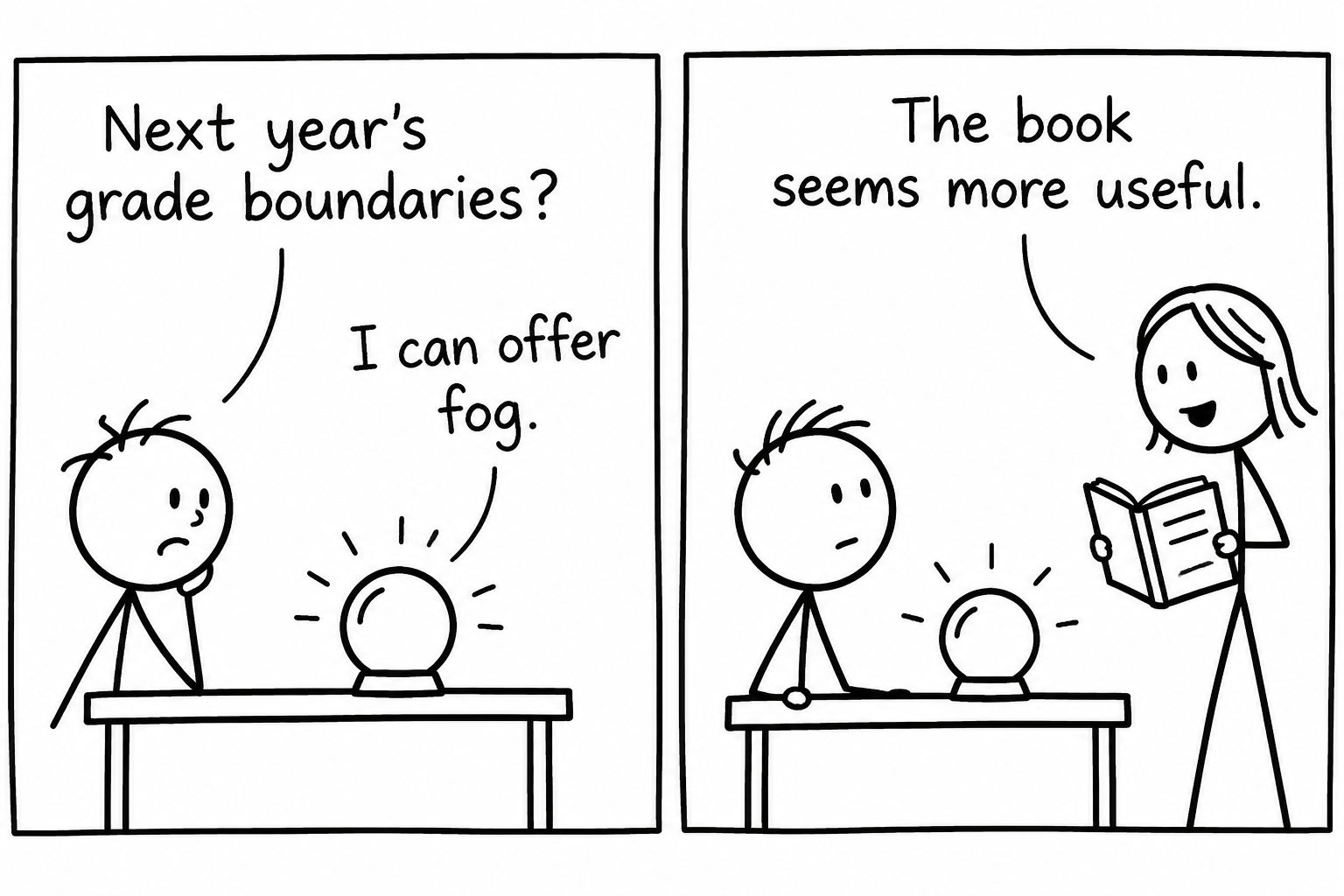 XKCD-style comic showing a student asking a crystal ball to predict grade boundaries while a parent recommends revision
How exam boards decide the boundaries
Setting boundaries is known as awarding. It is not based on one simple calculation. Exam boards consider statistical evidence alongside the professional judgement of senior examiners.
The evidence can include how students performed across the paper, how particular questions functioned and how the current group compares with previous groups. Senior examiners also review scripts around possible boundaries to judge whether the work demonstrates the expected standard.
This distinction matters. A grade is not intended to represent a permanent percentage such as 70%70\%70%. It represents a standard of performance. The raw mark needed to demonstrate that standard can move because the assessment itself changes.
For any paper, a percentage score can be calculated using:
percentage=marks achievedtotal marks×100 \text{percentage}=\frac{\text{marks achieved}}{\text{total marks}}\times100 percentage=total marksmarks achieved×100But the resulting percentage does not automatically translate into the same GCSE grade every year. Students who want a fuller account of awarding can read how GCSE grade boundaries work.
Why different exam boards have different boundaries
It is tempting to compare an Edexcel boundary with an OCR or AQA boundary and decide that one board is easier. The numbers alone cannot support that conclusion.
Each exam board uses different papers. Their question structures, mark totals and overall difficulty may differ, even though the qualifications must meet regulated subject requirements. A lower boundary can simply indicate that a paper was more demanding.
A student also cannot choose a board on results day. Their school or college has already entered them for a particular specification. The useful comparison is therefore between the student’s performance and the boundaries for their own board, tier and exam series.
Maths Genie’s guide to Edexcel and OCR grade boundaries explains why raw figures should be interpreted in context rather than treated as a league table.
What changing boundaries mean for revision
Uncertain boundaries can make revision feel like aiming at a moving target. In reality, the target is more stable than it appears.
The aim is not to predict whether a grade 555 will require one particular total. The aim is to build enough secure knowledge to perform well across several plausible boundaries. If a past boundary suggests that a target grade required approximately xxx marks, revising only until practice scores occasionally reach xxx leaves no room for unfamiliar questions, mistakes or ordinary exam-day pressure.
A better approach is to:
- complete practice questions by topic;
- mark the work honestly using the mark scheme;
- record topics where marks are repeatedly lost;
- use revision lessons and video solutions to repair those gaps;
- sit full past or predicted papers under timed conditions;
- track marks across several papers rather than trusting one result.
The important trend is not a guessed boundary. It is whether your scores are becoming more consistent.
The GCSE Maths marks per grade guide can help students interpret previous thresholds, but it should be used as a planning tool rather than a promise.
Common mistakes students and parents make
Treating last year’s boundary as this year’s target
Previous GCSE maths grade boundaries provide context, not certainty. The next papers will contain a different combination of questions and may produce different boundaries.
Assuming lower boundaries mean an easier qualification
Usually, a lower boundary reflects a harder assessment. It does not show that an exam board awards grades more generously.
Converting every practice mark into a precise grade
A past paper should be judged using the boundary from its own exam series. Even then, one paper is only one piece of evidence. Performance across several papers gives a more reliable picture.
Revising only enough to reach the old boundary
A boundary is a threshold, not a comfortable target. Building a margin above previous thresholds is wiser than relying on the boundary moving in your favour.
Focusing on boundary rumours after the exam
Unofficial predictions cannot change a completed paper. Before the examination, focus on preparation. Afterwards, wait for the official result and published boundaries.
Focus on the marks you can move
Grade boundaries receive attention because they are uncertain. Revision deserves more attention because it is controllable.
A student cannot decide whether the next paper is judged slightly harder or easier. They can improve fractions, algebra, ratio, graphs and problem solving. They can learn why a method works, practise it, check the mark scheme and return to it until the marks become dependable.
Start with Maths Genie’s free GCSE Maths revision resources. Use Maths Genie Lessons on the topics that move marks most, then reinforce them with practice questions, mini tests, past papers, predicted papers, mark schemes and video solutions. Boundaries will move. Secure mathematical understanding moves with you.















