

Why Choose GCSE Arabic? What Makes It Worthwhile
Why choose GCSE Arabic? Discover what students value, how the course is assessed and how to balance language learning with effective maths revision.
Choosing GCSE options can feel strangely permanent. A subject that occupies one line on a form will soon claim lessons, homework and revision time alongside maths, English and science. So, why choose GCSE Arabic? The clearest answer is that it can turn an existing cultural, family or personal connection into a recognised qualification while developing practical skills in reading, writing, listening and speaking.
For other students, the appeal is discovery. Arabic offers a different writing system, a rich linguistic tradition and the satisfaction of learning to communicate in a language that matters to communities across the UK and beyond. It is not automatically an easy GCSE, even for someone who speaks an Arabic dialect at home. But for the right student, it can be unusually meaningful.
GCSE Arabic at a glance
Before choosing the subject, ask yourself:
- Do I enjoy learning and using Arabic?
- Am I willing to practise all four language skills regularly?
- Do I already speak or hear Arabic at home, and can I adapt that knowledge to formal written Arabic?
- Does my school provide enough teaching and preparation for the qualification?
- Can I fit Arabic practice around maths and my other compulsory subjects?
- Have I checked the exact exam board specification offered by my school?
A good option choice sits at the meeting point of enjoyment, usefulness and manageable difficulty. Research into GCSE subject choices has repeatedly found that students consider all three. The question is not simply whether Arabic sounds impressive. It is whether you are prepared to keep working when the vocabulary, grammar or writing becomes demanding.
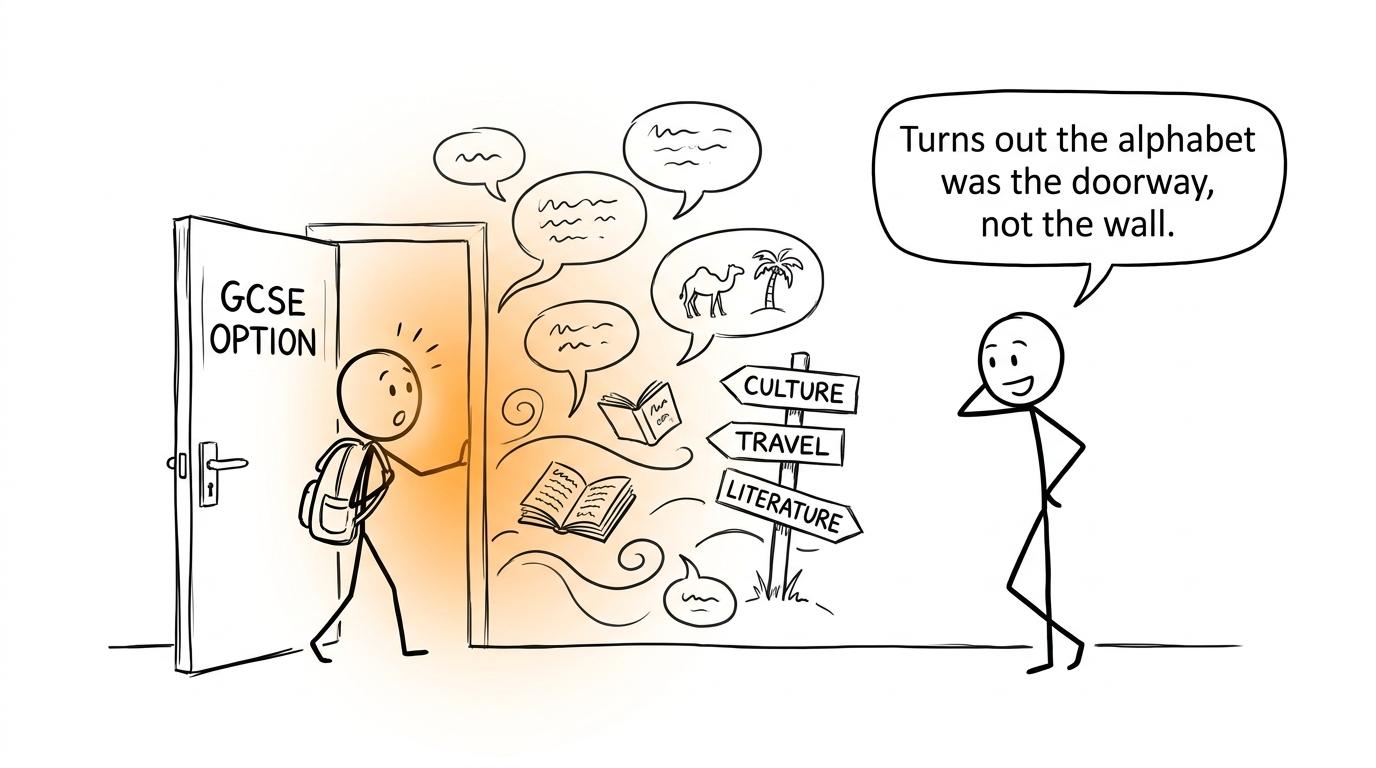 A student discovers that the alphabet is a doorway rather than a wall
What students value about choosing GCSE Arabic
Published British Council research involving GCSE Arabic learners found several recurring motivations: communicating with family and other Arabic speakers, understanding culture or religious texts, enjoying the language, travelling, continuing into further study and supporting future career interests. These are not promises that every student will enjoy the course, but they show why it can feel worth choosing.
It can strengthen an existing connection
Some learners already hear Arabic at home or within their wider community. GCSE Arabic gives that familiarity a structure. Instead of only understanding informal conversation, students develop the accuracy needed for reading, formal writing and assessed speaking.
That distinction matters. Spoken dialects can differ from the Modern Standard Arabic generally used in formal education and assessment. A student may speak confidently with relatives yet still need substantial practice with spelling, grammar, translation and formal vocabulary.
For those students, the qualification can make an existing part of life more deliberate. They are not beginning with nothing, but neither are they simply collecting a certificate for knowledge they already possess.
Progress becomes visible
Languages produce small moments of evidence. A passage that once looked dense becomes readable. A listening extract begins to separate into recognisable phrases. A spoken answer becomes more natural because the vocabulary has been retrieved many times.
This visible progress is one reason some students enjoy language learning. The improvements may be modest from week to week, yet they accumulate. It is similar to maths revision: confidence often arrives after repeated successful practice, not before it.
It offers a distinctive intellectual challenge
Arabic requires students to move between different modes of thought. They must recognise vocabulary quickly, listen for meaning, control grammar, write accurately and respond in real time during speaking tasks.
The script is read from right to left, letters change shape according to their position, and accurate written expression requires attention. These features can look intimidating initially. For students who enjoy patterns, however, they may become part of the attraction. The language stops appearing like one enormous difficulty and starts becoming a collection of learnable systems.
It may support later choices
A GCSE does not guarantee a particular university place or career. It does, however, provide formal evidence that a student has worked across several language skills and completed an assessed course.
Arabic may be relevant to later language study and to interests involving international relations, translation, education, public service, journalism or work with Arabic-speaking communities. Its immediate value can also be simpler: communicating more confidently or understanding cultural material with greater independence.
Choose it because the subject matters to you now, not solely because of a distant job title that may change.
What the GCSE Arabic course involves
The current Pearson Edexcel GCSE Arabic qualification used in England is graded on the 999-111 scale and assesses four skills:
- listening
- speaking
- reading
- writing
Each skill contributes 25%25\%25% of the qualification. The course includes themes connected with identity and culture, local and global interests, and current or future study and employment. Reading can include adapted authentic or literary material, while the qualification also involves translation.
Foundation and higher tiers are available. Students are entered for one tier across all four papers, so the decision should be discussed carefully with the school before the speaking assessment period. Specifications and administrative arrangements can change, so always use the current information supplied by your teacher and exam board rather than relying on an old revision guide.
GCSE Arabic should not be confused with an International GCSE in Arabic as a first language. The content and assessment structure are different. Confirm the precise qualification code your school is entering before buying any materials or downloading past papers.
Who is likely to be glad they picked it?
GCSE Arabic may suit you if several of the following statements feel true:
- You enjoy the language enough to practise when no deadline is approaching.
- You want stronger communication with family or community members.
- You are curious about Arabic-speaking cultures and formal Arabic.
- You like seeing knowledge grow through frequent recall.
- You are comfortable being corrected on pronunciation and grammar.
- Your school offers consistent teaching and speaking practice.
- You can protect time for maths and your other GCSEs.
Prior knowledge helps, but it is not the only factor. Motivation, teaching support and regular practice matter. A heritage speaker should not assume that conversational fluency removes the need to revise; a beginner should not assume that the subject is impossible simply because the script is unfamiliar.
The most useful conversation is with the Arabic teacher at your school. Ask what previous students found difficult, how speaking practice is organised, which tier is commonly entered and what support exists outside lessons.
Balancing GCSE Arabic with maths revision
A language improves through frequent contact. Maths improves through frequent problem-solving. Both suffer when revision is postponed until one exhausting weekend.
A manageable weekly routine might include short Arabic vocabulary, listening and writing sessions alongside focused maths practice. The aim is not to divide every hour equally. It is to stop either subject disappearing from your timetable.
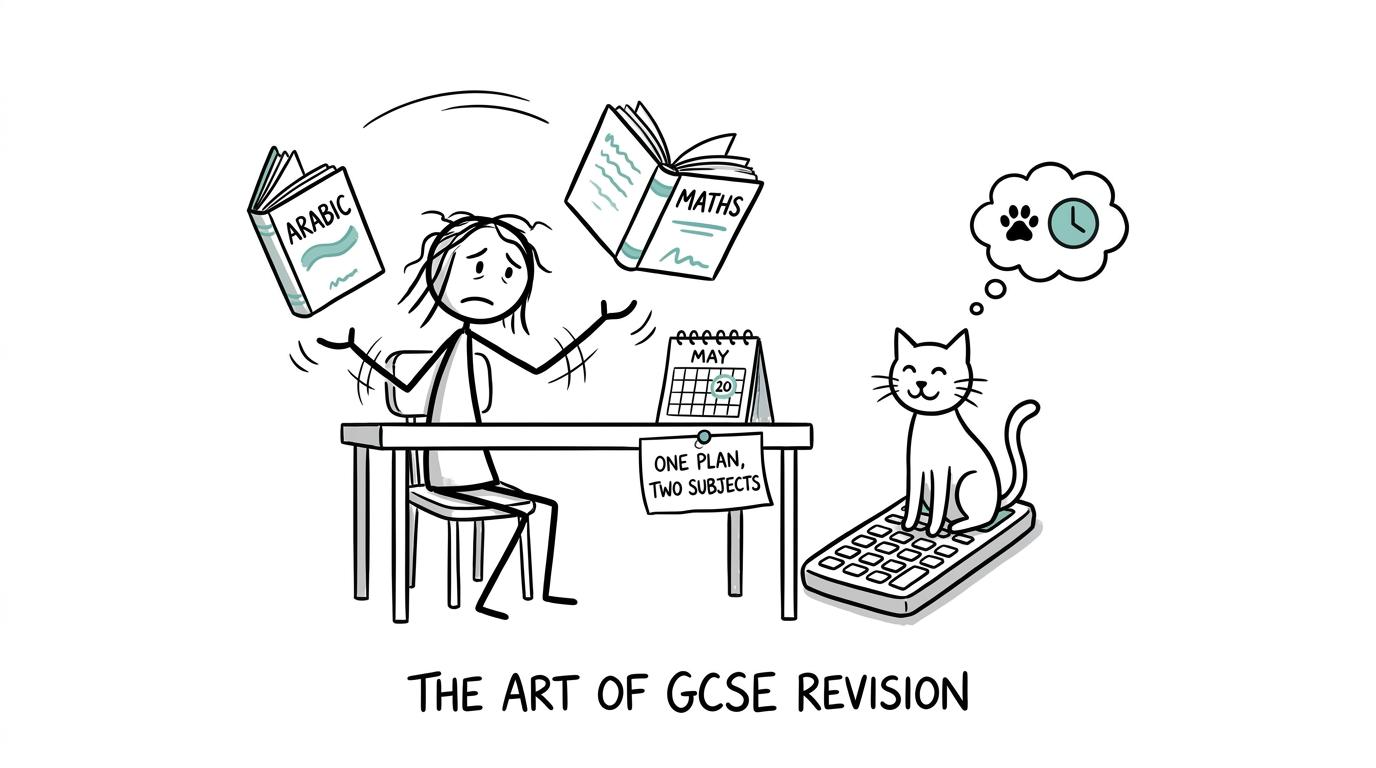 A cat attempts to manage a student's Arabic and maths revision timetable
Use the GCSE maths revision timetable guide to build a plan around your actual weak areas. For maths, begin with the revision hub matching your board, such as AQA GCSE Maths revision, rather than revising random topics because they feel comfortable.
A simple rhythm is:
- recall Arabic vocabulary little and often;
- practise one receptive skill, such as listening or reading;
- produce Arabic through speaking or writing;
- complete a focused maths lesson and its practice questions;
- mark your work and record the specific mistake;
- return to that weakness later in the week.
When you need a short maths check rather than a full examination, use the GCSE Maths mini tests. Closer to the exams, introduce GCSE predicted papers and board-specific past papers. If you take Edexcel maths, the Edexcel GCSE Maths past papers include mark schemes and solutions where available.
A paper is most useful when its mistakes change what you revise next. The MathsGenie guide to using GCSE past papers properly explains the attempt, mark, diagnose, fix and retest cycle.
Common mistakes when deciding on GCSE Arabic
Assuming it will be easy because you speak Arabic at home
Conversational ability is valuable, but the examination assesses formal listening, speaking, reading and writing. Dialect vocabulary, spelling and sentence structure may not match what the mark scheme requires.
Choosing it only because someone else says it is useful
Usefulness is personal. A subject can have obvious value and still be the wrong option if you dislike its daily work. Look at specimen material and ask what the lessons actually involve.
Ignoring the speaking assessment
Some students focus heavily on reading and writing because those skills feel easier to practise alone. Speaking requires its own preparation: pronunciation, spontaneous responses, interaction and the ability to recover when a word disappears.
Using the wrong qualification materials
GCSE Arabic and International GCSE Arabic are not interchangeable. Nor should you assume that resources from an older specification match your current papers. Check the board, qualification code, tier and assessment format.
Letting one option consume every revision session
An enjoyable subject can quietly absorb time from compulsory GCSEs. Give Arabic regular, bounded sessions and keep maths moving through topic practice, mini tests and marked papers. The MathsGenie GCSE and A Level revision hub makes it easier to return directly to the skill you need rather than losing time searching.
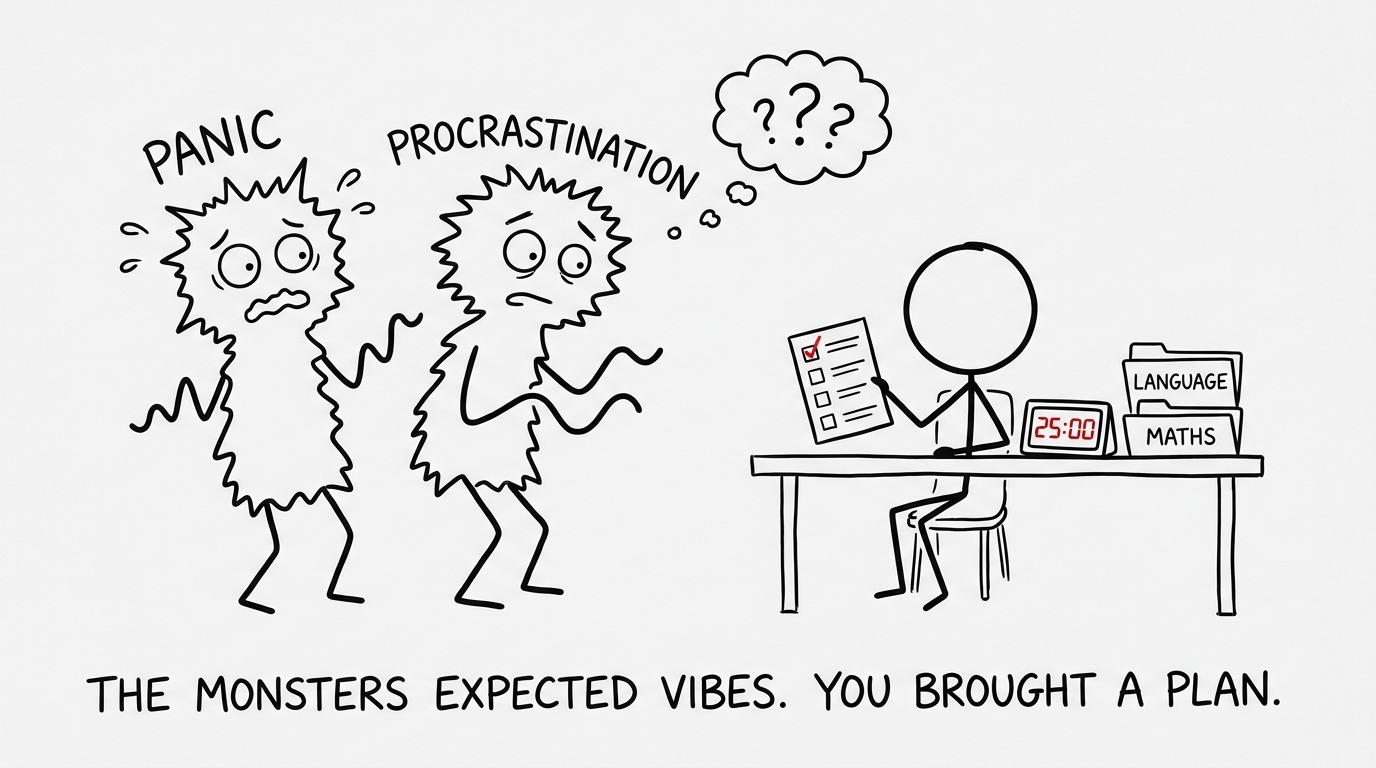 A calm student defeats the revision monsters with a checklist
A choice that should become a habit
The best reason to choose GCSE Arabic is not that it will always be comfortable. It is that the work feels meaningful enough to continue. For some students, that meaning comes from family and identity. For others, it comes from curiosity, communication or the pleasure of mastering a demanding language.
Make the decision with evidence. Read the current specification, inspect assessment materials, speak to your teacher and think honestly about your available time. If the subject still feels worthwhile after you understand the difficult parts, that is a much stronger signal than being told it is an easy grade.
Then protect your wider revision. Use MathsGenie's free revision lessons and practice questions to repair weak maths topics, mini tests to check progress, and past papers or predicted papers to build examination confidence. Mark carefully, use video solutions when a method is unclear and let every mistake decide your next step.










