What to Revise in December of Year 11 Maths
What to revise in December of Year 11 Maths: use mock feedback, strengthen key topics and follow a realistic weekly plan over the Christmas break well.
December creates an awkward question: should you switch off for Christmas, revise everything, or complete full papers every day? Knowing what to revise in December of Year 11 Maths starts with recent classwork or mock feedback. Identify weaknesses, repair important gaps and keep core skills active through a realistic weekly routine.
Imagine a Year 11 student called Maya. Her mock results have arrived, several topics are circled, and the summer exams feel closer. Her first instinct is an enormous timetable. A more useful response is to decide which missing skills deserve attention next.
Your December revision checklist
A useful plan should help you:
- analyse recent mocks, tests or classwork
- choose three to five priority topics
- strengthen essential number and algebra skills
- practise questions and review mistakes
- revisit topics after a few days
- protect time for rest
- prepare clear priorities for January
The GCSE maths revision timetable guide explains how to organise the wider year. December is one manageable part of that journey.
What to revise first in December
Start with assessment evidence
Your school’s mock timetable may differ from another school’s. Use the most recent reliable evidence available, whether that is a mock paper, marked homework or teacher feedback.
Sort lost marks into four categories:
- Knowledge: you did not know the method.
- Recall: you had learnt it but could not remember it.
- Application: you knew the skill but did not recognise when to use it.
- Accuracy: arithmetic, notation or checking caused the error.
These distinctions help you choose the right response. A missing method needs explanation and practice; an accuracy problem needs closer attention to working and checking.
If your paper is unavailable, use the GCSE revision guides to identify topics that need attention.
Repair connected core skills
Ask which weaknesses affect several topics. Uncertain fractions can disrupt ratio and probability; weak algebraic manipulation can make equations and graphs harder.
Check your confidence with:
- fractions, decimals, percentages and ratio
- negative numbers, powers and standard form
- simplifying expressions, substitution and equations
- rearranging formulae, graphs and sequences
- perimeter, area, volume and angles
- probability and interpreting statistical information
Your priorities must reflect your exam board, specification and confirmed tier. Foundation and higher tier students can follow the same planning method while choosing different questions. Use the GCSE Maths revision hub to find suitable resources, alongside your teacher’s guidance.
Turn mistakes into practice cycles
Watching an explanation is a starting point. You also need to answer questions independently.
Review a revision lesson, attempt focused questions, then check the mark scheme. Identify precisely why each error happened and redo incorrect questions without looking at the solution. Return to similar questions later in the week.
MathsGenie’s guide to revising GCSE maths efficiently explains how targeted practice and careful marking work together.
A manageable weekly December plan
Maya chooses three sessions during an ordinary school week. The number is a practical starting point, which she can adjust around homework and other subjects.
Diagnose and learn
Choose one priority topic. Review the relevant lesson and explain the method in your own words. Keep the scope narrow enough to leave time for questions. “Algebra” is too broad; one specific algebra skill is easier to practise and assess.
Practise and mark
Complete topic questions under quiet conditions. Mark carefully, correct mistakes and record anything you still cannot explain. Video solutions can help you locate the step where your reasoning went wrong.
Revisit and mix
Return to the topic several days later. Include questions from older topics so you practise choosing methods without a worksheet title giving the approach away. Mini tests can help reveal what you remember independently.
At the weekend, update your priorities. Keep secure topics in occasional mixed practice and carry persistent weaknesses into the following week. The Revision Planner can help turn these decisions into a workable schedule.
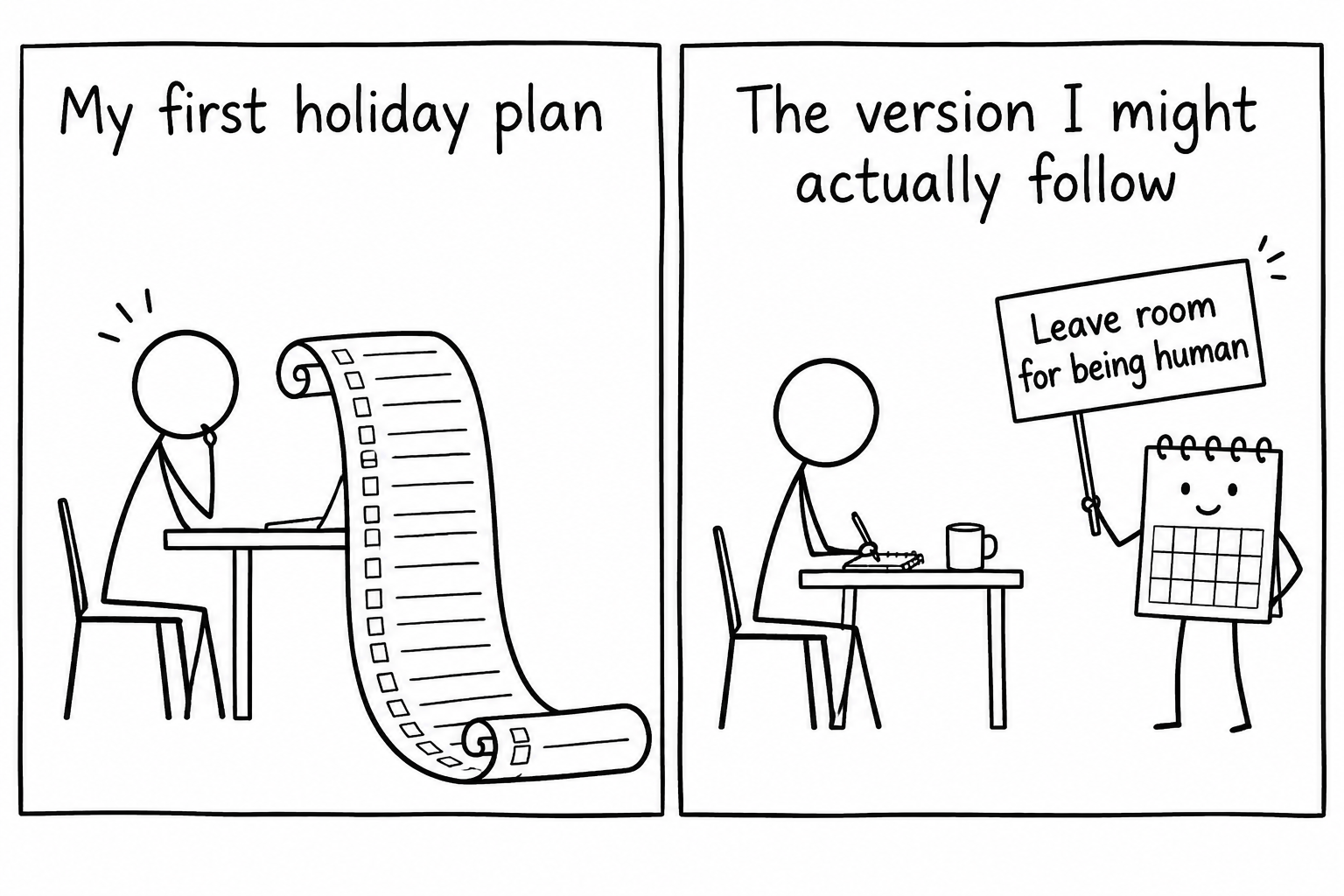 A student replaces an enormous holiday revision calendar with a realistic plan that leaves room for being human
Adapting revision for the Christmas break
Family plans, travel and rest change the holiday rhythm. Build around commitments you already know about and leave some days free.
During the first few days, rest, finish urgent schoolwork and organise assessment feedback. Then spread focused sessions across the available days, alternating weaker topics with material you have already practised.
Sections of past papers can reveal gaps. A full paper is useful when you also have time to mark it and investigate mistakes. You do not need to wait until spring, but repeated papers offer limited benefit if the same weaknesses remain unresolved.
Predicted papers can provide additional practice later; they cannot guarantee what will appear in your exam. In December, choose resources according to the skills you need to improve. Edexcel students can also use the guide to revising GCSE Maths without wasting time.
Before school returns, revisit your priorities and prepare a January list. Record what you can now do independently and what still needs teacher support.
Common December revision mistakes
Trying to cover everything
An enormous checklist can crowd out careful practice. Choose fewer priorities and complete the learning cycle before adding more.
Staying with comfortable questions
Familiar topics can build confidence, but leave room for weaknesses where improvement is realistic. Ask for help when repeated attempts reveal the same misunderstanding.
Completing papers without reviewing them
Use each paper to identify missing skills. Practise those separately before attempting another paper.
Neglecting non-calculator skills
Keep arithmetic, fractions, estimation and algebra active. They also help you work efficiently and check answers when calculators are allowed.
Build your December schedule
Maya’s plan becomes useful when it contains specific tasks she can complete. Choose your first priority, find the relevant MathsGenie lesson and questions, and schedule a return visit. Use the free resources and Revision Planner to begin January with clearer methods, reviewed mistakes and a sustainable routine.