What to Revise in April of Year 11 Maths
What to revise in April of Year 11 Maths: prioritise weak topics, practise GCSE papers, learn from mistakes and build a realistic plan for your exam revision.
April can feel like the month when every unfinished topic suddenly becomes visible. Mock results sit on your desk, the GCSE exams are close, and a long revision list offers little help with deciding what to do first.
If you are wondering what to revise in April of Year 11 Maths, start with your weakest important topics, mixed exam questions and mistakes from recent papers. You do not need to restart the entire specification. You need evidence of what deserves attention next.
The goal is not to read every page of your notes. It is to know which skills are secure, which errors keep returning, and what to practise before each exam.
Your April revision checklist
A productive plan should include:
- checking your exam board, tier and official timetable
- using mocks to identify weaknesses
- revising priority topics each week
- completing mixed and timed questions
- marking papers and recording mistakes
- retesting corrected work
- leaving room for other subjects and rest
For the wider strategy, use the GCSE maths revision timetable guide to organise revision around school and other commitments.
Make your mistakes guide your revision
April is the time to move from broad coverage towards deliberate exam preparation. Reading notes can make a method look familiar without proving that you can use it independently.
Most sessions should therefore produce evidence: completed questions, a marked mini test, a timed section or a corrected mistake.
Take a recent mock and sort lost marks into three groups:
- Knowledge gaps: you did not know the method.
- Application gaps: you knew the method but did not recognise when to use it.
- Accuracy gaps: your approach was correct, but calculation, notation or rounding caused errors.
Knowledge gaps need a revision lesson and focused practice. Application gaps need varied questions. Accuracy gaps need clear working and checking habits. This distinction prevents you from watching another explanation when your real difficulty is recognising the method under pressure.
Start with the GCSE maths revision hub and choose resources matching your course.
What to revise in April of Year 11 Maths
Secure skills that support other topics
Depending on your weaknesses, priorities may include fractions, percentages, ratio, standard form, algebraic manipulation, equations, graphs, area, volume, probability and interpreting data.
Foundation students should secure reliable marks across core content before spending too long on the hardest questions. Higher students also need these foundations because demanding problems often combine several familiar skills.
Do not copy a friend's topic list automatically. Even classmates taking the same specification can have very different gaps. Check your own marked work first.
Repair weaknesses through short cycles
For each priority topic:
- review the method using a lesson or video solution
- complete practice questions independently
- mark your answers and correct errors fully
- test the skill again several days later
The final step matters. Getting a question right immediately after watching a solution does not show that you can recall the method later.
Combine topic practice with timed work
A paper reveals weaknesses; targeted practice repairs them. Use both rather than waiting until every topic feels secure before attempting exam questions.
Find matching resources, such as the Edexcel GCSE maths past papers, and select your correct tier. If you take AQA, OCR or Eduqas, use materials for that board. Predicted papers can provide extra practice, but cannot guarantee what will appear.
A manageable April revision plan
Adapt this structure around Easter, school commitments and your confirmed exam timetable.
| Week | Main purpose | Suggested work |
|---|---|---|
| First week | Diagnose | Review a mock, rank weaknesses and repair priority gaps |
| Second week | Strengthen | Practise core number and algebra, then mixed questions |
| Third week | Apply | Tackle geometry, ratio, probability and statistics problems |
| Fourth week | Rehearse | Complete timed work, analyse errors and retest weaknesses |
Treat these as priorities, not rigid boundaries. If your mock shows that algebra needs urgent attention, do not postpone it because the table suggests another topic.
On busy school days, use the short GCSE maths revision routine. A brief session can include retrieval, focused questions and marking. Save longer sessions for papers and detailed corrections.
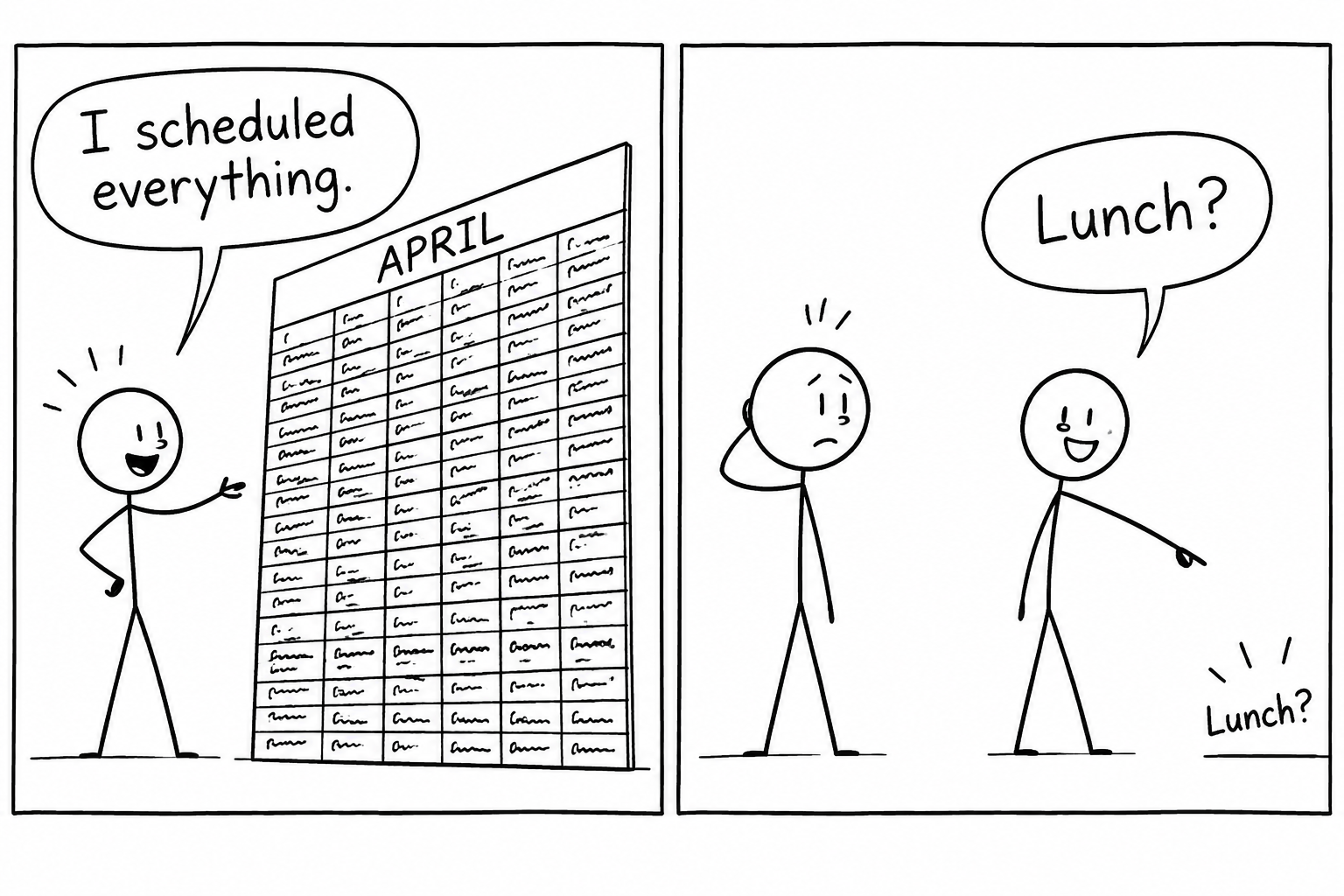 A Year 11 student discovers that an overfilled April revision calendar has forgotten lunch
Give marking its own place
A balanced week might include focused topic practice on Monday, mixed questions on Wednesday, a mini test on Thursday and a timed section at the weekend. Leave other days available for different subjects, rest or catch-up.
Schedule the review as carefully as the paper itself. Read the mark scheme, use video solutions where available, then redo incorrect questions without help. Record the skill you need to practise, not just the question number.
The paper creates information. Reviewing it turns that information into your next revision session. For a compressed schedule, compare the GCSE one-month maths revision plan.
Common April revision mistakes
Revising only comfortable topics
Keep some familiar questions for fluency, but give focused time to weaknesses within reach. Comfort is not always evidence of useful revision.
Collecting marks without correcting mistakes
Repeated papers can measure the same weaknesses repeatedly. Always leave time to understand errors and retest the relevant skills.
Ignoring your tier or timetable
Check your entry and confirmed exam dates with school. Ask your teacher if you are unsure which materials match your course.
Filling every available hour
Leave catch-up space. A missed session should lead to a small adjustment, not the collapse of the whole plan.
Turn April priorities into daily actions
You do not need a perfect timetable. You need a repeatable process: identify a gap, practise it, check your work and return to it later.
Use MathsGenie's revision lessons, practice questions, mini tests and past papers to make each session purposeful. Then build your schedule in the Revision Planner, giving corrections and rest their own space alongside exam practice.