Using RAG Ratings to Plan Revision
Using RAG ratings to plan revision helps you prioritise weak topics, test progress and build a focused GCSE or A Level revision schedule.
A parent looks at a revision timetable covered in neat coloured blocks. It appears organised. Yet their daughter is still spending most evenings on the topics she already understands, partly because success feels reassuring and partly because weakness is uncomfortable.
This is the problem that using RAG ratings to plan revision can solve. Rate each topic red, amber or green according to current evidence, then give more time to red and amber topics. Crucially, the colour should come from questions, past papers or mini tests, not confidence alone.
RAG ratings do not replace a timetable or decide how many hours you should revise. They answer a different question: what deserves your next revision session?
The RAG revision method at a glance
Use this practical cycle:
- Red: you cannot yet answer a typical exam question without substantial help.
- Amber: you understand some of the method but make errors, need prompts or struggle with unfamiliar questions.
- Green: you can answer exam-style questions accurately and explain your method without notes.
- Test topics before assigning colours.
- Give most revision time to red and amber topics.
- Retest regularly and change the ratings when the evidence changes.
- Keep some green-topic practice so earlier learning is not forgotten.
That final point matters. Green means secure for now, not finished forever.
How to create an honest RAG rating
Imagine a student called Leah preparing for GCSE Maths. She feels comfortable with simultaneous equations because the lesson made sense. She marks the topic green. Later, she attempts a question without notes and cannot decide how to begin.
Her first rating measured familiarity. The question measured learning.
A reliable RAG rating should combine three pieces of evidence:
| Evidence | What to check |
|---|---|
| Accuracy | Can you reach the correct answer? |
| Independence | Can you do it without notes, hints or a video? |
| Application | Can you handle an unfamiliar exam-style question? |
Start with your specification, school checklist or the topic lists within MathsGenie's GCSE Maths revision resources and A Level Maths revision resources. Attempt a small set of questions for each topic under quiet, closed-book conditions.
Use the result to choose a colour:
- Mark it red if you cannot begin, rely heavily on support or repeatedly use the wrong method.
- Mark it amber if your method is partly correct but inconsistent.
- Mark it green if you solve representative questions independently and can identify why your method works.
Do not require perfection before moving a topic from red to amber. RAG ratings are navigation signals, not judgements about ability.
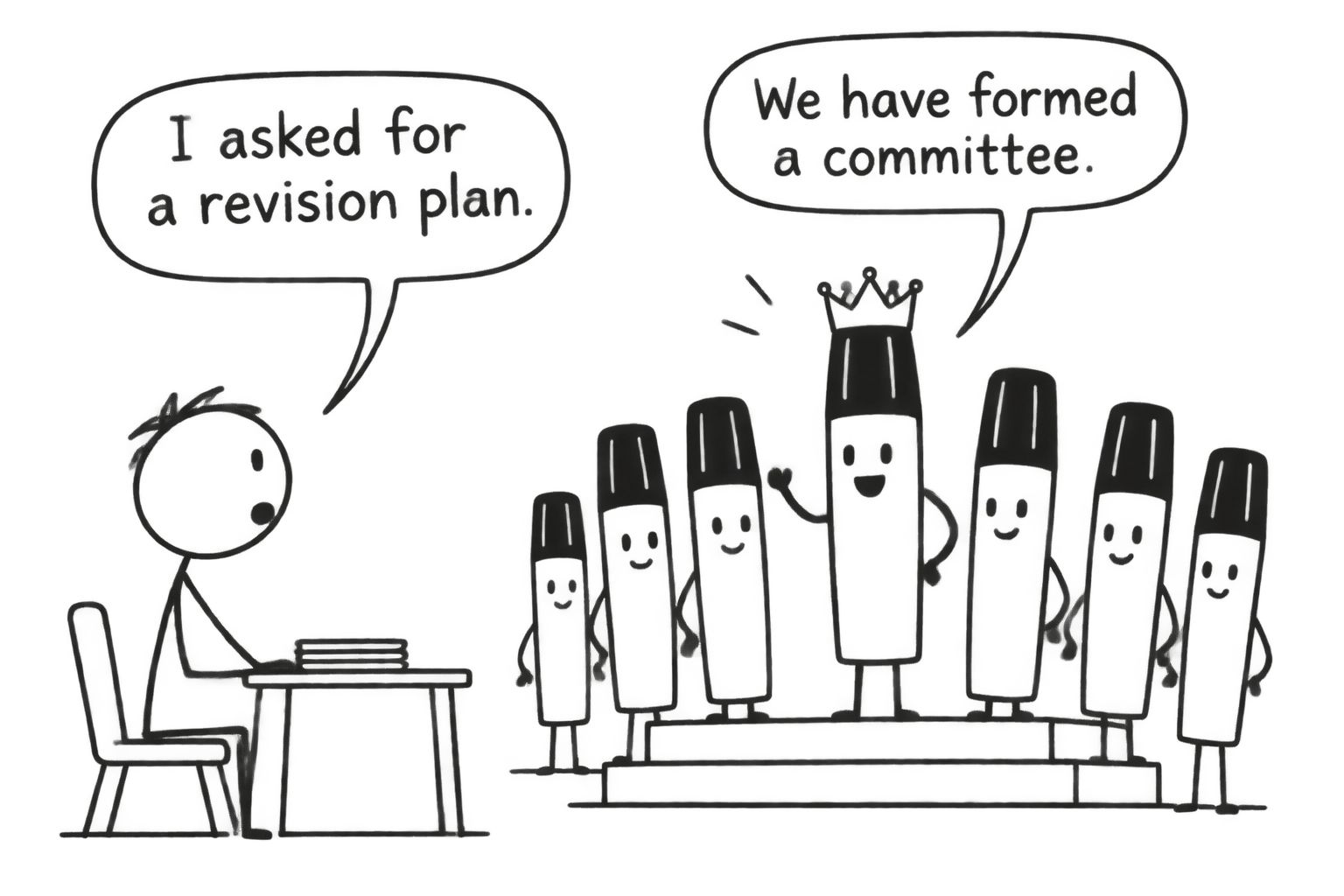 A student discovers that highlighters have formed their own revision-planning committee
Turn the colours into a revision plan
Colouring a checklist can feel productive while changing very little. The useful step is converting each rating into time and action.
A simple weekly split is:
- around half of your topic sessions on red areas;
- around a third on amber areas;
- the remaining sessions on green-topic retrieval and mixed exam practice.
These are starting proportions, not rigid rules. A student with an approaching assessment on one unit may temporarily weight that content more heavily. GCSE and A Level students should also consider exam dates, subject demands and whether a weak topic depends on an earlier skill.
For every session, write a specific task rather than a broad subject name. “Maths” creates a decision when you sit down. “Complete expanding double brackets practice, mark it and correct every error” removes that decision.
A useful session might follow this pattern:
- Retrieve the method from memory.
- Review a short explanation if needed.
- Complete practice questions without notes.
- Mark the work carefully.
- Record mistakes and schedule a retest.
MathsGenie's topic pages bring together revision lessons and practice by GCSE grade, while GCSE Maths past papers let you test whether skills transfer to mixed exam questions. A Level students can use the corresponding A Level past papers to gather broader evidence.
Once you have your coloured list and weekly priorities, build a schedule in the MathsGenie Revision Planner rather than repeatedly arranging the same plan on paper.
Fit RAG ratings into a realistic timetable
RAG ratings decide priority. Your timetable decides when the work happens.
Begin with the time you genuinely have after lessons, homework, meals, sleep and other commitments. Then assign short, defined topic sessions to available spaces. Avoid building an impressive timetable that assumes every evening will go perfectly.
Leah might have three maths sessions in one week. Her plan could contain one red algebra topic, one red geometry topic and one amber statistics topic. Ten green topics do not need ten separate sessions. They can be checked through mixed questions or a paper.
This keeps revision planning responsive without allowing it to consume revision time. Set the plan once each week, then make brief updates after marking work. For broader help with structuring preparation, use MathsGenie's free maths revision resources.
Update ratings through testing, not mood
A difficult session can make a student feel that nothing is improving. An easy session can create the opposite illusion. Neither feeling provides enough evidence on its own.
Retest red and amber topics after a gap, using different questions from the original practice. This checks whether you remember the method rather than merely recognising yesterday's answers.
Move a topic:
- from red to amber when you can complete the core method with limited support;
- from amber to green when you can answer varied questions independently;
- from green back to amber when later retrieval reveals gaps.
Moving a colour backwards is not failure. It is useful information arriving early enough to act on.
Past papers become increasingly important as exams approach because topics do not appear in tidy colour-coded groups. Use the relevant Edexcel GCSE Maths papers, AQA GCSE Maths papers or OCR GCSE Maths papers, then trace mistakes back to your RAG list. Always check that resources match your exam board and tier.
Common mistakes when using RAG ratings
Rating confidence instead of performance
A topic can feel familiar because you have watched a solution. Attempt it independently before choosing a colour.
Revising only red topics
Red topics deserve priority, but exclusive attention creates new gaps. Include spaced checks of amber and green material.
Leaving categories too broad
“Algebra” is not a useful rating. Separate it into skills such as factorising, rearranging formulae and solving quadratic equations. Precise labels produce precise sessions.
Never changing the colours
A static RAG sheet becomes decoration. Review ratings after mini tests, marked questions and past papers.
Spending longer planning than practising
Use one short weekly review. The purpose of the system is to make the next action obvious, not to create a perfect-looking spreadsheet.
Build your colour-coded schedule
Leah's progress begins when the colours stop being labels and start determining her next task. Knowing that a topic is red is valuable, but improvement comes from scheduling the practice, marking it and returning for a later check.
You now have the same method: test, rate, prioritise and retest. Exams have fixed dates, so turn your current red and amber topics into specific sessions while there is still time to revisit them. Build your schedule in the MathsGenie Revision Planner.