

Using A-Level Maths Mock Results for UCAS
Using A-Level Maths mock results for UCAS: understand predicted grades, discuss feedback with teachers and turn weak topics into a focused revision plan.
The paper comes back face down. Before you turn it over, you are already thinking about university: the course you liked, its entry requirements, and whether this result changes your chances. Using A-Level Maths mock results for UCAS means understanding how they may inform your predicted grade, then using the feedback to build stronger evidence of your progress. A mock grade is not automatically your UCAS prediction.
Imagine a sixth-form student opening that paper and finding a result below their target. Their most useful next step is to understand the school's prediction policy, discuss the evidence with their teacher, and turn the marked script into a focused revision plan.
That gives the result a purpose beyond the disappointment of the first few minutes.
Your mock-to-UCAS checklist
Before making decisions about university choices, work through these steps:
- Ask how your school or college uses mocks when setting predicted grades.
- Review where you lost marks, including questions you partly understood.
- Agree specific improvement priorities with your maths teacher.
- Practise those skills, then test them again independently.
- Compare course requirements with your predicted grades and your adviser's guidance.
Start with the MathsGenie A Level Maths revision resources, selecting the correct exam board and specification. The closer your practice matches what you need to learn, the more useful the resulting evidence becomes.
Using A-Level Maths mock results for UCAS predictions
UCAS describes a predicted grade as the grade your school or college believes you are likely to achieve in positive circumstances. Your mock result can contribute to that judgement, but the two grades serve different purposes.
A mock records your performance on a particular assessment. A prediction looks ahead to your likely qualification outcome. Your school may consider mocks alongside class assessments, homework and other evidence, according to its own policy.
For our hypothetical student, that distinction matters. A disappointing paper deserves attention, but it does not explain everything by itself. Was the assessment based only on content taught so far? Were several lost marks concentrated in one topic? Does the result match their performance across the term?
Ask your teacher how the prediction is reached and whether there are further opportunities to demonstrate progress. Avoid assuming that another school’s process applies to yours.
You are looking for a clear account of the evidence and the next steps available.
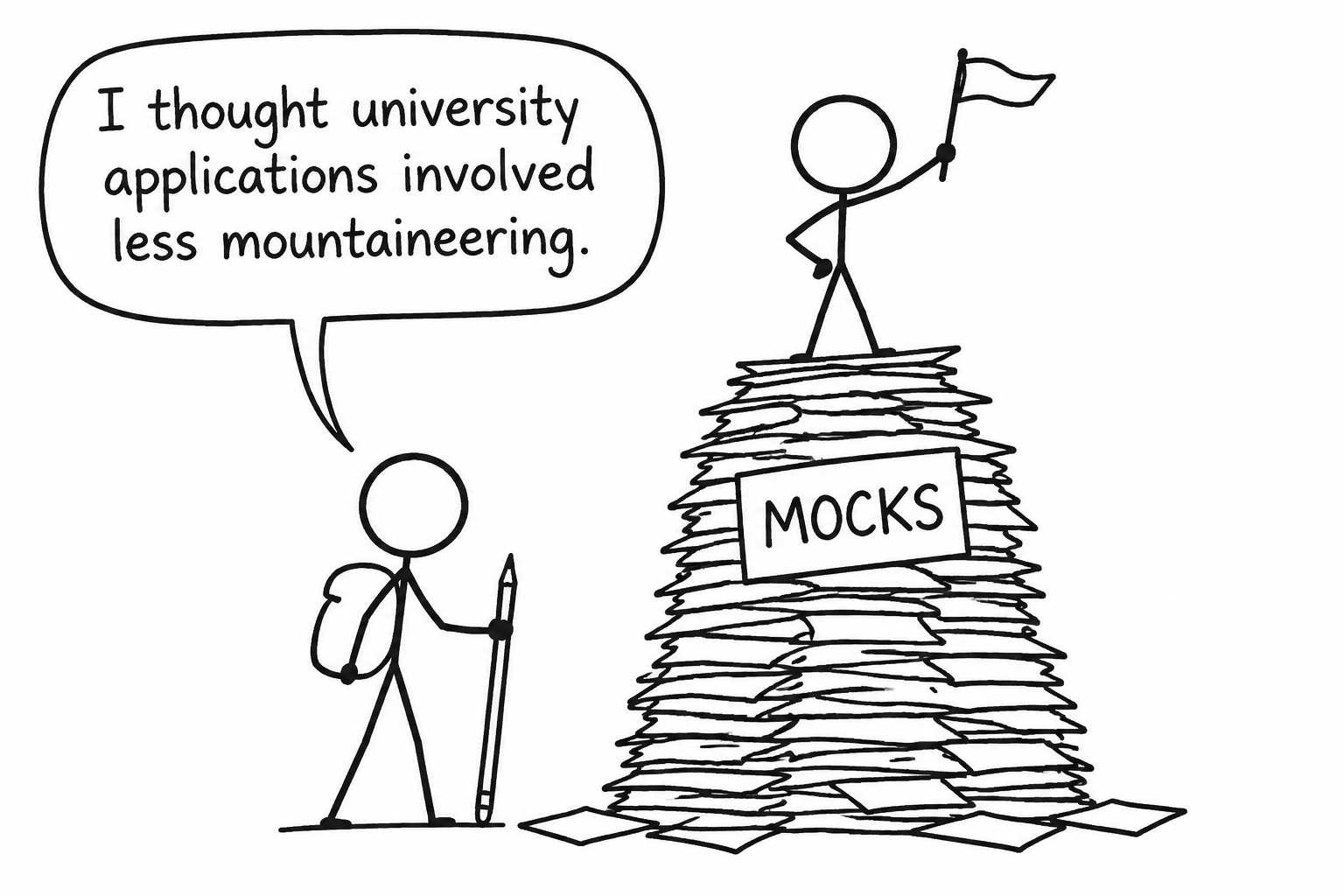 Two stick-figure students treat a pile of mock papers as a mountain, joking about university applications.
Read the script before reacting to the grade
Later that afternoon, the student opens the paper again. This time, they cover the total and read the annotations.
That is where useful A-Level maths revision begins. A lost mark can have several causes: an unfamiliar method, an algebraic slip, a misread instruction or a question left unfinished. Each needs a different response.
Sort the errors into a short record:
| What happened | What to do next |
|---|---|
| You could not choose a method | Revisit the topic explanation, then attempt unfamiliar questions |
| You chose a suitable method but made algebraic errors | Practise accurate manipulation and check intermediate lines |
| You misunderstood the question | Identify its command words and required answer form |
| You ran out of time | Practise timed sections and review where time was spent |
| You understood the solution only after seeing it | Retry the question later without prompts |
Use mark schemes to identify what your working needed to show. Then close the solution and try again. Understanding somebody else's method and producing it independently are different stages of learning.
For Edexcel students, the A Level Maths question bank provides topic-based practice with mark schemes. Students taking other boards should select matching resources from the A Level hub.
Turn a weak topic into measurable progress
Suppose our student notices repeated errors when differentiating products. A short worked example shows how to turn that observation into a precise revision target.
Differentiate:
y=x2sinx.y=x^2\sin x.y=x2sinx.The product rule gives:
dydx=2xsinx+x2cosx.\frac{dy}{dx}=2x\sin x+x^2\cos x.dxdy=2xsinx+x2cosx.If the student wrote only 2xcosx2x\cos x2xcosx, they differentiated both factors and multiplied the results. The issue is a misunderstanding of the product rule. Their revision needs to address when and how to use it.
They can revisit the explanation, attempt several questions independently, and return to the topic later within a mixed set. That final step matters: an exercise labelled “product rule” tells you which method to use. A mixed paper asks you to recognise it yourself.
The Edexcel A Level Maths revision page brings together relevant practice resources. Use targeted questions first, then broader assessment once the method feels secure.
Make the predicted-grade conversation specific
A week later, our student has something useful to bring to their teacher: the marked mock, a short error record and fresh independent work.
A productive conversation might cover:
- Which evidence currently supports the predicted grade?
- Which weaknesses most limit performance?
- What would convincing improvement look like?
- Are there further assessments before the school finalises predictions?
Keep the discussion focused on learning and evidence. Completing a large pile of questions shows effort, but your teacher also needs to judge accuracy, independence and consistency.
If illness or other circumstances affected your mock, explain this promptly through your school's usual process. Ask how the circumstances can be considered rather than assuming the mark will speak for itself.
There is no universal number of extra marks that guarantees a higher prediction. Your school's policy and professional judgement matter.
Connect your results to university choices
Once you understand your predicted grade, revisit the requirements for the courses you are considering. Check the qualification and subject requirements carefully, including any specific Maths grade, Further Maths requirement or admissions assessment.
Discuss your choices with your UCAS adviser. Entry requirements provide essential information, but a mock percentage alone cannot tell you whether an application will succeed.
Also avoid treating a percentage as a fixed grade across every paper. The assessment's difficulty, content coverage and applicable grade boundaries affect its interpretation. Use the boundaries supplied for your mock and ask your teacher about anything unclear.
For broader practice, Edexcel A Level Maths past papers can help you assess performance across topics under timed conditions. Choose papers appropriate to the content you have covered.
Common mistakes after A-Level maths mocks
Revising only the comfortable topics. Familiar questions feel reassuring, but recurring weaknesses deserve protected time in your plan.
Counting corrected work as independent evidence. A solution completed with the mark scheme open is useful learning. Follow it with an unaided attempt to check what has stuck.
Treating one improved paper as a settled trend. Repeat the skills across different questions and occasions. Consistency makes progress easier to judge.
Waiting for a prediction discussion before changing your revision. Start addressing clear gaps while you clarify the school's process. Both actions can happen together.
Give the next assessment a clear purpose
By the next assessment, our student's original mock still matters, but it now sits beside a clearer picture: identified weaknesses, focused practice and evidence of what they can do independently.
That is the useful role of mock season. It gives you information early enough to act on it.
Use MathsGenie's free revision resources to revisit explanations, practise questions and check your working against mark schemes. Then build a targeted practice paper in Mock Exam Builder, focusing on the weaknesses your mock revealed. Complete it independently, review the result and take that evidence into your next conversation with your teacher.















