

Upper and Lower Bounds Exam Questions: GCSE Guide
Upper and lower bounds exam questions made clear with three step-by-step GCSE examples, method-mark guidance, common mistakes and focused practice advice.
Upper and lower bounds exam questions often feel harder than the underlying maths. The arithmetic is usually familiar. The difficulty is deciding which values belong in the calculation.
The reliable method is to find the error interval for every rounded measurement, choose the combination of bounds that produces the required extreme, and round only after completing the calculation. GCSE specifications expect students to interpret limits of accuracy, not simply repeat the rounded values.
Imagine a student called Maya working through three questions of rising difficulty. Her calculations are accurate, but the real improvement comes when she starts recording the bounds before touching her calculator.
Upper and lower bounds GCSE exam checklist
Use this process whenever a value has been rounded:
- Identify the rounding unit.
- Find half of that unit.
- Subtract it for the lower bound.
- Add it for the upper bound.
- Write the error interval if it helps.
- Decide which bounds make the requested result smallest or largest.
- Keep the full calculator value until the final step.
- Include the correct units and requested accuracy.
For a value xxx rounded to the nearest unit uuu, the general error interval is:
x−u2≤actual value<x+u2x-\frac{u}{2}\leq \text{actual value}<x+\frac{u}{2}x−2u≤actual value<x+2uThe lower bound is included. The upper bound is not, because a value exactly at the upper boundary would round to the next stated value.
Before attempting calculations with bounds, the Error Intervals Lesson provides a useful foundation. The matching Bounds Lesson then develops the method into full exam questions.
If setting up every possible question feels like a lot, use the Maths Genie Bounds Lessons to review the method, then apply it immediately in the Question Bank.
Question one: finding a simple error interval
Maya begins with a direct question.
A length is measured as 7.37.37.3 cm, correct to the nearest 0.10.10.1 cm. Write down its lower and upper bounds.
The rounding unit is 0.10.10.1 cm. Half of this is:
0.1÷2=0.050.1\div2=0.050.1÷2=0.05Maya subtracts and adds 0.050.050.05:
7.3−0.05=7.257.3-0.05=7.257.3−0.05=7.25 7.3+0.05=7.357.3+0.05=7.357.3+0.05=7.35Therefore:
7.25≤L<7.357.25\leq L<7.357.25≤L<7.35The lower bound is 7.257.257.25 cm and the upper bound is 7.357.357.35 cm.
A typical two-mark question may award one mark for identifying the correct half-unit and one for giving both bounds correctly. Exact mark allocations vary, so Maya shows the subtraction and addition rather than writing only the final interval.
The key habit is simple: do not add and subtract the complete rounding unit. Bounds sit half a rounding unit away from the stated measurement.
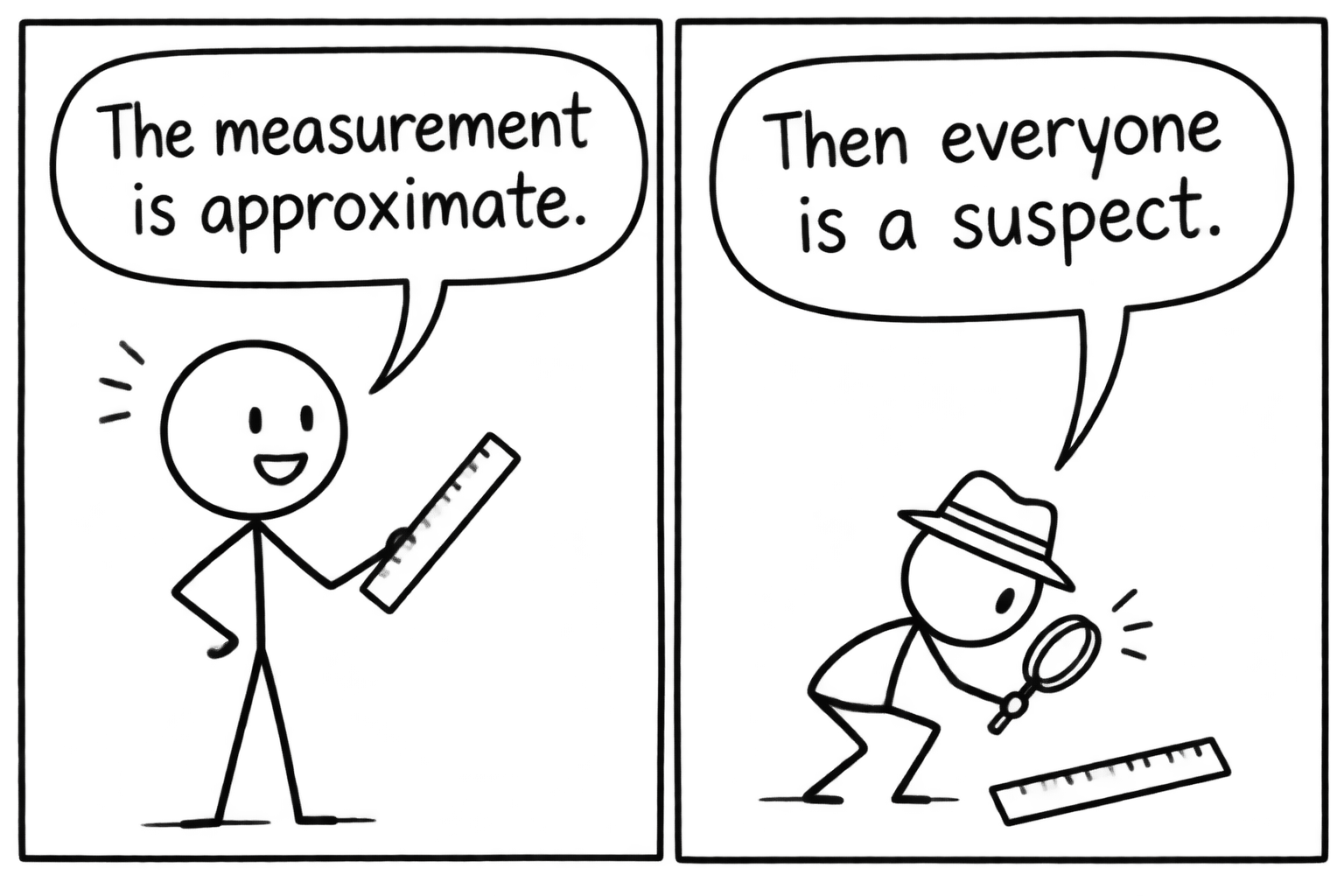 A student and a tiny detective investigate an approximate ruler measurement
Question two: the upper bound of an area
The next question requires Maya to choose the correct extremes.
A rectangle has a length of 8.48.48.4 cm and a width of 5.25.25.2 cm, each measured to the nearest 0.10.10.1 cm. Find the upper bound for its area.
First, Maya writes the limits for the length:
8.35≤l<8.458.35\leq l<8.458.35≤l<8.45Then the limits for the width:
5.15≤w<5.255.15\leq w<5.255.15≤w<5.25The area is:
A=lwA=lwA=lwTo make a product of positive measurements as large as possible, both values must be as large as possible. Maya therefore uses both upper bounds:
Aupper=8.45×5.25A_{\text{upper}}=8.45\times5.25Aupper=8.45×5.25 Aupper=44.3625A_{\text{upper}}=44.3625Aupper=44.3625The upper bound for the area is 44.362544.362544.3625 cm2^22.
For a typical three-mark structure, marks may come from finding the correct bounds, selecting both upper bounds and completing the multiplication accurately. Writing
8.45×5.258.45\times5.258.45×5.25is important because it makes Maya's method visible. If she makes a calculator slip later, that correct setup may still earn a method mark.
A common temptation is to calculate 8.4×5.28.4\times5.28.4×5.2 first and then adjust the answer. That does not account reliably for how both measurements vary. Find the individual bounds before applying the area formula.
Question three: bounds involving division
The final question is more demanding because division behaves differently.
A journey has a distance of 120120120 km, correct to the nearest 101010 km. The time taken is 2.42.42.4 hours, correct to the nearest 0.10.10.1 hour. Calculate the upper bound for the average speed. Give your answer to 333 significant figures.
Maya starts with the distance. Half of 101010 km is 555 km:
115≤d<125115\leq d<125115≤d<125For the time, half of 0.10.10.1 hour is 0.050.050.05 hour:
2.35≤t<2.452.35\leq t<2.452.35≤t<2.45Average speed is calculated using:
v=dtv=\frac{d}{t}v=tdTo make the fraction as large as possible, Maya needs the largest possible numerator and the smallest possible denominator. She uses the upper bound for distance and the lower bound for time:
vupper=1252.35v_{\text{upper}}=\frac{125}{2.35}vupper=2.35125 vupper=53.191489…v_{\text{upper}}=53.191489\ldotsvupper=53.191489…To 333 significant figures:
vupper=53.2 km/hv_{\text{upper}}=53.2\text{ km/h}vupper=53.2 km/hA typical four-mark route could reward the two correct error intervals, the correct upper-bound calculation and the accurately rounded final answer. The exact scheme depends on the exam board and question, but visible working protects Maya far better than a single calculator answer.
This is the central division rule for positive quantities:
largest quotient=largest numeratorsmallest denominator\text{largest quotient}=\frac{\text{largest numerator}}{\text{smallest denominator}}largest quotient=smallest denominatorlargest numeratorSimilarly:
smallest quotient=smallest numeratorlargest denominator\text{smallest quotient}=\frac{\text{smallest numerator}}{\text{largest denominator}}smallest quotient=largest denominatorsmallest numeratorHow method marks are protected
Upper and lower bounds past paper questions often contain several linked decisions. An incorrect final number does not always mean every mark is lost, provided the working shows a valid route.
Maya protects her method marks by writing:
- each error interval;
- the formula being used;
- the selected upper or lower values;
- the complete substitution;
- the unrounded calculator result;
- the final answer with units and required accuracy.
This structure also makes checking easier. If Maya sees an upper-speed calculation using the largest time, she can correct the choice before moving on.
For further exam-style practice, try a Bounds Question Bank problem on suitable accuracy, a three-decimal-place bounds question and a more challenging bounds problem. Each question should be attempted before checking its worked solution and mark scheme.
Common mistakes in bounds questions
Using the full rounding unit
For a measurement rounded to the nearest 0.10.10.1, the adjustment is 0.050.050.05, not 0.10.10.1. Always halve the rounding unit.
Including the upper end of an error interval
The conventional form is:
a≤x<ba\leq x<ba≤x<bUse ≤\leq≤ at the lower boundary and <<< at the upper boundary.
Choosing every upper bound
This works for the upper bound of a product involving positive values, but not for every calculation. In division, a smaller denominator creates a larger result.
Rounding during the calculation
Early rounding can slightly change the final answer. Keep the full calculator display and round only when the question asks you to.
Ignoring the requested quantity
Underline whether the question asks for a lower bound, an upper bound, a minimum, a maximum or a suitable degree of accuracy. Those words determine which extremes to select.
Exam-style practice routine
Start with direct error intervals, then move to products such as area and volume. Finish with division questions involving speed, density or rates. After each attempt, compare your setup with the worked solution, not only the final answer.
The complete Maths Genie Bounds topic page keeps the relevant explanations and practice together. This makes it easier to notice whether your difficulty comes from finding bounds or choosing which bounds to use.
Turn the method into exam marks
Maya's progress does not come from memorising more rules. It comes from slowing down long enough to write the intervals, choose the extremes and expose every useful step. You now have the same method, but knowing it and applying it consistently are different tasks.
Start the Bounds Lesson, then work through the Bounds Question Bank.















