

University GCSE English Language Requirement Guide
University GCSE English Language requirement explained: when universities check it, which courses ask for higher grades, and what to do if yours is low.
A university application can feel as though it belongs to a distant future. Then one question pulls that future sharply into the present: will universities really look back at a GCSE English Language result?
The short answer is yes. A university GCSE English Language requirement is common, even when you are applying for a degree in maths, engineering or science. For many courses, the requirement is simply a minimum standard, often grade 444 or an accepted equivalent. Other universities and competitive professional courses may ask for grade 555 or 666, and some use GCSE results more actively when selecting applicants.
That does not mean one grade defines your entire application. It means you should check the exact requirement early, understand whether it is a minimum or part of the selection process, and act while you still have options.
The quick checklist
Before worrying about your English Language grade, answer these questions:
- Does the individual university course specify GCSE English Language?
- What grade or equivalent qualification does it accept?
- Is the grade merely a minimum requirement, or are GCSEs scored competitively?
- Does the rule apply to English Language specifically rather than English Literature?
- Are resits accepted, and must the result be achieved before application?
- Does the course have separate English-language proficiency rules?
- Could contextual admissions or an alternative qualification affect the requirement?
Requirements can change between application cycles. Always use the course page for the year in which you intend to apply, then contact the university admissions team if the wording is unclear.
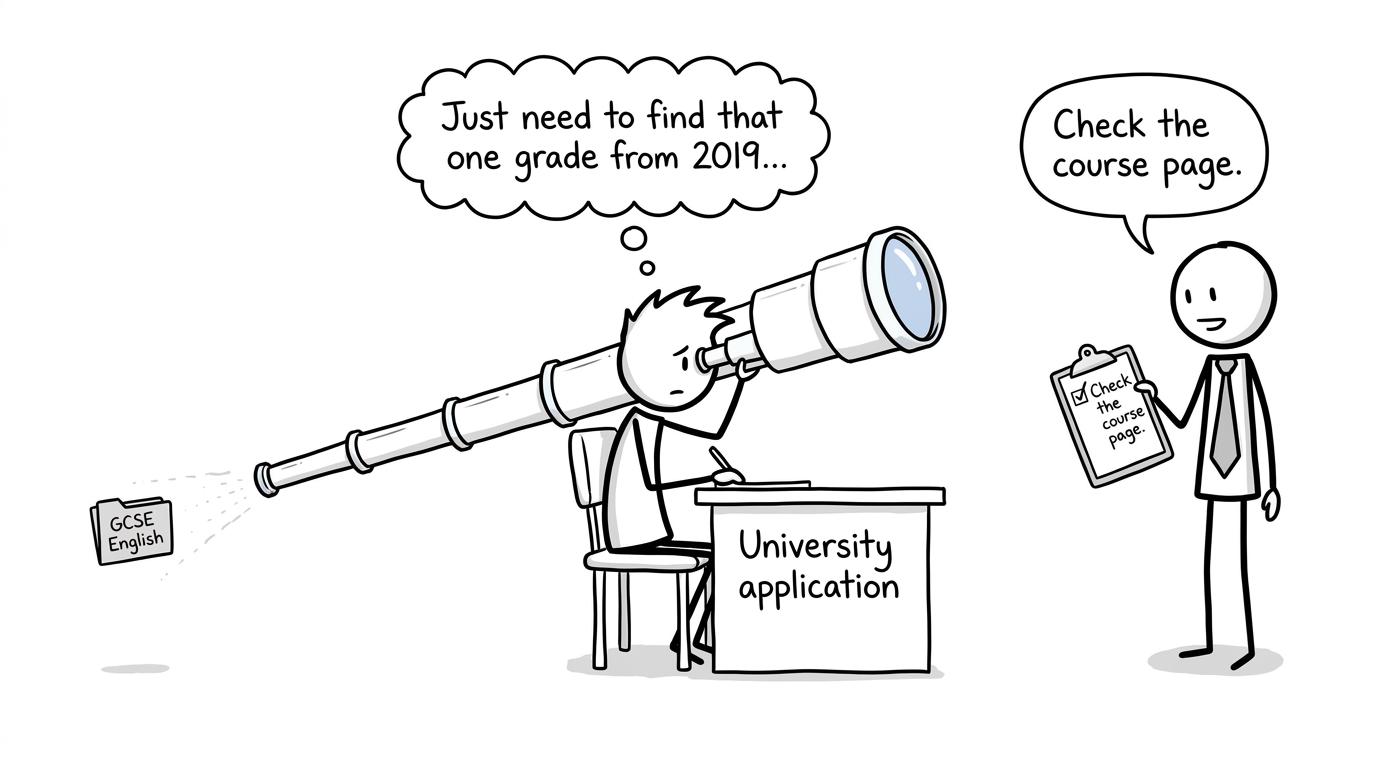 A student looking back at GCSE English through a university application telescope
Why universities may check GCSE English Language
Universities principally judge whether you are prepared for degree-level work. Your A Levels, T Levels, BTEC qualifications or other Level 333 results usually carry much of that weight, but GCSE English Language can still serve as evidence of a basic academic skill.
Every degree involves communication. A maths student must explain reasoning. An engineer writes reports. A scientist evaluates evidence. Even a highly numerical course may include group projects, presentations and extended written work.
That is why GCSE English Language sometimes operates like a key rather than a competition. Once you have the required grade, a stronger result may not necessarily improve your chance of admission. But without the minimum grade, the application may not meet the published criteria.
Current official admissions information illustrates how much policies vary. UCL states a general minimum of grade 444 in GCSE English Language and Mathematics, while noting that individual programmes may ask for higher grades. The University of Nottingham normally uses grade 444 in English Language as its general minimum, but some courses set higher requirements. Imperial College London has published higher English Language expectations for home applicants, with Medicine requiring more than its general home-student minimum for the relevant entry cycle.
These are examples, not universal rules. The important lesson is that the university name alone does not tell you enough. You need the requirements for the particular course and entry year.
When your English Language grade matters most
It is a stated minimum entry requirement
This is the most straightforward situation. A course might require GCSE English Language at grade 444, 555 or 666. If you do not have that grade or an accepted equivalent, strong A Level predictions may not automatically compensate for it.
Look carefully for phrases such as:
- “must include English Language”
- “minimum grade required”
- “requirements must be achieved before application”
- “or an accepted equivalent”
An essential requirement is different from a typical applicant profile. The first determines eligibility; the second describes the academic level of students who commonly apply or receive offers.
You are applying for a competitive professional course
Medicine is the clearest example. Some medical schools require grade 666 in English Language, Mathematics and relevant sciences. Certain medical admissions processes also score a selection of GCSE results when deciding whom to interview.
For example, published Medicine selection information from Nottingham includes English Language among the GCSE subjects considered and sets a minimum grade 666. Birmingham Medicine has also published a grade 666 English Language requirement. These policies show why general advice such as “universities only care about A Levels” can be misleading.
Requirements may also be especially important for Dentistry, Veterinary Science, teaching and some health-related courses. Professional or regulated programmes can have subject-specific conditions that do not apply across the rest of the university.
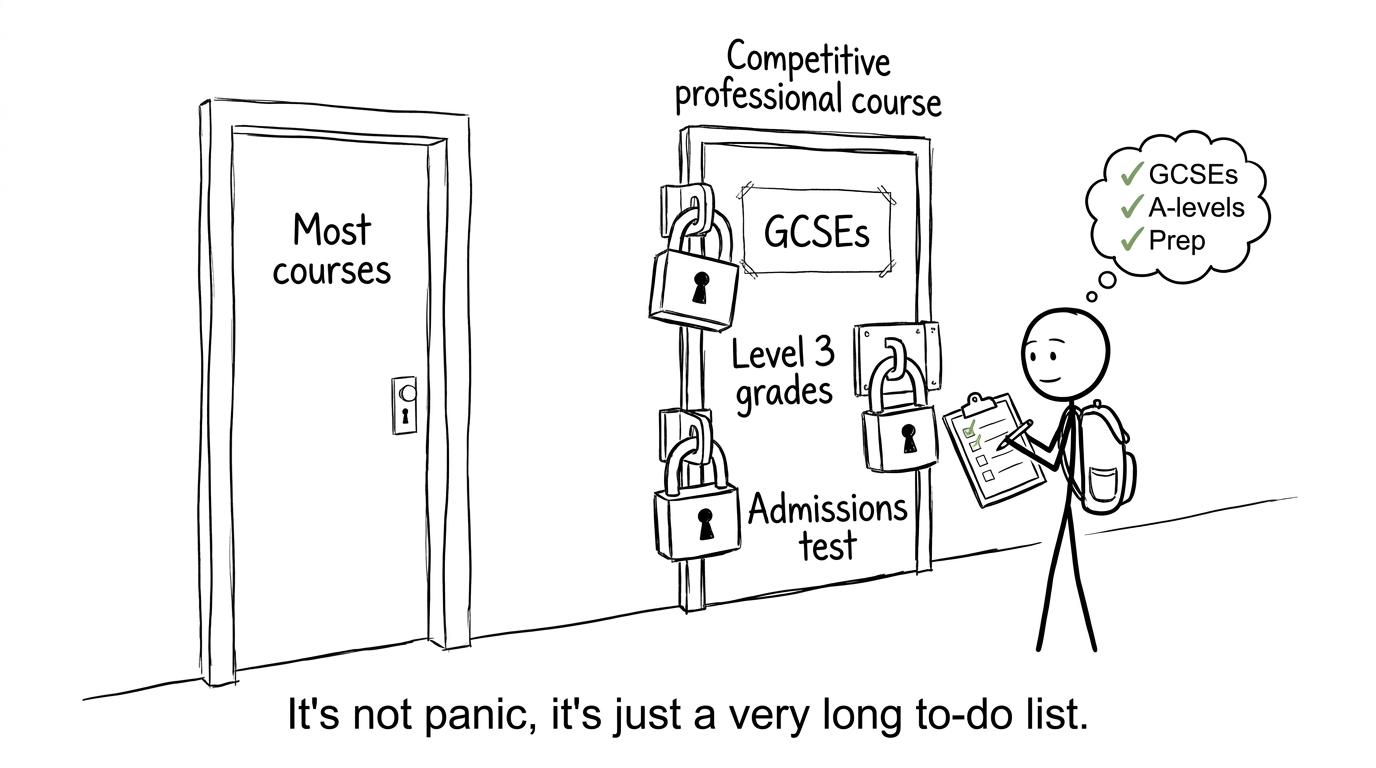 A student choosing between university course doors with different admissions locks
The university considers your wider GCSE profile
Some competitive courses do more than check that you passed English Language. They may consider the number and pattern of your GCSE grades, compare applicants academically or use GCSEs alongside an admissions test and Level 333 predictions.
In that situation, English Language is one part of a larger picture. A grade 666 might satisfy the subject requirement, while the rest of your GCSE profile still influences selection.
This is not how every university works. Avoid assuming that a policy used for Medicine also applies to a standard Mathematics, Physics or Engineering degree at the same institution.
You need evidence of English-language proficiency
A GCSE English Language condition and an English-language proficiency requirement are related, but they are not always identical.
Home applicants may be able to meet a university’s requirement through GCSE English Language. International applicants, or applicants with different qualifications, may need an approved test or another accepted form of evidence. Universities publish their own lists of acceptable qualifications and minimum scores.
Do not assume that GCSE English Literature can automatically replace English Language. Some universities accept particular combined qualifications, but others name English Language explicitly.
Do universities care about the exact grade above the minimum?
Sometimes. But not always.
If a course says it requires grade 444 and does not score GCSEs, a grade 777 may not bring an admissions advantage over a grade 444. Both applicants have crossed the published threshold. Their Level 333 subjects, predicted grades, achieved results and any other selection evidence may matter more.
The picture changes when:
- the course scores GCSEs;
- applicants are ranked using their academic profiles;
- the course asks for a higher grade in English Language;
- a strong overall GCSE record forms part of competitive selection.
This distinction can make revision feel more rational. You are not trying to maximise every number simply because higher is always better. You are trying to keep future routes open while giving the most attention to the subjects that matter for your next step.
For maths students, that means protecting both English Language and Mathematics while building a strong overall set of grades. The GCSE Maths revision hub gives you lessons, exam questions, papers and topic-based practice in one place.
What if your English Language grade is lower than required?
First, check the wording. A lower grade is a problem only when it falls below the rule that applies to your chosen course.
Then consider the practical options.
Ask whether a resit is accepted
Many universities consider GCSE English Language resits, but policies are not identical. Some competitive courses restrict resits, limit attempts or require qualifications to be completed by a particular stage in the admissions process.
Never rely on a general statement that “universities accept resits”. Check the admissions policy for the exact programme and ask for written clarification if necessary.
Check accepted equivalent qualifications
Universities may accept specified alternatives to GCSE English Language, but the lists differ. Functional Skills, international GCSEs and other qualifications are not treated uniformly. An alternative accepted by one institution may be rejected by another, particularly for regulated courses.
Build a realistic course list
A sensible application list reflects the qualifications you have, the results you are likely to achieve and the published entry criteria. If one course requires grade 666 and another accepts grade 444, that difference deserves attention before you apply.
This is not about lowering ambition. It is about directing ambition towards doors that can actually open, while improving any qualification that is blocking a course you genuinely want.
Balancing English with GCSE maths revision
When several subjects feel urgent, students often revise whichever one is creating the most anxiety. That is understandable, but anxiety is not a revision planner.
Start with evidence. For maths, complete a short test or exam paper, mark it honestly, and identify the topics responsible for lost marks. The GCSE maths topic checklist can help you organise gaps across number, algebra, ratio, geometry, probability and statistics.
Then use a simple cycle:
- learn or revisit one method;
- complete focused practice questions;
- mark your answers using the mark scheme;
- record the exact mistake;
- retest the topic after a gap;
- apply it later in a mixed paper.
The guide to using GCSE past papers properly explains how to turn each paper into a focused revision plan rather than simply collecting a score.
Your tier also matters. Foundation tier offers access to grades 111-555, while higher tier offers grades 444-999. If you are discussing a change with your teacher, use results rather than guesswork. MathsGenie’s guide to moving from foundation to higher tier explains the knowledge and evidence needed for a sensible decision.
 A revision robot helping a student queue English, maths and A Level priorities
Common mistakes when checking university requirements
Reading the university-wide requirement but not the course page
A university may publish a general English Language minimum while Medicine, teaching or another course sets a higher condition. The course-specific rule is the one you need to satisfy.
Confusing English Language with English Literature
Universities usually name English Language when they want evidence of core English competency. English Literature is valuable, but it is not automatically an alternative.
Treating a minimum grade as a guaranteed offer
Meeting the GCSE condition makes you eligible under that part of the criteria. It does not guarantee admission. You must still satisfy the Level 333 requirements and any other selection conditions.
Assuming one course represents every university
There is no single grade that covers every UK degree. Requirements differ by institution, subject, applicant circumstances and entry year.
Waiting until the UCAS deadline to investigate
Early checking gives you time to discuss resits, choose suitable Level 333 subjects and build a balanced shortlist. Late checking turns a manageable requirement into an unpleasant surprise.
Keep the grade in perspective
Universities do sometimes look back as far as GCSE English Language. For many courses, it is a threshold: meet the stated minimum and the application moves forward. For competitive or professionally regulated degrees, it can matter more and may form part of a wider GCSE assessment.
Your next action is simple. Check the current page for every course you are considering, write down the precise English Language condition, and ask the admissions team about anything ambiguous. Then return your attention to what you can still improve.
For maths, start with MathsGenie’s free revision resources. Use revision lessons and practice questions to repair weak topics, mini tests to check recall, and past papers, predicted papers, mark schemes and video solutions to build exam confidence. A future application is shaped by many decisions, but the useful ones are usually small, specific and made early.










