Unit Conversions GCSE Maths Explained
Unit conversions GCSE maths made simple with clear rules, worked examples, common mistakes and exam-style questions for confident revision at every tier.
Getting a conversion wrong can feel strangely unfair. You understood the shape, chose the correct formula and used your calculator accurately. Then the answer disappeared because one measurement was in centimetres and another was in metres.
Imagine a student called Sam. Sam treats every conversion as a half-remembered instruction: move the decimal point, add some zeros and hope. What finally makes unit conversions GCSE maths click is a more dependable idea. Converting units does not change the actual measurement. It only changes the number used to describe it.
A distance of 222 metres is the same distance as 200200200 centimetres. The unit becomes smaller, so more of those units are needed. That single thought is more useful than memorising which way a decimal point moves.
The unit conversion checklist
Before attempting any conversion, use this short method:
- Identify the unit you have and the unit you need.
- Write the relevant conversion fact.
- Decide whether the answer should become larger or smaller.
- Multiply or divide by the conversion factor.
- Include the correct unit in the final answer.
- Check whether the measurement involves length, area or volume.
You can see this process developed in the Metric Conversions lesson, with explanations that build towards GCSE exam-style problems.
Metric conversion facts to know
These are the main relationships used in GCSE questions:
| Measurement | Conversion fact |
|---|---|
| Length | 1 cm=10 mm1\text{ cm}=10\text{ mm}1 cm=10 mm |
| Length | 1 m=100 cm1\text{ m}=100\text{ cm}1 m=100 cm |
| Length | 1 km=1000 m1\text{ km}=1000\text{ m}1 km=1000 m |
| Mass | 1 kg=1000 g1\text{ kg}=1000\text{ g}1 kg=1000 g |
| Capacity | 1 litre=1000 ml1\text{ litre}=1000\text{ ml}1 litre=1000 ml |
| Volume and capacity | 1 cm3=1 ml1\text{ cm}^3=1\text{ ml}1 cm3=1 ml |
The central question is not simply, “Do I multiply or divide?” Ask whether you are moving to a smaller or larger unit.
When converting from a larger unit to a smaller unit, multiply. There are 100100100 centimetres in each metre, so the numerical answer must increase.
When converting from a smaller unit to a larger unit, divide. It takes 100010001000 grams to make one kilogram, so a mass written in kilograms has a smaller numerical value.
Sam starts drawing a quick arrow above each calculation:
larger unit→multiplysmaller unit\text{larger unit}\xrightarrow{\text{multiply}}\text{smaller unit}larger unitmultiplysmaller unit smaller unit→dividelarger unit\text{smaller unit}\xrightarrow{\text{divide}}\text{larger unit}smaller unitdividelarger unitThat small pause prevents most direction errors.
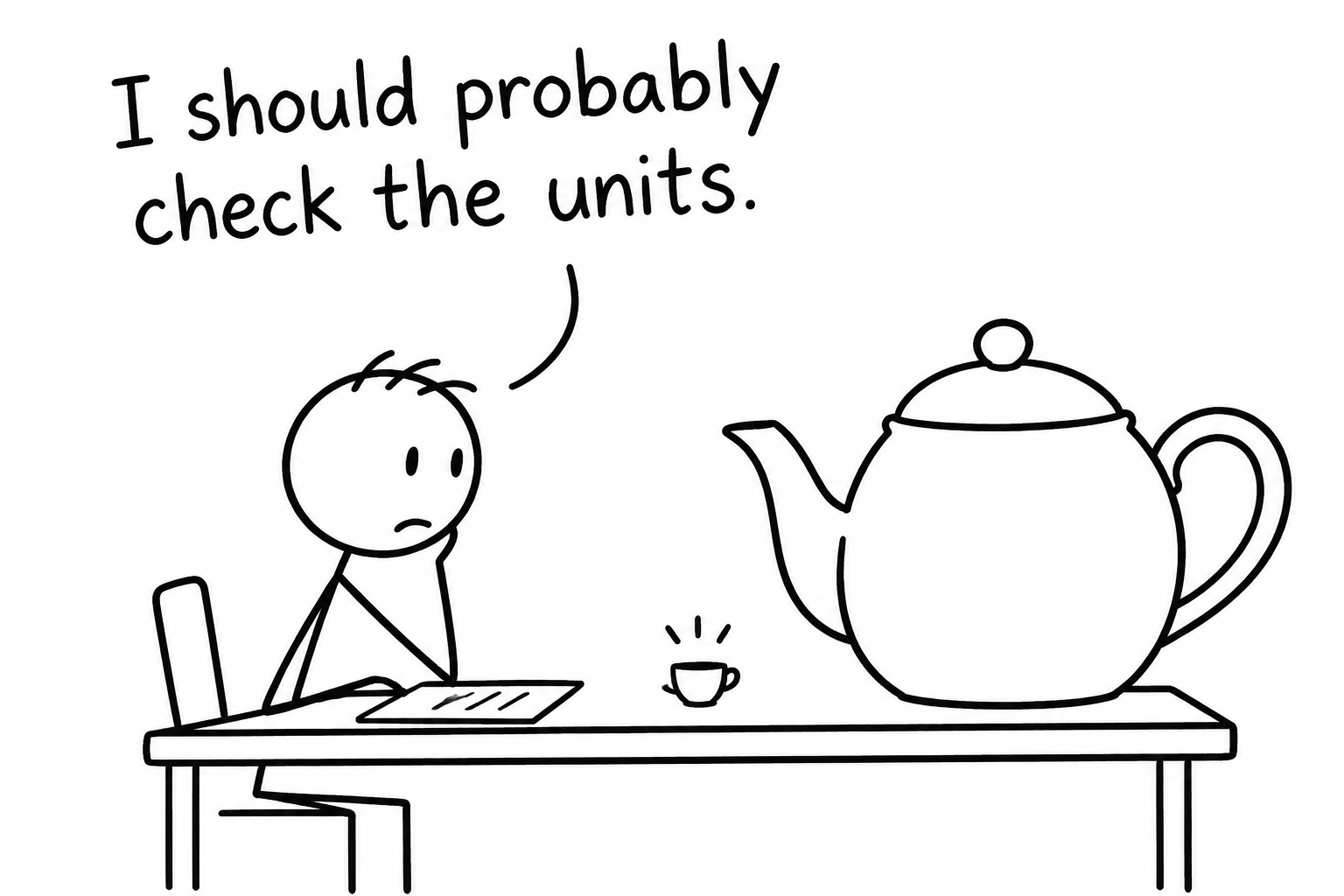 A student realises that checking units matters before pouring an enormous teapot into a tiny cup
Unit conversions worked examples
Converting metres to centimetres
Convert 3.7 m3.7\text{ m}3.7 m to centimetres.
Start with the conversion fact:
1 m=100 cm1\text{ m}=100\text{ cm}1 m=100 cmCentimetres are smaller than metres, so multiply by 100100100:
3.7×100=3703.7\times100=3703.7×100=370Therefore:
3.7 m=370 cm3.7\text{ m}=370\text{ cm}3.7 m=370 cmThe answer is larger numerically, which is sensible because it takes many centimetres to describe the same distance.
Converting grams to kilograms
Convert 4650 g4650\text{ g}4650 g to kilograms.
Use:
1000 g=1 kg1000\text{ g}=1\text{ kg}1000 g=1 kgKilograms are larger units, so divide by 100010001000:
4650÷1000=4.654650\div1000=4.654650÷1000=4.65Therefore:
4650 g=4.65 kg4650\text{ g}=4.65\text{ kg}4650 g=4.65 kgFor more guided examples, use the Metric Conversions revision guide alongside your own written working.
Converting hours and minutes
Time conversions need particular care because time is not organised entirely in multiples of 101010.
Convert 2.42.42.4 hours into hours and minutes.
The whole-number part gives 222 hours. Convert the remaining 0.40.40.4 hours into minutes using 111 hour =60=60=60 minutes:
0.4×60=240.4\times60=240.4×60=24Therefore:
2.4 hours=2 hours 24 minutes2.4\text{ hours}=2\text{ hours }24\text{ minutes}2.4 hours=2 hours 24 minutesA common wrong answer is 222 hours 404040 minutes. That treats time as though an hour contained 100100100 minutes.
Once this method feels clear, use the Maths Genie Metric Conversions lesson and Question Bank to practise choosing the operation without relying on guesswork.
Area and volume need different scale factors
This is where Sam’s original rule breaks down. Multiplying by 100100100 works when converting metres to centimetres, but not when converting square metres to square centimetres.
A square with side length 1 m1\text{ m}1 m has side length 100 cm100\text{ cm}100 cm. Its area is:
100×100=10000 cm2100\times100=10000\text{ cm}^2100×100=10000 cm2Therefore:
1 m2=10000 cm21\text{ m}^2=10000\text{ cm}^21 m2=10000 cm2The length scale factor is 100100100, so the area scale factor is:
1002=10000100^2=100001002=10000Convert 2.6 m22.6\text{ m}^22.6 m2 to square centimetres:
2.6×10000=260002.6\times10000=260002.6×10000=26000Therefore:
2.6 m2=26000 cm22.6\text{ m}^2=26000\text{ cm}^22.6 m2=26000 cm2For volume, cube the length scale factor. Since 1 m=100 cm1\text{ m}=100\text{ cm}1 m=100 cm:
1 m3=1003 cm3=1000000 cm31\text{ m}^3=100^3\text{ cm}^3=1000000\text{ cm}^31 m3=1003 cm3=1000000 cm3Convert 0.03 m30.03\text{ m}^30.03 m3 to cubic centimetres:
0.03×1000000=300000.03\times1000000=300000.03×1000000=30000Therefore:
0.03 m3=30000 cm30.03\text{ m}^3=30000\text{ cm}^30.03 m3=30000 cm3The pattern is worth remembering:
- Length uses the ordinary scale factor.
- Area uses the scale factor squared.
- Volume uses the scale factor cubed.
The Conversions and Units revision resources provide further practice with conversions inside longer problems.
Conversions inside exam questions
Unit conversion questions are not always labelled clearly. A question may give a rectangle’s length in metres and width in centimetres, or ask for a speed using kilometres and minutes. Convert the quantities into compatible units before applying a formula.
Suppose a rectangle is 1.2 m1.2\text{ m}1.2 m long and 80 cm80\text{ cm}80 cm wide. Convert 1.2 m1.2\text{ m}1.2 m into centimetres first:
1.2×100=120 cm1.2\times100=120\text{ cm}1.2×100=120 cmNow calculate the area:
120×80=9600 cm2120\times80=9600\text{ cm}^2120×80=9600 cm2Writing the units on every line makes the structure visible. It also helps you notice if you have accidentally multiplied metres by centimetres.
You can practise this exam wording through the Edexcel Metric Conversions questions. Students following another specification can use the corresponding AQA Metric Conversions questions or Eduqas Metric Conversions resources.
Common unit conversion mistakes
Moving the decimal point without a reason
A decimal shortcut can work, but it is easy to move it in the wrong direction. Write the conversion factor and use multiplication or division instead.
Using the length factor for area or volume
For 1 m21\text{ m}^21 m2, the conversion factor to square centimetres is 1002100^21002, not 100100100. For 1 m31\text{ m}^31 m3, it is 1003100^31003.
Treating time as a decimal system
Use 606060 seconds in a minute and 606060 minutes in an hour. For example:
1.5 hours=1 hour 30 minutes1.5\text{ hours}=1\text{ hour }30\text{ minutes}1.5 hours=1 hour 30 minutesConverting after using a formula
Sometimes this works, but it often creates extra difficulty. Converting all lengths into the same unit before calculating is usually safer.
Leaving off units
A number alone does not fully answer a measurement question. Write units throughout your working and check whether the final answer needs mm\text{mm}mm, cm2\text{cm}^2cm2, m3\text{m}^3m3 or another unit.
Exam-style practice
Try these unit conversions questions before checking the answers.
- Convert 4.28 m4.28\text{ m}4.28 m to centimetres.
- Convert 7350 ml7350\text{ ml}7350 ml to litres.
- Convert 2.252.252.25 hours to hours and minutes.
- Convert 0.7 m20.7\text{ m}^20.7 m2 to square centimetres.
- Convert 240000 cm3240000\text{ cm}^3240000 cm3 to cubic metres.
- A rectangle measures 2.4 m2.4\text{ m}2.4 m by 75 cm75\text{ cm}75 cm. Find its area in square centimetres.
Answers
- 428 cm428\text{ cm}428 cm
- 7.35 litres7.35\text{ litres}7.35 litres
- 222 hours 151515 minutes
- 7000 cm27000\text{ cm}^27000 cm2
- 0.24 m30.24\text{ m}^30.24 m3
- 18000 cm218000\text{ cm}^218000 cm2
Turn the method into reliable marks
Sam’s improvement begins when conversions stop being a decimal-point trick and become a decision: identify the units, choose the factor, predict whether the number should grow or shrink, then calculate. Knowing that method is the first step; applying it accurately under exam pressure requires purposeful practice.
Your turn: start the Maths Genie Metric Conversions Lessons and Question Bank and work through the unit conversions until each scale factor feels familiar.