Metric Conversions
x

Revision notes for Edexcel GCSE Maths Metric Conversions. Open the guide for explanations and worked examples. Written against the Edexcel GCSE Maths (1MA1) specification, so the content matches what's examinable rather than general Maths background.

Metric Conversions

What you'll learn

  • Understand a unit: the label on a measurement, such as cm, kg or litres.
  • Use metric facts for length (distance), mass (how heavy something is) and capacity (liquid amount).
  • Decide when to multiply or divide by 10, 100 or 1000.
  • Check whether your answer should get bigger or smaller.

Metric units: what changes?

A measurement has two parts: a number and a unit. For example, in 30 cm, the number is 30 and the unit is cm.

Definition

Metric conversion

The metric system is a measurement system using units like metres, grams and litres. A conversion changes from one unit to another without changing the real amount.

Key facts to remember

Learn these facts:

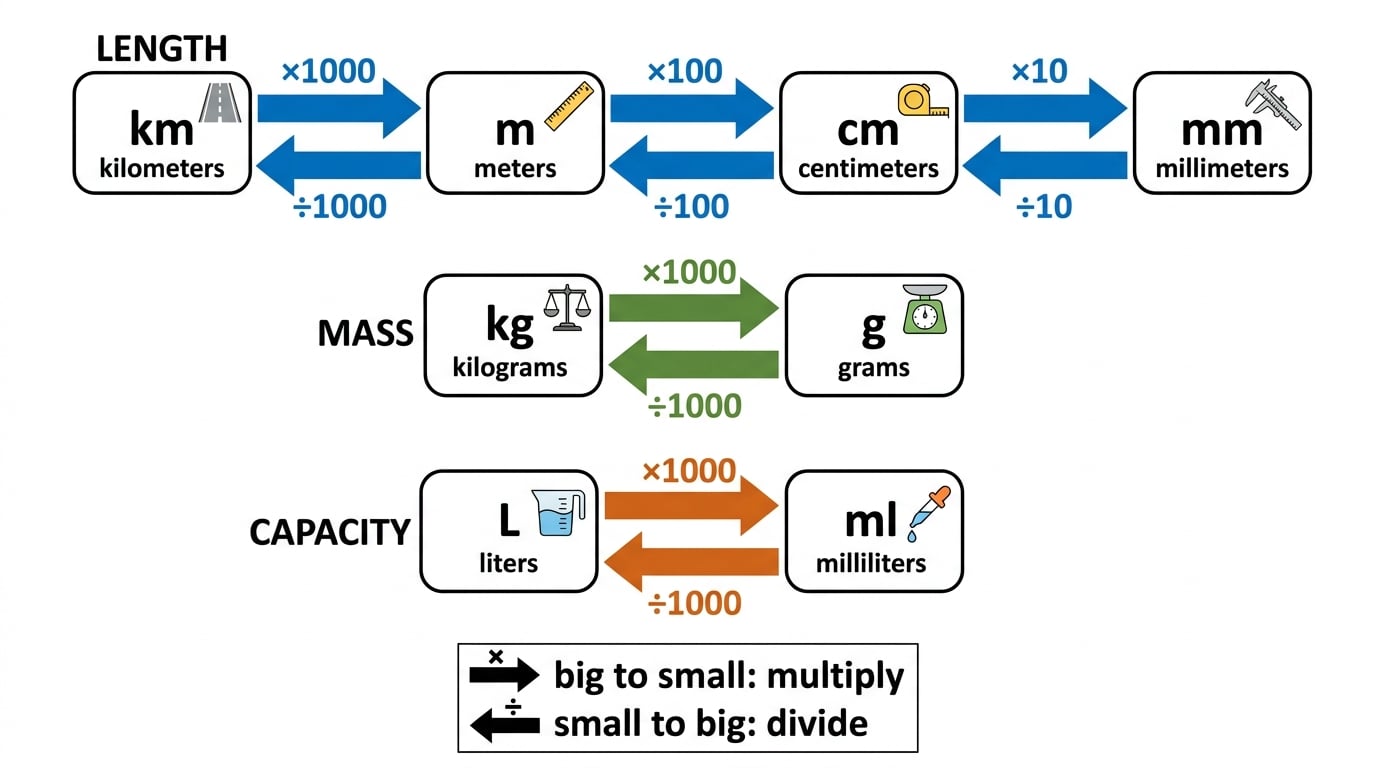
A metric conversion ladder showing whether to multiply or divide between common length, mass and capacity units.

Metric conversion ladder showing the key links between common length, mass and capacity units.

  • 1 kilometre = 1000 metres
  • 1 metre = 100 centimetres
  • 1 centimetre = 10 millimetres
  • 1 kilogram = 1000 grams
  • 1 litre = 1000 millilitres

The short unit names are:

  • kilometres = km
  • metres = m
  • centimetres = cm
  • millimetres = mm
  • kilograms = kg
  • grams = g
  • millilitres = ml
Example

Change 6 metres to centimetres

Six one-metre lengths are each split into 100 centimetres, so the number of centimetres is larger.

  1. You are changing from metres to centimetres.

  2. Use the fact 1 metre = 100 centimetres.

  3. There are 6 lots of 100, so calculate:

    6×100=6006 \times 100 = 6006×100=600
  4. Answer: 600 cm.

Big unit to smaller unit: multiply

A bigger unit covers more. For example, 1 km is much longer than 1 m.

If you change to a smaller unit, you need more of them, so the number gets bigger.

Changing from a larger unit to a smaller unit makes the numerical value increase, so you multiply.

Key Idea

Big to small means multiply

Changing from a bigger unit to a smaller unit makes the number bigger, so multiply by the conversion number.

Example

Change 2.7 kilometres to metres

Changing from kilometres to metres goes from a larger unit to a smaller unit, so the number increases.

  1. Kilometres are bigger than metres.

  2. Use the fact 1 km = 1000 m.

  3. Because you are going from big to small, multiply by 1000:

    2.7×1000=27002.7 \times 1000 = 27002.7×1000=2700
  4. Answer: 2700 m.

Example

Change 0.72 kilograms to grams

Kilograms are larger than grams, so converting 0.72 kg to grams uses many smaller gram units.

  1. Kilograms are bigger than grams.

  2. Use the fact 1 kg = 1000 g.

  3. Multiply by 1000:

    0.72×1000=7200.72 \times 1000 = 7200.72×1000=720
  4. Answer: 720 g.

Smaller unit to big unit: divide

If you change to a bigger unit, you need fewer of them, so the number gets smaller.

Changing from a smaller unit to a larger unit makes the numerical value decrease, so you divide.

For example, 3000 g is only 3 kg, because kilograms are larger units.

Example

Change 4300 grams to kilograms

Converting grams to kilograms groups grams into thousands, so the number becomes smaller.

  1. Grams are smaller than kilograms.

  2. Use the fact 1000 g = 1 kg.

  3. Because you are going from small to big, divide by 1000:

    4300÷1000=4.34300 \div 1000 = 4.34300÷1000=4.3
  4. Answer: 4.3 kg.

Common Mistake

Multiplying every time

Do not automatically multiply just because you see 1000. First ask: “Am I changing to a bigger unit or a smaller unit?”

Length conversions

Length means distance or how long something is.

For length, there are three common links:

A length unit chain summarising the three GCSE metric links for kilometres, metres, centimetres and millimetres.

  • km to m uses 1000
  • m to cm uses 100
  • cm to mm uses 10

Metres and centimetres

Example

Change 8.4 metres to centimetres

  1. Metres are bigger than centimetres.

  2. Use the fact 1 metre = 100 centimetres.

  3. Going from big to small means multiply:

    8.4×100=8408.4 \times 100 = 8408.4×100=840
  4. Answer: 840 cm.

Example

Change 950 centimetres to metres

Centimetres are grouped into hundreds to make metres.

  1. Centimetres are smaller than metres.

  2. Use the fact 100 cm = 1 m.

  3. Going from small to big means divide:

    950÷100=9.5950 \div 100 = 9.5950÷100=9.5
  4. Answer: 9.5 m.

Centimetres and millimetres

Example

Change 37 centimetres to millimetres

Each centimetre contains 10 millimetres, so converting to millimetres makes the number larger.

  1. Centimetres are bigger than millimetres.

  2. Use the fact 1 cm = 10 mm.

  3. Going from big to small means multiply:

    37×10=37037 \times 10 = 37037×10=370
  4. Answer: 370 mm.

Tip

Quick size check

If the unit gets smaller, your number should get bigger. If the unit gets bigger, your number should get smaller.

Capacity conversions: litres and millilitres

Capacity means how much liquid something can hold.

One litre is the same capacity as 1000 millilitres.

The key fact is:

  • 1 litre = 1000 millilitres
Example

Change 3.6 litres to millilitres

Litres convert to millilitres by multiplying by 1000 because millilitres are smaller units.

  1. Litres are bigger than millilitres.

  2. Use the fact 1 litre = 1000 ml.

  3. Going from big to small means multiply:

    3.6×1000=36003.6 \times 1000 = 36003.6×1000=3600
  4. Answer: 3600 ml.

Example

Change 680 millilitres to litres

  1. Millilitres are smaller than litres.

  2. Use the fact 1000 ml = 1 litre.

  3. Going from small to big means divide:

    680÷1000=0.68680 \div 1000 = 0.68680÷1000=0.68
  4. Answer: 0.68 litres.

Decimals are normal

A decimal is a number with a decimal point, such as 1.5 or 0.42.

Decimals work in exactly the same way. You still multiply or divide by the conversion number.

Example

Change 0.95 kilometres to metres

  1. Kilometres are bigger than metres.

  2. Use the fact 1 km = 1000 m.

  3. Multiply by 1000:

    0.95×1000=9500.95 \times 1000 = 9500.95×1000=950
  4. Answer: 950 m.

Exam technique

In the exam

  1. Underline the starting unit and the unit you are changing to.

  2. Write the correct fact, such as 1 m = 100 cm or 1 kg = 1000 g.

  3. Decide whether the number should get bigger or smaller before you calculate.

Self review

Check yourself

  • Should the number get bigger or smaller when changing kilograms to grams?

  • Which fact links centimetres and millimetres?

  • What would you do to change millilitres into litres?

Recap questions

Test yourself with 5 quick questions on this guide. Answer them all correctly to complete it.

You've reached the end

Test yourself on this topic, or move on to the next guide.

FlashcardsSelf-test with active recall
Writing, Simplifying and Ordering FractionsUp next

How was this guide?

Metric Conversions Revision Guide

  1. GCSE
  2. /Maths
  3. /Metric Conversions
